Roche Products Ltd, Welwyn Garden City, UK.
Moorfields Eye Hospital NHS Foundation Trust, London, UK.
BMJ Open Ophthalmol. 2024 Oct 1;9(1):e001855. doi: 10.1136/bmjophth-2024-001855.
To identify baseline characteristics that best correlate to treatment interval for naive neovascular age-related macular degeneration patients treated with faricimab in the first year (Y1) of the TENAYA and LUCERNE phase 3 trials, and to further understand how these characteristics may impact treatment intervals.
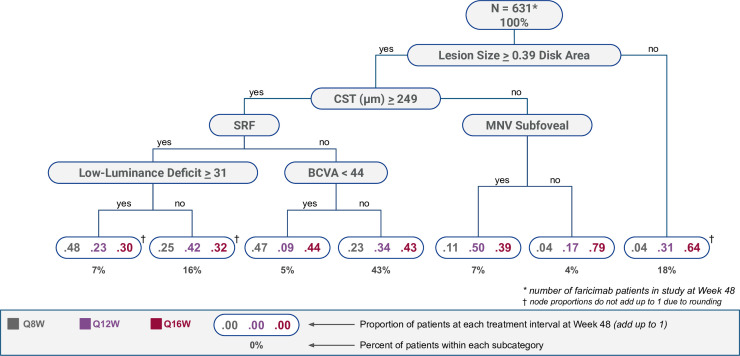
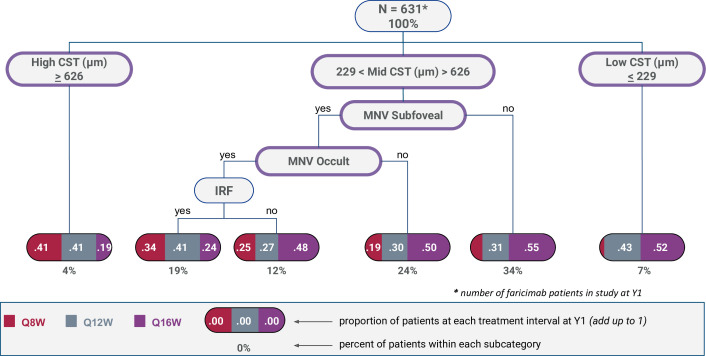
This post-hoc analysis of Y1 data from the TENAYA and LUCERNE trials evaluated ocular baseline characteristics associated with Y1 treatment intervals. Patients were categorised into three subgroups based on their Y1 treatment interval: Q16W, Q12W or Q8W. Baseline characteristics (central subfield thickness (CST), best-corrected visual acuity, presence of subretinal fluid in centre 1 mm, presence of retinal fluid in centre 1 mm, macular neovascularisation (MNV) location and MNV type) were inputted into an R package 'rpart' to create a classification tree model. A data-driven tree model based on CST was fitted, producing CST subgroups of low, middle and high ranges. Within each CST subgroup, the model identified the most impactful variables and associated thresholds.
After fitting the data to produce data-driven CST ranges, the model chose MNV location, followed by MNV lesion type as the most impactful baseline characteristics with these factors having a p value <0.05 in a multivariate analysis.
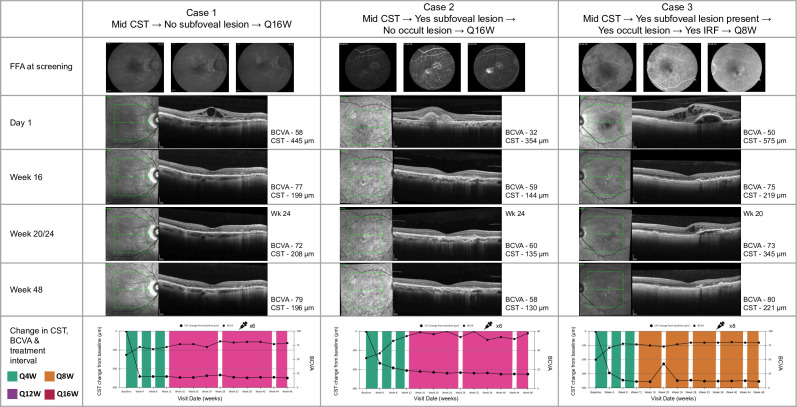
Among the selected ocular baseline characteristics from TENAYA and LUCERNE trial, CST, MNV type and MNV location were seen as the most relevant variables to enable extension of treatment intervals during Y1. While this analysis provides insights for treatment intervals during the first year, further analysis incorporating Y2 data from the TENAYA and LUCERNE studies will be needed to assess factors influencing treatment intervals over a longer period.
确定与接受 faricimab 治疗的初治新生血管性年龄相关性黄斑变性患者在第 1 年(Y1)的治疗间隔最相关的基线特征,并进一步了解这些特征如何影响治疗间隔。
本研究对 TENAYA 和 LUCERNE 两项 3 期临床试验的 Y1 数据进行了事后分析,评估了与 Y1 治疗间隔相关的眼部基线特征。根据 Y1 治疗间隔将患者分为三组:Q16W、Q12W 或 Q8W。将基线特征(中央视网膜厚度(CST)、最佳矫正视力、中心 1mm 内存在视网膜下液、中心 1mm 内存在视网膜内液、黄斑新生血管(MNV)位置和 MNV 类型)输入到 R 包“rpart”中,创建分类树模型。根据 CST 拟合了一个数据驱动的树模型,产生了 CST 低、中、高范围的亚组。在每个 CST 亚组内,该模型确定了最具影响力的变量和相关阈值。
在拟合数据以产生数据驱动的 CST 范围后,该模型选择了 MNV 位置,其次是 MNV 病变类型,作为最具影响力的基线特征,这些因素在多变量分析中 p 值<0.05。
在 TENAYA 和 LUCERNE 试验中选择的眼部基线特征中,CST、MNV 类型和 MNV 位置被认为是在 Y1 期间延长治疗间隔的最相关变量。虽然这项分析为第一年的治疗间隔提供了见解,但需要进一步分析 TENAYA 和 LUCERNE 研究的 Y2 数据,以评估在更长时间内影响治疗间隔的因素。