Khanani Arshad M, Guymer Robyn H, Basu Karen, Boston Heather, Heier Jeffrey S, Korobelnik Jean-François, Kotecha Aachal, Lin Hugh, Silverman David, Swaminathan Balakumar, Willis Jeffrey R, Yoon Young Hee, Quezada-Ruiz Carlos
Sierra Eye Associates, Reno, Nevada.
Reno School of Medicine, University of Nevada, Reno, Nevada.
Ophthalmol Sci. 2021 Nov 17;1(4):100076. doi: 10.1016/j.xops.2021.100076. eCollection 2021 Dec.
To describe the design and rationale of the phase 3 TENAYA (ClinicalTrials.gov identifier, NCT03823287) and LUCERNE (ClinicalTrials.gov identifier, NCT03823300) trials that aimed to assess efficacy, safety, and durability of faricimab, the first bispecific antibody for intraocular use, which independently binds and neutralizes both angiopoietin-2 and vascular endothelial growth factor-A (VEGF-A) versus aflibercept in patients with neovascular age-related macular degeneration (nAMD).
Identical, global, double-masked, randomized, controlled, phase 3 clinical trials.
Adults with treatment-naïve nAMD.
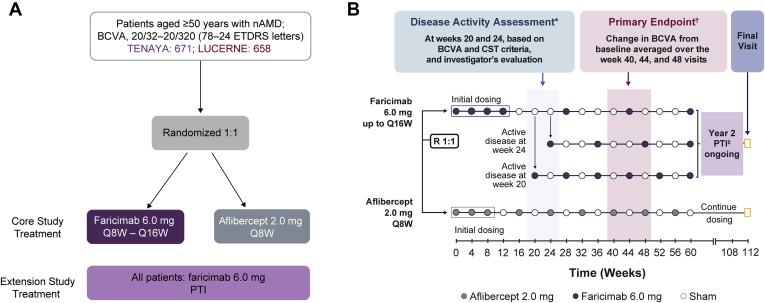
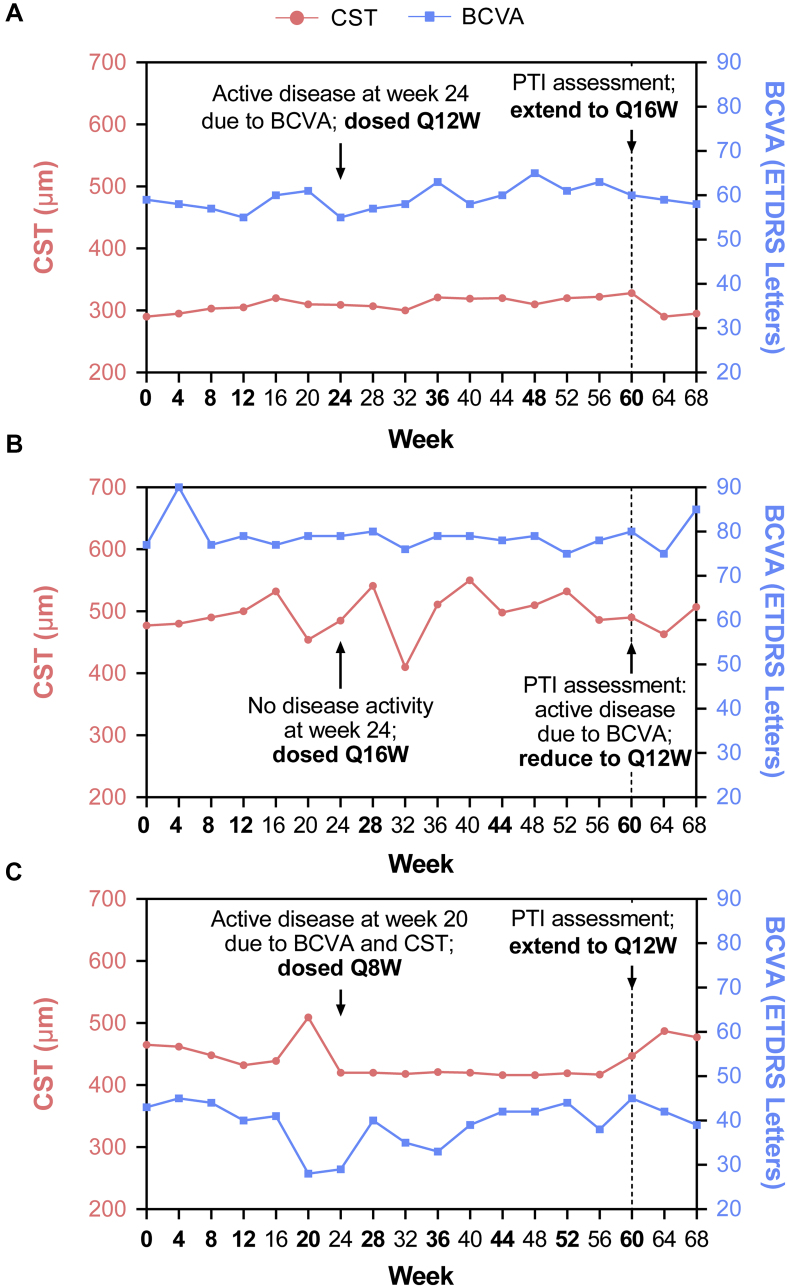
These trials were designed to evaluate patients randomized to receive faricimab 6.0 mg up to every 16 weeks after 4 initial every-4-week doses or aflibercept 2.0 mg every 8 weeks after 3 initial every-4-week doses. The initial doses in the faricimab arm were followed by individualized fixed treatment intervals up to week 60, based on disease activity assessment at weeks 20 and 24, guided by central subfield thickness, best-corrected visual acuity (BCVA), and investigator assessment. The primary efficacy end point was BCVA change from baseline averaged over weeks 40, 44, and 48. Secondary end points included the proportion of patients receiving every-8-week, every-12-week, and every-16-week faricimab and anatomic outcomes. Safety outcomes included incidence and severity of ocular and nonocular adverse events. From week 60, faricimab-treated patients followed a personalized treatment interval (PTI), a novel protocol-driven treat-and-extend regimen with interval adjustment from every 8 weeks to every 16 weeks based on individualized treatment response measured by anatomic criteria, functional criteria, and investigator assessment of patients' disease activity.
Rationale for trial design and PTI approach.
The TENAYA and LUCERNE trials were the first registrational trials in nAMD to test fixed dosing regimens up to every 16 weeks based on patients' disease activity in year 1 and incorporate a PTI paradigm during year 2. The PTI approach was designed to tailor treatment intervals to individual patient needs, to reflect clinical practice treatment practice, and to reduce treatment burden.
The innovative trial design rationale for the TENAYA and LUCERNE trials included maximizing the benefits of angiopoietin-2 blockade through dosing up to every 16 weeks and PTI regimens based on patients' disease activity while fulfilling health authority requirements for potential registrational efforts.
描述3期TENAYA试验(ClinicalTrials.gov标识符,NCT03823287)和LUCERNE试验(ClinicalTrials.gov标识符,NCT03823300)的设计和基本原理,这两项试验旨在评估faricimab(首款用于眼内的双特异性抗体,可独立结合并中和血管生成素-2和血管内皮生长因子-A(VEGF-A))对比阿柏西普治疗新生血管性年龄相关性黄斑变性(nAMD)患者的疗效、安全性和持久性。
相同的全球双盲随机对照3期临床试验。
初治nAMD成人患者。
这些试验旨在评估随机接受faricimab 6.0 mg(最初每4周给药一次,共4剂,之后每16周给药一次)或阿柏西普2.0 mg(最初每4周给药一次,共3剂,之后每8周给药一次)的患者。faricimab组的初始剂量之后,根据第20周和第24周的疾病活动评估结果,以中心子场厚度、最佳矫正视力(BCVA)和研究者评估为指导,进行个体化固定治疗间隔,直至第60周。主要疗效终点是第40、44和48周的BCVA较基线的平均变化。次要终点包括接受每8周、每12周和每16周faricimab治疗的患者比例以及解剖学结果。安全性结果包括眼部和非眼部不良事件的发生率和严重程度。从第60周开始,接受faricimab治疗的患者遵循个性化治疗间隔(PTI),这是一种新的方案驱动的治疗并延长方案,根据解剖学标准、功能标准和研究者对患者疾病活动的评估所测量的个体化治疗反应,将间隔从每8周调整至每16周。
试验设计和PTI方法的基本原理。
TENAYA和LUCERNE试验是nAMD领域首批注册试验,旨在测试基于患者第1年疾病活动情况的每16周固定给药方案,并在第2年采用PTI模式。PTI方法旨在根据个体患者需求调整治疗间隔,反映临床实践,并减轻治疗负担。
TENAYA和LUCERNE试验创新的试验设计基本原理包括通过每16周给药一次和基于患者疾病活动的PTI方案,最大限度地发挥血管生成素-2阻断的益处,同时满足卫生当局对潜在注册工作的要求。