Department of Neurology, McGill University, Montreal, QC, Canada.
Center for Alzheimer's and Neurodegenerative Diseases, Peter O'Donnell Jr. Brain Institute, Dallas, TX, US.
Nat Commun. 2024 Oct 1;15(1):8497. doi: 10.1038/s41467-024-52265-x.
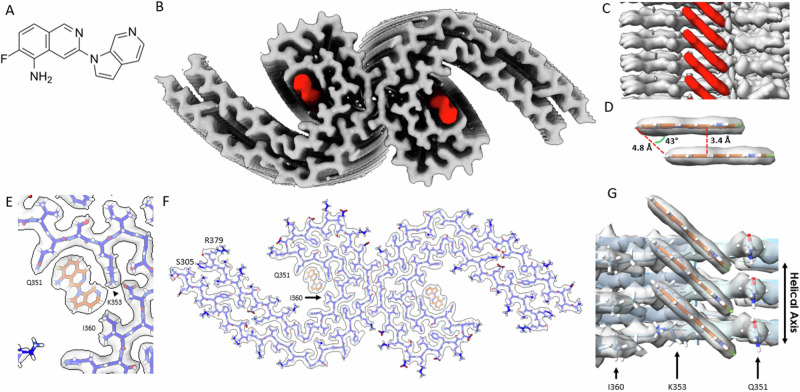
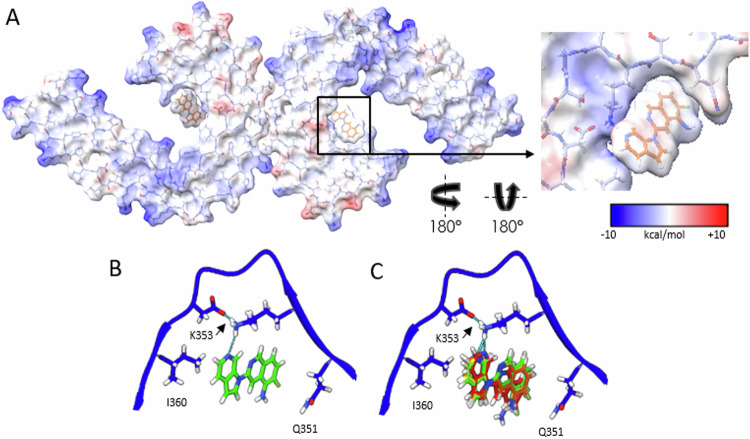
Positron Emission Tomography (PET) ligands have advanced Alzheimer's disease (AD) diagnosis and treatment. Using autoradiography and cryo-EM, we identify AD brain tissue with elevated tau burden, purify filaments, and determine the structure of second-generation high avidity PET ligand MK-6240 at 2.31 Å resolution, which bound at a 1:1 ratio within the cleft of tau paired-helical filament (PHF), engaging with glutamine 351, lysine 353, and isoleucine 360. This information elucidates the basis of MK-6240 PET in quantifying PHF deposits in AD and may facilitate the structure-based design of superior ligands against tau amyloids.
正电子发射断层扫描(PET)配体已应用于阿尔茨海默病(AD)的诊断和治疗。通过放射性自显影和低温电子显微镜,我们鉴定出 AD 脑组织中tau 负荷升高,纯化纤维,并确定第二代高亲和力 PET 配体 MK-6240 的结构,分辨率为 2.31 Å,该配体在 tau 双螺旋纤维(PHF)的裂隙中以 1:1 的比例结合,与谷氨酰胺 351、赖氨酸 353 和异亮氨酸 360 结合。这些信息阐明了 MK-6240 PET 定量 AD 中 PHF 沉积物的基础,可能有助于基于结构设计针对 tau 淀粉样蛋白的更好配体。