Verain Julien, Trouillet Charlotte, Moulin Fréderic, Christophe Charles
Claude Bernard Clinical Hospital ELSAN Metz France.
Health Sci Rep. 2024 Sep 30;7(10):e2151. doi: 10.1002/hsr2.2151. eCollection 2024 Oct.
The use of virtual reality (VR) therapy has grown considerably, as it is effective for reducing pain and anxiety in different clinical areas. However, it has not been well evaluated for coronary angiography and angioplasty. This study aimed to compare VR therapy with pharmacological sedation (Sedation) for reducing pain in patients undergoing a planned coronary angiography or coronary/peripheral angioplasty.
In this prospective randomized controlled trial, patients were randomly allocated to one of two groups before catheterization: a Sedation group (injection of midazolam and fentanyl) or a VR group (Deepsen VR headset). The primary outcome measure was the maximum pain during the procedure (visual analogue scale: 0-10). The secondary outcome measures were anxiety following the procedure (Spielberger State Anxiety Inventory: 20-80), the occurrence of arterial spasm, the haemodynamic profile and patient satisfaction.
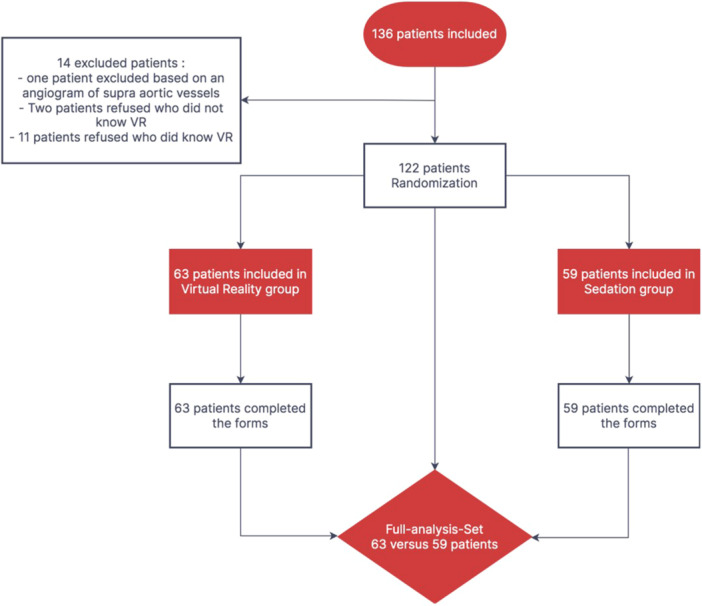
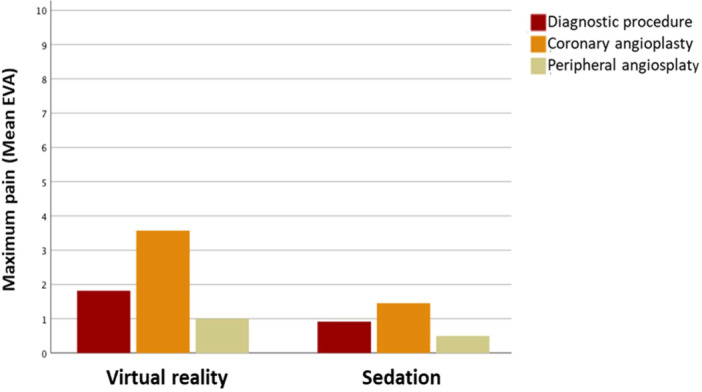
The VR group ( = 63) had a mean pain rating of 2.5; for the Sedation group ( = 59) this was 1.0. This did not meet the criterion for non-inferiority. Anxiety was comparable between the two groups (VR: 25.4; Sedation: 24.7), as was the occurrence of arterial spasm (VR: 7.9%; Sedation: 8.5%; = 0.91), but blood pressure was higher in the VR group (140.2/71.7 mmHg vs. 121.8/64.7 mmHg). There were no VR-related adverse effects, and patient satisfaction was high for both groups.
Virtual reality therapy was not non-inferior to pharmacological sedation for reducing pain during coronary angiography or angioplasty. However, it reduced anxiety to a comparable level. Virtual reality therapy represents an alternative to pharmacological sedation, which is well accepted by patients.
虚拟现实(VR)疗法的应用已大幅增加,因为它在不同临床领域对减轻疼痛和焦虑有效。然而,其在冠状动脉造影和血管成形术中尚未得到充分评估。本研究旨在比较VR疗法与药物镇静(镇静)在计划进行冠状动脉造影或冠状动脉/外周血管成形术患者中减轻疼痛的效果。
在这项前瞻性随机对照试验中,患者在导管插入术前被随机分配到两组之一:镇静组(注射咪达唑仑和芬太尼)或VR组(Deepsen VR头戴式设备)。主要结局指标是手术过程中的最大疼痛程度(视觉模拟评分:0 - 10)。次要结局指标包括术后焦虑(斯皮尔伯格状态焦虑量表:20 - 80)、动脉痉挛的发生情况、血流动力学参数和患者满意度。
VR组(n = 63)的平均疼痛评分为2.5;镇静组(n = 59)为1.0。这未达到非劣效性标准。两组之间的焦虑程度相当(VR组:25.4;镇静组:24.7),动脉痉挛的发生率也相当(VR组:7.9%;镇静组:8.5%;P = 0.91),但VR组的血压更高(140.2/71.7 mmHg对121.8/64.7 mmHg)。没有与VR相关的不良反应,两组患者的满意度都很高。
在冠状动脉造影或血管成形术中,虚拟现实疗法在减轻疼痛方面并不优于药物镇静。然而,它能将焦虑减轻到相当的水平。虚拟现实疗法是药物镇静的一种替代方法,患者对此接受度良好。