Nielsen Frederik Bay, Lindberg Ulrich, Bordallo Heloisa N, Johnbeck Camilla Bardram, Law Ian, Fischer Barbara Malene, Andersen Flemming Littrup, Andersen Thomas Lund
Department of Clinical Physiology & Nuclear Medicine, Copenhagen University Hospital-Rigshospitalet, Copenhagen, Denmark.
Faculty of Natural and Life Sciences, Niels Bohr Institute, University of Copenhagen, Copenhagen, Denmark.
Front Nucl Med. 2024 Apr 19;4:1360326. doi: 10.3389/fnume.2024.1360326. eCollection 2024.
We present an algorithm to estimate the delay between a tissue time-activity curve and a blood input curve at a single-voxel level tested on whole-body data from a long-axial field-of-view scanner with tracers of different noise characteristics.
Whole-body scans of 15 patients divided equally among three tracers, namely [O]HO, [F]FDG and [Cu]Cu-DOTATATE, which were used in development and testing of the algorithm. Delay times were estimated by fitting the cumulatively summed input function and tissue time-activity curve with special considerations for noise. To evaluate the performance of the algorithm, it was compared against two other algorithms also commonly applied in delay estimation: name cross-correlation and a one-tissue compartment model with incorporated delay. All algorithms were tested on both synthetic time-activity curves produced with the one-tissue compartment model with increasing levels of noise and delays between the tissue activity curve and the blood input curve. Whole-body delay maps were also calculated for each of the three tracers with data acquired on a long-axial field-of-view scanner with high time resolution.
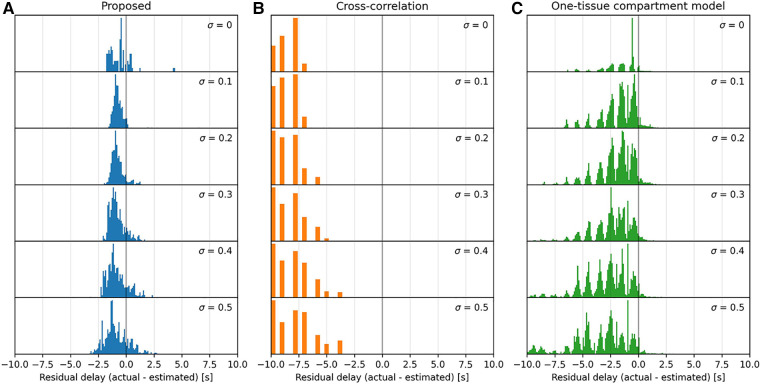
Our proposed model performs better for low signal-to-noise ratio time-activity curves compared to both cross-correlation and the one-tissue compartment models for non-[O]HO tracers. Testing on synthetically produced time-activity curves showed only a small and even residual delay, while the one-tissue compartment model with included delay showed varying residual delays.
The algorithm is robust to noise and proves applicable on a range of tracers as tested on [O]HO, [F]FDG and [Cu]Cu-DOTATATE, and hence is a viable option offering the ability for delay correction across various organs and tracers in use with kinetic modeling.
我们提出一种算法,用于在单像素水平上估计组织时间-活性曲线与血液输入曲线之间的延迟,并在来自具有不同噪声特征示踪剂的长轴视野扫描仪的全身数据上进行了测试。
15名患者的全身扫描被平均分为三组,分别使用三种示踪剂,即[O]HO、[F]FDG和[Cu]Cu-DOTATATE,用于该算法的开发和测试。通过对累积求和的输入函数和组织时间-活性曲线进行拟合来估计延迟时间,同时特别考虑了噪声。为了评估该算法的性能,将其与另外两种也常用于延迟估计的算法进行了比较:即互相关算法和包含延迟的单组织室模型算法。所有算法都在由单组织室模型生成的具有不同噪声水平以及组织活性曲线与血液输入曲线之间不同延迟的合成时间-活性曲线上进行了测试。还使用在具有高时间分辨率的长轴视野扫描仪上采集的数据,为三种示踪剂分别计算了全身延迟图。
对于非[O]HO示踪剂,与互相关算法和单组织室模型相比,我们提出的模型在低信噪比时间-活性曲线上表现更好。在合成生成的时间-活性曲线上进行测试时,我们提出的模型仅显示出微小甚至残余的延迟,而包含延迟的单组织室模型则显示出不同程度的残余延迟。
该算法对噪声具有鲁棒性,并且在[O]HO、[F]FDG和[Cu]Cu-DOTATATE等示踪剂上的测试表明其适用于多种示踪剂,因此是一种可行的选择,能够在动力学建模中对各种器官和使用的示踪剂进行延迟校正。