Guttuso Thomas, Zhu Jingtao, Wilding Gregory E
Department of Neurology, Jacobs School of Medicine and Biomedical Sciences, University at Buffalo, Williamsville, New York.
Department of Biostatistics, Jacobs School of Medicine and Biomedical Sciences, University at Buffalo, Williamsville, New York.
JAMA Netw Open. 2024 Oct 1;7(10):e2436874. doi: 10.1001/jamanetworkopen.2024.36874.
Neurologic post-COVID-19 condition (PCC), or long COVID, symptoms of fatigue and cognitive dysfunction continue to affect millions of people who have been infected with SARS-CoV-2. There currently are no effective evidence-based therapies available for treating neurologic PCC.
To assess the effects of lithium aspartate therapy on PCC fatigue and cognitive dysfunction.
DESIGN, SETTING, AND PARTICIPANTS: A randomized, double-blind, placebo-controlled trial (RCT) enrolling participants in a neurology clinic from November 28, 2022, to June 29, 2023, with 3 weeks of follow-up, was conducted. Subsequently, an open-label lithium dose-finding study with 6 weeks of follow-up was performed among the same participants enrolled in the RCT. Eligible individuals needed to report new, bothersome fatigue or cognitive dysfunction persisting for more than 4 weeks after a self-reported positive test for COVID-19, Fatigue Severity Scale-7 (FSS-7) or Brain Fog Severity Scale (BFSS) score of 28 or greater, Beck Depression Inventory-II score less than 24, and no history of a condition known to cause fatigue or cognitive dysfunction. All participants in the RCT were eligible for the dose-finding study, except for those who responded to the placebo. Intention-to-treat analysis was used.
Lithium aspartate, 10 to 15 mg/d, or identically appearing placebo for 3 weeks followed by open-label lithium aspartate, 10 to 15 mg/d, for 2 weeks. In the subsequent dose-finding study, open-label lithium aspartate dosages up to 45 mg/d for 6 weeks were given.
Change in sum of FSS-7 and BFSS scores. The scores for each measure range from 7 to 49, with higher scores indicating more severe symptoms. Secondary outcomes included changes from baseline in the scores of additional questionnaires.
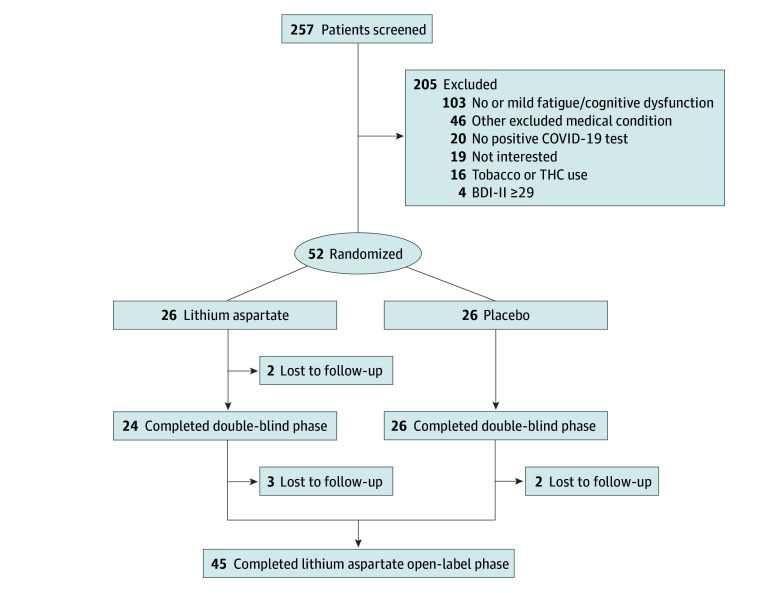
Fifty-two participants were enrolled (30 [58%] males; mean [SD] age, 58.54 [14.34] years) and 26 were randomized to treatment with lithium aspartate (10 females) and 26 to placebo (12 female). Two participants assigned to lithium aspartate were lost to follow-up and none withdrew. No adverse events were attributable to lithium therapy. There were no significant intergroup differences for the primary outcome (-3.6; 95% CI, -16.6 to 9.5; P = .59) or any secondary outcomes. Among 3 patients completing a subsequent dose-finding study, open-label lithium aspartate, 40 to 45 mg/d, was associated with numerically greater reductions in fatigue and cognitive dysfunction scores than 15 mg/d, particularly in 2 patients with serum lithium levels of 0.18 and 0.49 mEq/L compared with 1 patient with a level of 0.10 mEq/L.
In this RCT, therapy with lithium aspartate, 10 to 15 mg/d, was ineffective for neurologic PCC fatigue and cognitive dysfunction. Another RCT is required to assess the potential benefits of higher lithium dosages for treating neurologic PCC.
ClinicalTrials.gov Identifier: NCT05618587 and NCT06108297.
新冠后神经功能障碍(PCC),即长新冠,其疲劳和认知功能障碍症状仍在影响着数百万感染过严重急性呼吸综合征冠状病毒2(SARS-CoV-2)的人。目前尚无有效的循证疗法可用于治疗神经功能PCC。
评估天冬氨酸锂疗法对PCC疲劳和认知功能障碍的影响。
设计、地点和参与者:进行了一项随机、双盲、安慰剂对照试验(RCT),于2022年11月28日至2023年6月29日在一家神经科诊所招募参与者,并进行3周的随访。随后,对参与RCT的相同参与者进行了一项为期6周随访的开放标签天冬氨酸锂剂量探索研究。符合条件者需报告在自我报告的新冠病毒检测呈阳性后,新出现的、令人烦恼的疲劳或认知功能障碍持续超过4周,疲劳严重程度量表-7(FSS-7)或脑雾严重程度量表(BFSS)得分28分或更高,贝克抑郁量表-II得分低于24分,且无已知会导致疲劳或认知功能障碍的疾病史。RCT中的所有参与者均有资格参加剂量探索研究,但对安慰剂有反应者除外。采用意向性分析。
天冬氨酸锂,10至15毫克/天,或外观相同的安慰剂,持续3周,随后为开放标签的天冬氨酸锂,10至15毫克/天,持续2周。在随后的剂量探索研究中,给予高达45毫克/天的开放标签天冬氨酸锂,持续6周。
FSS-7和BFSS得分总和的变化。每项指标的得分范围为7至49分,得分越高表明症状越严重。次要结局包括其他问卷得分相对于基线的变化。
共招募了52名参与者(30名[58%]男性;平均[标准差]年龄为58.54[±14.34]岁),26名被随机分配接受天冬氨酸锂治疗(10名女性),26名接受安慰剂治疗(12名女性)。两名分配接受天冬氨酸锂治疗的参与者失访且无人退出。没有不良事件可归因于锂治疗。主要结局(-3.6;95%置信区间为-16.6至9.5;P = 0.59)或任何次要结局在组间均无显著差异。在3名完成后续剂量探索研究的患者中,40至45毫克/天的开放标签天冬氨酸锂与15毫克/天相比,在疲劳和认知功能障碍得分的数值降低方面更大,特别是在2名血清锂水平为0.18和0.49毫当量/升的患者中,而1名血清锂水平为0.10毫当量/升的患者情况则不同。
在这项RCT中,10至15毫克/天的天冬氨酸锂疗法对神经功能PCC疲劳和认知功能障碍无效。需要另一项RCT来评估更高剂量锂治疗神经功能PCC的潜在益处。
ClinicalTrials.gov标识符:NCT05618587和NCT06108297。
