Mobility Consulting and Presentations, LLC, Loveland, CO, USA.
BMC Health Serv Res. 2024 Oct 2;24(1):1164. doi: 10.1186/s12913-024-11655-z.
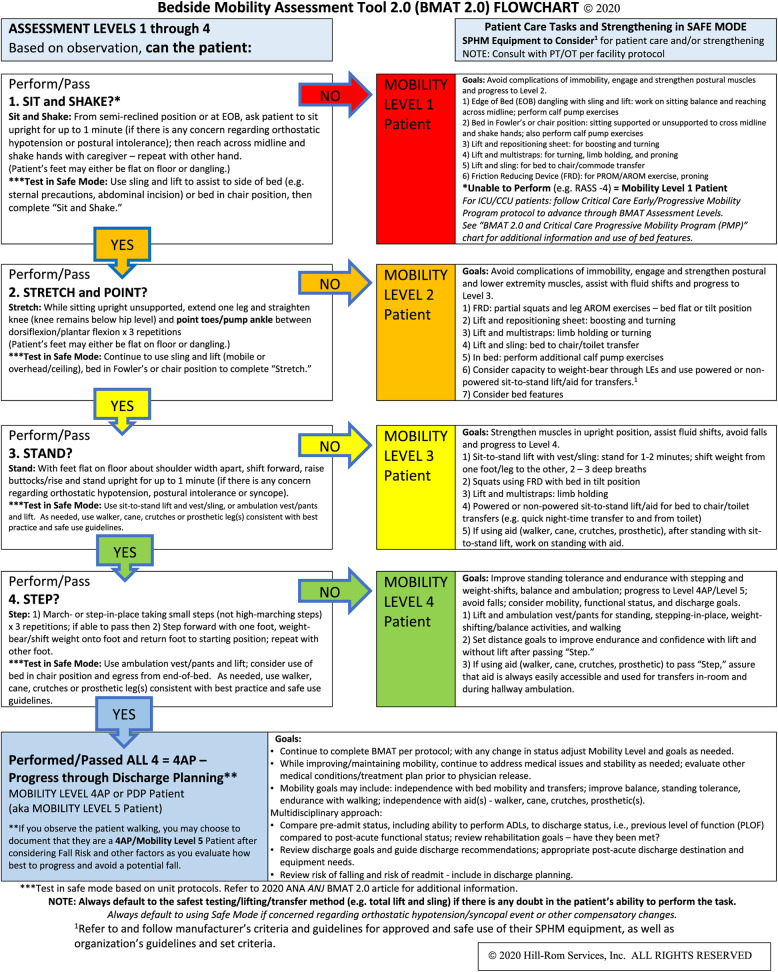
The Melillo et al. article: Reliability and validity of the Veterans Administration Mobility Screening and Solutions Tool (MSST) (Melillo et al, BMC Health Serv Res 22:1323, 2022) introduces the MSST, a derivative flowchart tool in which the Banner Bedside Mobility Assessment Tool (BMAT) is embedded. The authors identify similar goals for the MSST as those for the BMAT, i.e. determine real-time mobility status and choose safe patient handling and mobility (SPHM) equipment to complete transfer and mobility tasks. Further Melillo et al. indicate that goals included "revising and enhancing" and addressing "gaps" in the BMAT, as well as creating instructions for the four BMAT levels (sit and shake, stretch and point, stand, step: march-in-place, advance step and return) that are clear, understandable and comfortable to use. The authors indicate that another goal of the VA MSST is it "enables any healthcare worker at any time to accurately measure and communicate patient mobility and transfer equipment needs." The present article addresses inaccuracies observed in the Melillo et al. article and confusing elements found in the VA MSST flowchart. The present article is based on the author's involvement in developing the BMAT starting in 2003 along with teams from Banner Health and Liko/Hill-Rom which incorporated use of the BMAT by unlicensed assistive personnel (UAP) as a recheck or verification of earlier testing. The 2020 BMAT 2.0 clarified confusing elements identified in BMAT 1.0, i.e. items that needed to be revised or enhanced. BMAT 2.0 covered use of SPHM when testing, when completing care tasks and when progressing patients. The BMAT is primarily a nurse-driven mobility assessment tool created to not be overly prescriptive. BMAT was validated and determined to be reliable based on years of clinical utility studies and research in various settings across the continuum of care. It continues to be supported by a large medical equipment manufacturer who maintains the copyright license. Although the VA MSST flowchart has the four BMAT assessment levels embedded within it, for reasons outlined in this article, it is not feasible to use the VA MSST flowchart alongside or in conjunction with the BMAT 2.0.
退伍军人事务部移动筛查和解决方案工具(MSST)的可靠性和有效性(Melillo 等人,BMC 健康服务研究 22:1323,2022)介绍了 MSST,这是一个衍生流程图工具,其中嵌入了 Banner 床边移动评估工具(BMAT)。作者确定了 MSST 的目标与 BMAT 相似,即确定实时移动状态并选择安全的患者处理和移动(SPHM)设备来完成转移和移动任务。此外,梅利洛等人表示,目标包括“修改和增强”以及解决 BMAT 中的“差距”,以及为 BMAT 的四个级别(坐和摇晃、伸展和指点、站立、踏步:原地踏步、前进踏步和返回)创建清晰、易懂和舒适的使用说明。作者表示,VA MSST 的另一个目标是“使任何医护人员在任何时间都能够准确测量和沟通患者的移动和转移设备需求。”本文解决了梅利洛等人文章中观察到的不准确之处,以及 VA MSST 流程图中发现的混淆元素。本文基于作者从 2003 年开始参与开发 BMAT 的经历,以及 Banner Health 和 Liko/Hill-Rom 团队的参与,这些团队将 BMAT 纳入未经许可的辅助人员(UAP)的使用范围,作为早期测试的重新检查或验证。2020 年 BMAT 2.0 澄清了 BMAT 1.0 中确定需要修改或增强的混淆元素。BMAT 2.0 涵盖了测试、完成护理任务和推进患者时的 SPHM 使用。BMAT 主要是一种由护士驱动的移动评估工具,旨在不过于规范。BMAT 经过多年的临床实用研究和各种护理环境中的研究验证,被确定为可靠的工具。它继续得到一家大型医疗器械制造商的支持,该制造商维护版权许可证。尽管 VA MSST 流程图中嵌入了 BMAT 的四个评估级别,但由于本文中概述的原因,在使用 BMAT 2.0 时,VA MSST 流程图不可行。