Huang Zitong, Lin Liling, Li Xing, Rong Zuhua, Hu Jianxiong, Zhao Jianguo, Zeng Weilin, Zhu Zhihua, Li Yihong, Huang Yun, Zhang Li, Gong Dexin, Xu Jiaqing, Li Yan, Lai Huibing, Zhang Wangjian, Hao Yuantao, Xiao Jianpeng, Lin Lifeng
School of Public Health, Sun Yat-sen University, Guangzhou, 510080, Guangdong, China.
Guangdong Provincial Center for Disease Control and Prevention, Guangzhou, 511430, Guangdong, China.
Arch Public Health. 2024 Oct 2;82(1):173. doi: 10.1186/s13690-024-01406-1.
From January 2020 to June 2022, strict interventions against COVID-19 were implemented in Guangdong Province, China. However, the evolution of COVID-19 dynamics remained unclear in this period.
This study aims to investigate the evolution of within- and between-city COVID-19 dynamics in Guangdong, specifically during the implementation of rigorous prevention and control measures. The intent is to glean valuable lessons that can be applied to refine and optimize targeted interventions for future crises.
Data of COVID-19 cases and synchronous interventions from January 2020 to June 2022 in Guangdong Province were collected. The epidemiological characteristics were described, and the effective reproduction number (R) was estimated using a sequential Bayesian method. Endemic-epidemic multivariate time-series model was employed to quantitatively analyze the spatiotemporal component values and variations, to identify the evolution of within- and between-city COVID-19 dynamics.
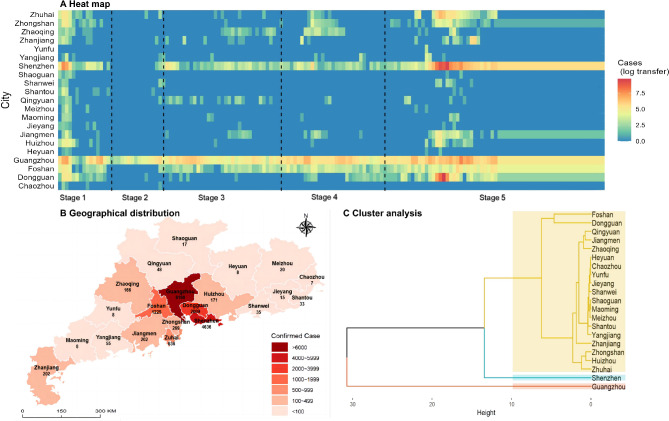
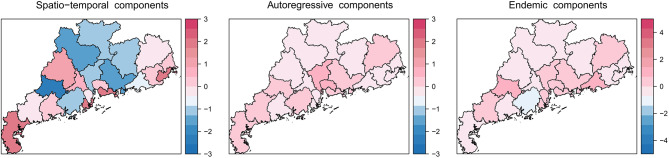
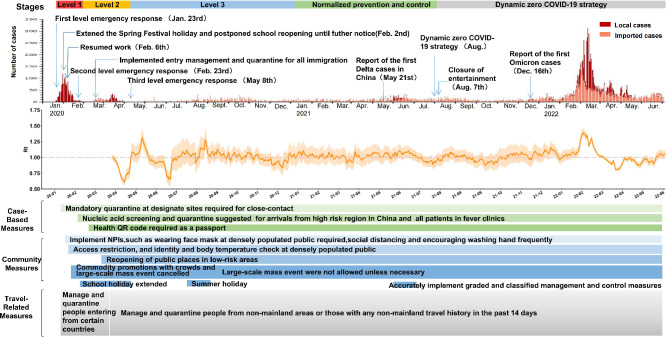
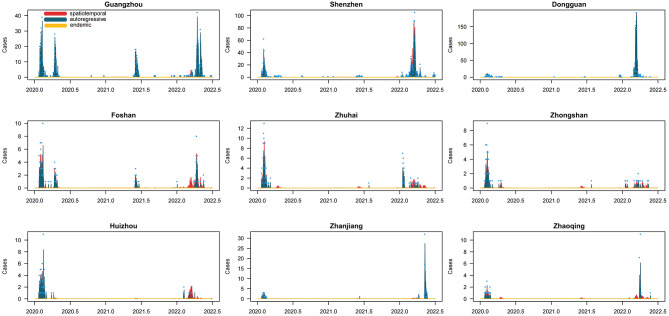
The incidence of COVID-19 in Guangdong Province was 12.6/100,000 population (15,989 cases) from January 2020 to June 2022. The R predominantly remained below 1 and increased to a peak of 1.39 in Stage 5. As for the evolution of variations during the study period, there were more spatiotemporal components in stage 1 and 5. All components were fewer from Stage 2 to Stage 4. Results from the endemic-epidemic multivariate time-series model revealed a strong follow-up impact from previous infections in Dongguan, Guangzhou and Zhanjiang, with autoregressive components of 0.48, 0.45 and 0.36, respectively. Local risk was relatively high in Yunfu, Shanwei and Shenzhen, with endemic components of 1.17, 1.04 and 0.71, respectively. The impact of the epidemic on the neighboring regions was significant in Zhanjiang, Shenzhen and Zhuhai, with epidemic components of 2.14, 1.92, and 1.89, respectively.
The findings indicate the presence of spatiotemporal variation of COVID-19 in Guangdong Province, even with the implementation of strict interventions. It's significant to prevent transmissions within cities with dense population. Preventing spatial transmissions between cities is necessary when the epidemic is severe. To better cope with future crises, interventions including vaccination, medical resource allocation and coordinated non-pharmaceutical interventions were suggested.
2020年1月至2022年6月期间,中国广东省针对新型冠状病毒肺炎(COVID-19)实施了严格干预措施。然而,在此期间COVID-19疫情动态的演变仍不清楚。
本研究旨在调查广东省内及城市间COVID-19疫情动态的演变情况,特别是在实施严格防控措施期间。目的是汲取宝贵经验教训,以便应用于完善和优化未来危机中的针对性干预措施。
收集了2020年1月至2022年6月广东省COVID-19病例数据及同步干预措施。描述了流行病学特征,并采用序贯贝叶斯方法估计有效再生数(R)。采用地方病-流行病多元时间序列模型定量分析时空成分值及变化,以确定城市内和城市间COVID-19疫情动态的演变。
2020年1月至2022年6月,广东省COVID-19发病率为12.6/10万人口(15989例)。R主要保持在1以下,并在第5阶段增至峰值1.39。关于研究期间变化的演变,第1阶段和第5阶段时空成分较多。从第2阶段到第4阶段,所有成分较少。地方病-流行病多元时间序列模型结果显示,东莞、广州和湛江既往感染的后续影响较强,自回归成分分别为0.48、0.45和0.36。云浮、汕尾和深圳的局部风险相对较高,地方病成分分别为1.17、1.04和0.71。疫情对周边地区的影响在湛江、深圳和珠海较为显著,疫情成分分别为2.14、1.92和1.89。
研究结果表明,即使实施了严格干预措施,广东省COVID-19仍存在时空变异。预防人口密集城市内部的传播具有重要意义。在疫情严重时,防止城市间的空间传播是必要的。为了更好地应对未来危机,建议采取包括疫苗接种、医疗资源分配和协调非药物干预等措施。