Tabet Caio Gomes, Pacheco Rafael Leite, Martimbianco Ana Luiza Cabrera, Riera Rachel, Hernandez Arnaldo José, Bueno Daniela Franco, Fernandes Tiago Lazzaretti
Sports Medicine Division, Instituto de Ortopedia e Traumatologia da Faculdade de Medicina do Hospital das Clínicas da Universidade de São Paulo (USP), São Paulo, Brazil.
Hospital Sírio-Libanês, São Paulo, Brazil.
J Orthop Translat. 2024 Aug 26;48:176-189. doi: 10.1016/j.jot.2024.07.012. eCollection 2024 Sep.
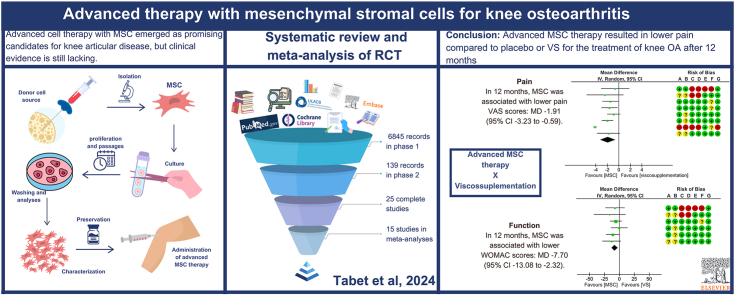
Advanced cell therapies emerged as promising candidates for treatment of knee articular diseases, but robust evidence regarding their clinical applicability is still lacking.
To assess the efficacy and safety of advanced mesenchymal stromal cells (MSC) therapy for knee osteoarthritis (OA) and chondral lesions.
Systematic review of randomized controlled trials conducted in accordance with Cochrane Handbook and reported following PRISMA checklist. GRADE approach was used for assessing the evidence certainty.
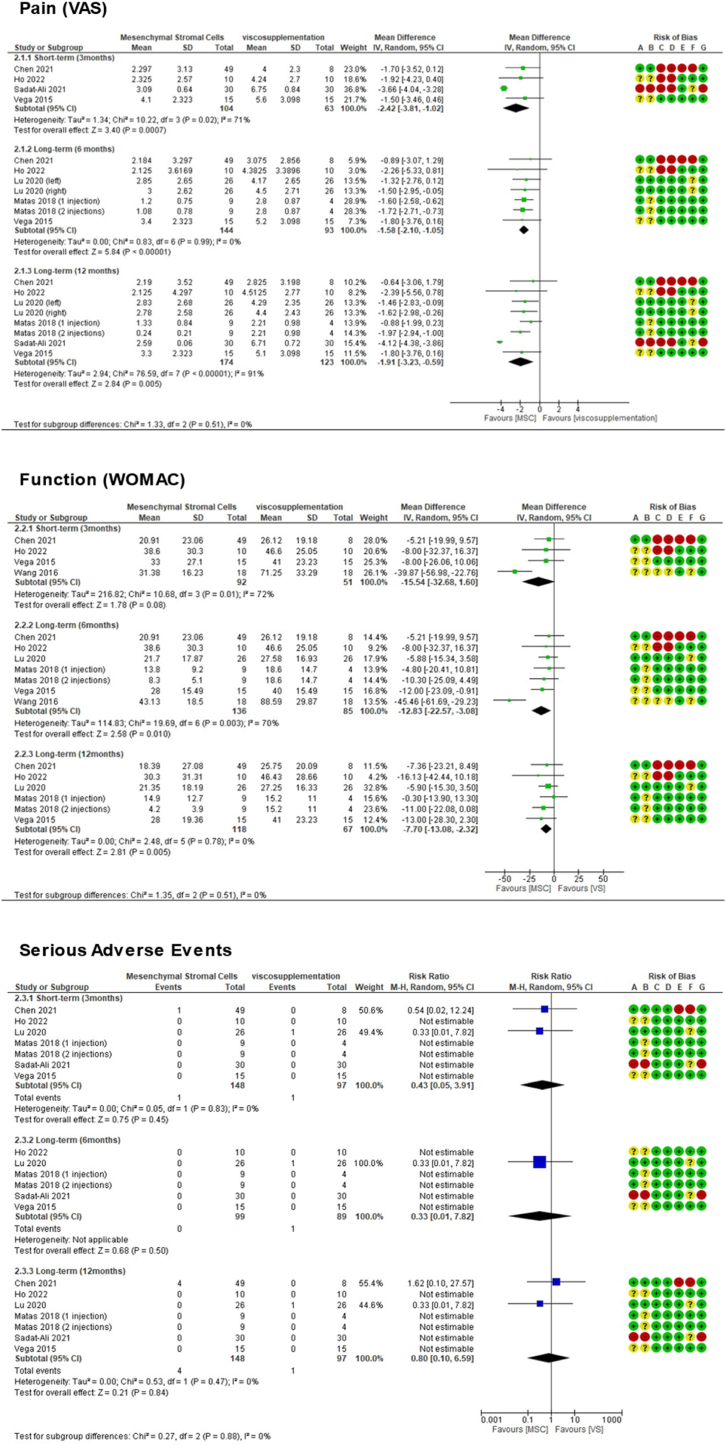
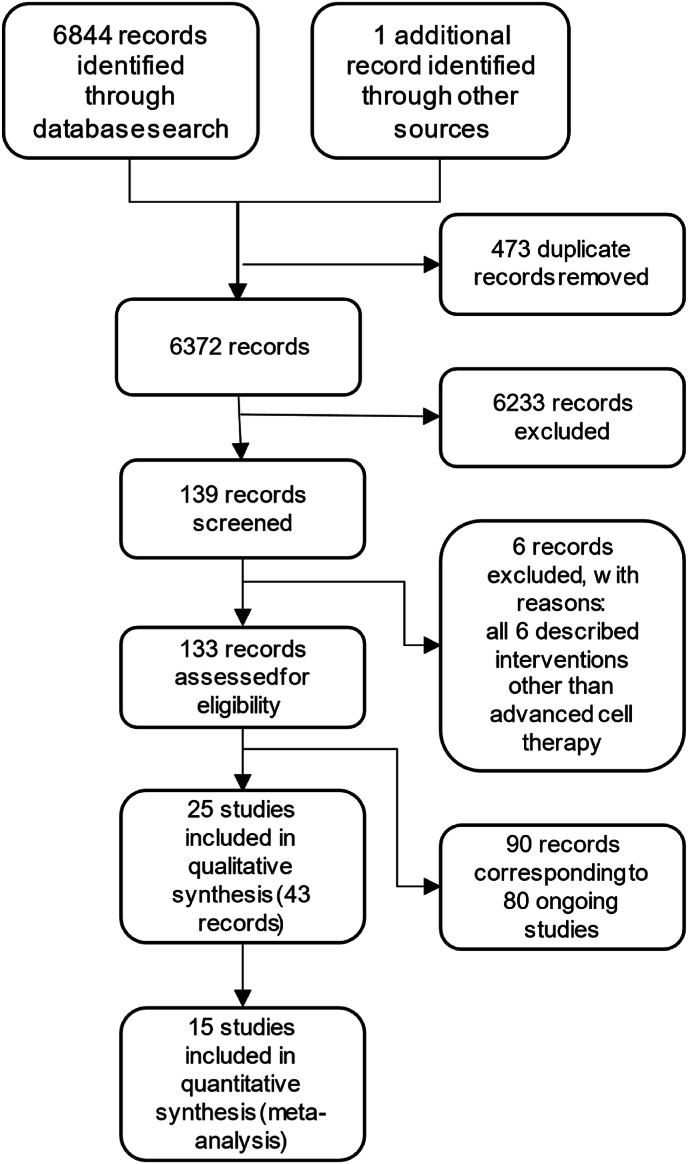
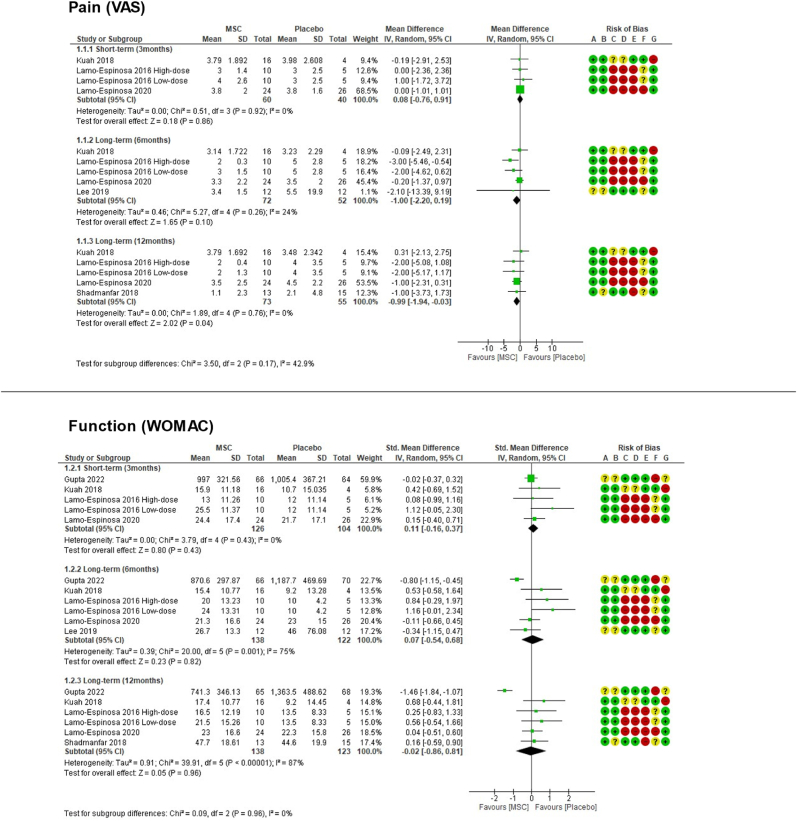
25 randomized controlled trials that enrolled 1048 participants were included. Meta-analyses data showed that, compared to viscosupplementation (VS), advanced MSC therapy resulted in a 1.91 lower pain VAS score (95 % CI -3.23 to -0.59; p < 0.00001) for the treatment of knee OA after 12 months. Compared to placebo, the difference was 0.99 lower pain VAS points (95 % CI -1.94 to -0.03; p = 0.76). According to the GRADE approach, the evidence was very uncertain for both comparisons. By excluding studies with high risk of bias, there was a similar size of effect (VAS MD -1.54, 95 % CI -2.09 to -0.98; p = 0.70) with improved (moderate) certainty of evidence, suggesting that MSC therapy probably reduces pain slightly better than VS. Regarding serious adverse events, there was no difference from advanced MSC therapy to placebo or to VS, with very uncertain evidence.
Advanced MSC therapy resulted in lower pain compared to placebo or VS for the treatment of knee OA after 12 months, with no difference in adverse events. However, the evidence was considered uncertain.
Currently, there is a lack of studies with good methodological structure aiming to evaluate the real clinical impact of advanced cell therapy for knee OA. The present study was well structured and conducted, with Risk of Bias, GRADE certainty assessment and sensitivity analysis. It explores the translational aspect of the benefits and safety of MSC compared with placebo and gold-standard therapy to give practitioners and researchers support to expand this therapy in their practice.
CRD42020158173. Access at https://www.crd.york.ac.uk/prospero/display_record.php?RecordID=158173.
先进细胞疗法已成为治疗膝关节疾病的有前景的候选方法,但关于其临床适用性的有力证据仍然缺乏。
评估先进间充质基质细胞(MSC)疗法治疗膝关节骨关节炎(OA)和软骨损伤的疗效和安全性。
根据Cochrane手册进行随机对照试验的系统评价,并按照PRISMA清单报告。采用GRADE方法评估证据确定性。
纳入25项随机对照试验,共1048名参与者。荟萃分析数据显示,与关节腔注射透明质酸钠(VS)相比,先进的MSC疗法在治疗膝关节OA 12个月后,疼痛视觉模拟评分(VAS)降低1.91(95%CI -3.23至-0.59;p<0.00001)。与安慰剂相比,差异为疼痛VAS评分降低0.99分(95%CI -1.94至-0.03;p = 0.76)。根据GRADE方法,这两种比较的证据都非常不确定。通过排除偏倚风险高的研究,效应大小相似(VAS平均差-1.54,95%CI -2.09至-0.98;p = 0.70),证据确定性有所提高(中等),表明MSC疗法可能在减轻疼痛方面略优于VS。关于严重不良事件,先进的MSC疗法与安慰剂或VS相比没有差异,证据非常不确定。
先进的MSC疗法在治疗膝关节OA 12个月后,与安慰剂或VS相比疼痛更低,不良事件无差异。然而,证据被认为是不确定的。
目前,缺乏旨在评估先进细胞疗法对膝关节OA实际临床影响的方法学结构良好的研究。本研究结构良好且实施得当,进行了偏倚风险、GRADE确定性评估和敏感性分析。它探讨了与安慰剂和金标准疗法相比,MSC的益处和安全性的转化方面,为从业者和研究人员在实践中扩展这种疗法提供支持。
PROSPERO注册号:CRD42020158173。可在https://www.crd.york.ac.uk/prospero/display_record.php?RecordID=158173访问。