Department of Ophthalmology and Visual Science, College of Medicine, The Catholic University of Korea, Seoul, Republic of Korea.
Department of Ophthalmology and Visual Science, Eunpyeong St. Mary's Hospital, College of Medicine, The Catholic University of Korea, Seoul, Republic of Korea.
PLoS One. 2024 Oct 3;19(10):e0310381. doi: 10.1371/journal.pone.0310381. eCollection 2024.
To compare the visual outcomes of different anti-vascular endothelial growth factor (VEGF) drugs, including aflibercept, ranibizumab, and bevacizumab, in a real-world setting in Korea.
We collected data from patients who received monotherapy using one of these three anti-VEGF drugs as naïve treatment after being diagnosed with neovascular age-related macular degeneration. The number of injections and visual acuity (VA) outcomes of each cohort were obtained and pairwise comparisons were performed using propensity score matching.
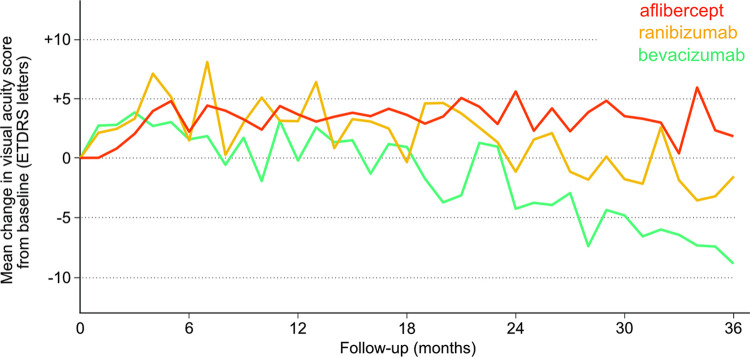
A total of 254 aflibercept, 238 ranibizumab, and 282 bevacizumab treatment-naïve eyes were included. The mean VA change at 3 years for all cohorts combined was -1.8 letters, and the mean number of injections was 9.4. In the direct comparison of the three drugs, the mean change in the VA letter score was +2.0 letters for aflibercept and -11.7 letters for bevacizumab (P < 0.001). The number of aflibercept injections was significantly higher than the number of bevacizumab injections (P = 0.002). The visual outcomes for aflibercept and ranibizumab were +4.7 letters and -1.9 letters, respectively, and comparable results were obtained (P = 0.13). The VA outcomes for ranibizumab and bevacizumab were also not significantly different (P = 0.09). The numbers of injections for aflibercept, ranibizumab, and bevacizumab were 10.8, 6.7, and 8.8, respectively. Significant differences were observed between the injection frequencies comparisons of aflibercept and ranibizumab and ranibizumab and bevacizumab (P < 0.001 and P = 0.002, respectively).
In the Korean clinical medical environment, which included various confounding factors, especially socioeconomic ones, the aflibercept VA outcome was significantly better than that of bevacizumab, and aflibercept injections were the most numerous. These real-world data imply that the drug effect as well as the environment in which the drug can be sufficiently used affected patient final VA scores.
本研究旨在比较在韩国的真实环境中,三种不同的抗血管内皮生长因子(VEGF)药物(阿柏西普、雷珠单抗和贝伐单抗)的视觉结果。
我们收集了被诊断为新生血管性年龄相关性黄斑变性后,使用这三种抗 VEGF 药物中的一种作为初始治疗的患者的数据。获取了每个队列的注射次数和视力(VA)结果,并通过倾向评分匹配进行了两两比较。
共纳入 254 只接受阿柏西普治疗、238 只接受雷珠单抗治疗和 282 只接受贝伐单抗治疗的眼作为治疗初治眼。所有队列联合的平均 VA 变化在 3 年时为 -1.8 个字母,平均注射次数为 9.4 次。在三种药物的直接比较中,阿柏西普组 VA 评分提高了+2.0 个字母,而贝伐单抗组降低了-11.7 个字母(P<0.001)。阿柏西普的注射次数明显高于贝伐单抗(P=0.002)。阿柏西普和雷珠单抗的 VA 结果分别为+4.7 个字母和-1.9 个字母,结果相当(P=0.13)。雷珠单抗和贝伐单抗的 VA 结果也无显著差异(P=0.09)。阿柏西普、雷珠单抗和贝伐单抗的注射次数分别为 10.8、6.7 和 8.8。阿柏西普和雷珠单抗以及雷珠单抗和贝伐单抗之间的注射频率比较差异均有统计学意义(P<0.001 和 P=0.002)。
在包括各种混杂因素,特别是社会经济因素的韩国临床医疗环境中,阿柏西普的 VA 结果明显优于贝伐单抗,且注射次数最多。这些真实世界的数据表明,药物疗效以及药物能够充分发挥作用的环境影响了患者最终的 VA 评分。