Lluch Aina, Latorre Jèssica, Oliveras-Cañellas Núria, Fernández-Sánchez Ana, Moreno-Navarrete José M, Castells-Nobau Anna, Comas Ferran, Buxò Maria, Rodríguez-Hermosa José I, Ballester María, Espadas Isabel, Martín-Montalvo Alejandro, Zhang Birong, Zhou You, Burkhardt Ralph, Höring Marcus, Liebisch Gerhard, Castellanos-Rubio Ainara, Santin Izortze, Kar Asha, Laakso Markku, Pajukanta Päivi, Olkkonen Vesa M, Fernández-Real José M, Ortega Francisco J
Institut d'Investigació Biomèdica de Girona (IDIBGI) - Girona, Spain; CIBER de la Fisiología de la Obesidad y la Nutrición (CIBEROBN), Madrid, Spain.
Institut d'Investigació Biomèdica de Girona (IDIBGI) - Girona, Spain; CIBER de la Fisiología de la Obesidad y la Nutrición (CIBEROBN), Madrid, Spain.
Mol Metab. 2024 Dec;90:102040. doi: 10.1016/j.molmet.2024.102040. Epub 2024 Oct 1.
Long non-coding RNAs (lncRNAs) can perform tasks of key relevance in fat cells, contributing, when defective, to the burden of obesity and its sequelae. Here, scrutiny of adipose tissue transcriptomes before and after bariatric surgery (GSE53378) granted identification of 496 lncRNAs linked to the obese phenotype. Only expression of linc-GALNTL6-4 displayed an average recovery over 2-fold and FDR-adjusted p-value <0.0001 after weight loss. The aim of the present study was to investigate the impact on adipocyte function and potential clinical value of impaired adipose linc-GALNTL6-4 in obese subjects.
We employed transcriptomic analysis of public dataset GSE199063, and cross validations in two large transversal cohorts to report evidence of a previously unknown association of adipose linc-GALNTL6-4 with obesity. We then performed functional analyses in human adipocyte cultures, genome-wide transcriptomics, and untargeted lipidomics in cell models of loss and gain of function to explore the molecular implications of its associations with obesity and weight loss.
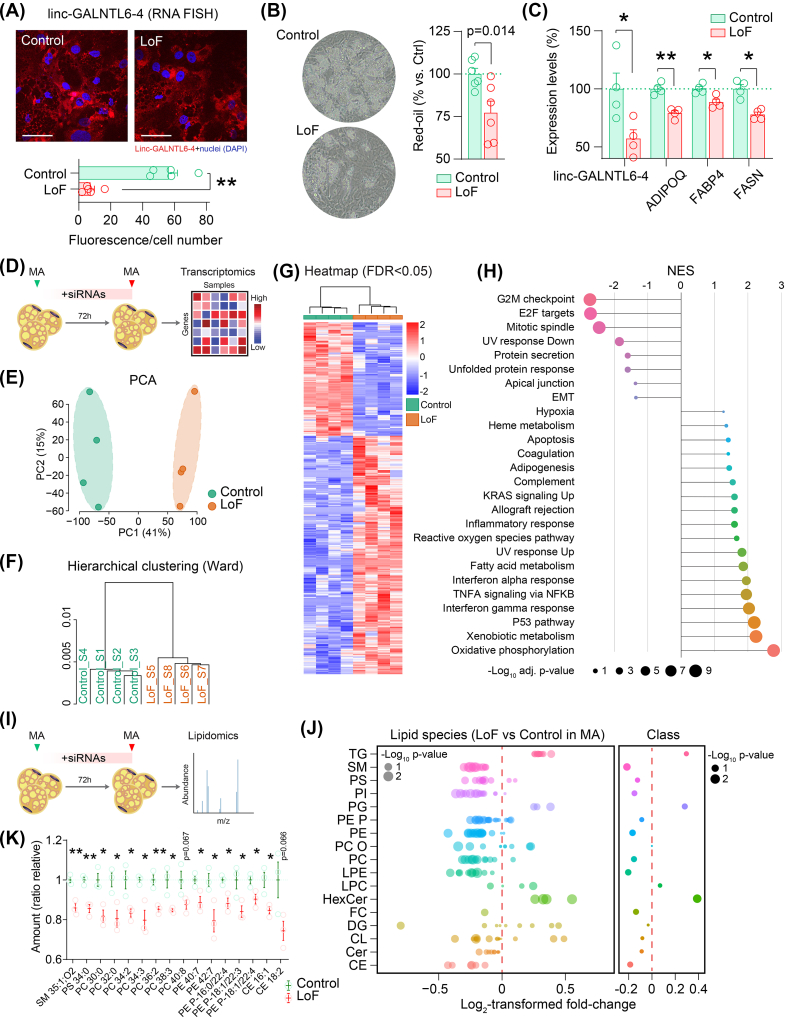
The expression of linc-GALNTL6-4 in human adipose tissue is adipocyte-specific and co-segregates with obesity, being normalized upon weight loss. This co-segregation is demonstrated in two longitudinal weight loss studies and two cross-sectional samples. While compromised expression of linc-GALNTL6-4 in obese subjects is primarily due to the inflammatory component in the context of obesity, adipogenesis requires the transcriptional upregulation of linc-GALNTL6-4, the expression of which reaches an apex in terminally differentiated adipocytes. Functionally, we demonstrated that the knockdown of linc-GALNTL6-4 impairs adipogenesis, induces alterations in the lipidome, and leads to the downregulation of genes related to cell cycle, while propelling in adipocytes inflammation, impaired fatty acid metabolism, and altered gene expression patterns, including that of apolipoprotein C1 (APOC1). Conversely, the genetic gain of linc-GALNTL6-4 ameliorated differentiation and adipocyte phenotype, putatively by constraining APOC1, also contributing to the metabolism of triglycerides in adipose.
Current data unveil the unforeseen connection of adipocyte-specific linc-GALNTL6-4 as a modulator of lipid homeostasis challenged by excessive body weight and meta-inflammation.
长链非编码RNA(lncRNAs)在脂肪细胞中发挥着关键作用,当出现缺陷时,会导致肥胖及其后遗症。在此,通过对减肥手术前后脂肪组织转录组的研究(GSE53378),鉴定出496种与肥胖表型相关的lncRNAs。体重减轻后,只有linc-GALNTL6-4的表达平均恢复超过2倍,且经FDR校正的p值<0.0001。本研究旨在探讨肥胖受试者中脂肪组织linc-GALNTL6-4受损对脂肪细胞功能的影响及其潜在临床价值。
我们对公共数据集GSE199063进行了转录组分析,并在两个大型横向队列中进行了交叉验证,以报告脂肪组织linc-GALNTL6-4与肥胖之间先前未知关联的证据。然后,我们在人类脂肪细胞培养物、全基因组转录组学以及功能丧失和功能获得的细胞模型中的非靶向脂质组学中进行了功能分析,以探索其与肥胖和体重减轻关联的分子机制。
linc-GALNTL6-4在人类脂肪组织中的表达具有脂肪细胞特异性,与肥胖共分离,体重减轻后恢复正常。这种共分离在两项纵向减肥研究和两个横断面样本中得到证实。虽然肥胖受试者中linc-GALNTL6-4的表达受损主要是由于肥胖背景下的炎症成分,但脂肪生成需要linc-GALNTL6-4的转录上调,其表达在终末分化的脂肪细胞中达到顶峰。在功能上,我们证明敲低linc-GALNTL6-4会损害脂肪生成,诱导脂质组改变,并导致与细胞周期相关的基因下调,同时在脂肪细胞中引发炎症、脂肪酸代谢受损以及基因表达模式改变,包括载脂蛋白C1(APOC1)的表达。相反,linc-GALNTL6-4的基因增加改善了分化和脂肪细胞表型,可能是通过抑制APOC1,也有助于脂肪组织中甘油三酯的代谢。
目前的数据揭示了脂肪细胞特异性linc-GALNTL6-4作为脂质稳态调节因子与超重和代谢性炎症之间的意外联系。