Department of Pharmacology and Cancer Biology, Duke University School of Medicine, Durham, NC, USA.
Department of Immunology, Duke University School of Medicine, Durham, NC, USA.
Nat Commun. 2024 Oct 3;15(1):8569. doi: 10.1038/s41467-024-52902-5.
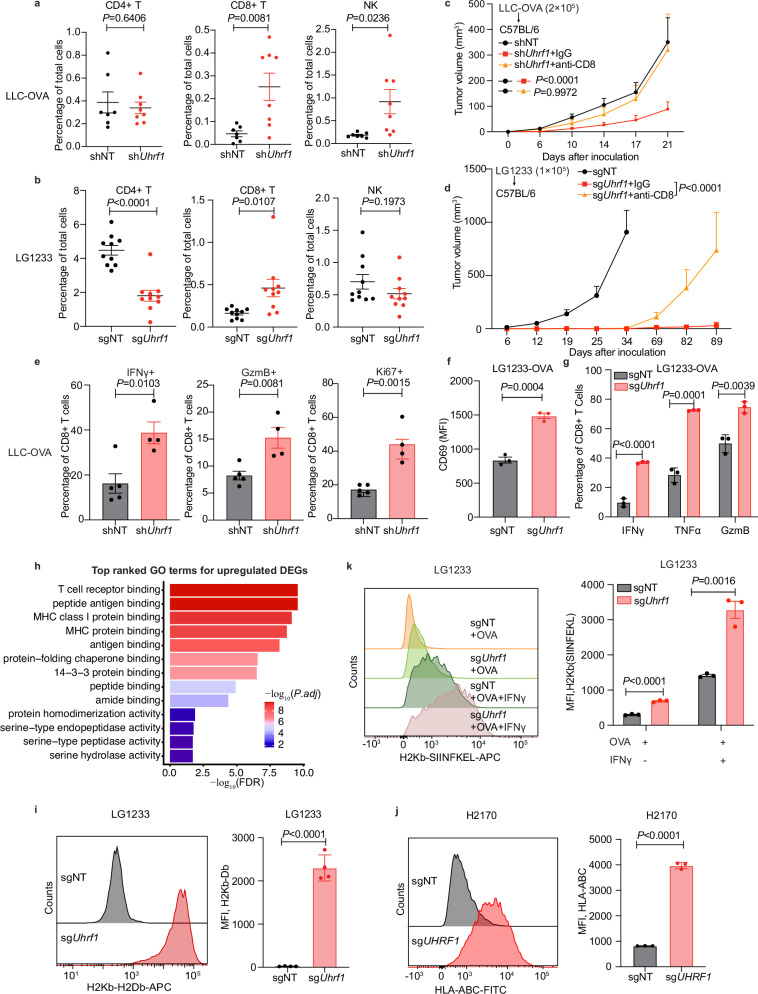
Immunotherapy successfully complements traditional cancer treatment. However, primary and acquired resistance might limit efficacy. Reduced antigen presentation by MHC-I has been identified as potential resistance factor. Here we show that the epigenetic regulator ubiquitin-like with PHD and ring finger domains 1 (UHRF1), exhibits altered expression and aberrant cytosolic localization in cancerous tissues, where it promotes MHC-I ubiquitination and degradation. Cytoplasmic translocation of UHRF1 is induced by its phosphorylation on a specific serine in response to signals provided by factors present in the tumor microenvironment (TME), such as TGF-β, enabling UHRF1 to bind MHC-I. Downregulation of MHC-I results in suppression of the antigen presentation pathway to establish an immune hostile TME. UHRF1 inactivation by genetic deletion synergizes with immune checkpoint blockade (ICB) treatment and induces an anti-tumour memory response by evoking low-affinity T cells. Our study adds to the understanding of UHRF1 in cancer immune evasion and provides a potential target to synergize with immunotherapy and overcome immunotherapeutic resistance.
免疫疗法成功地补充了传统的癌症治疗方法。然而,原发性和获得性耐药可能会限制其疗效。MHC-I 抗原呈递减少已被确定为潜在的耐药因素。在这里,我们表明,表观遗传调节剂含 PHD 和环指结构域 1(UHRF1)在癌组织中表现出改变的表达和异常的细胞质定位,在那里它促进 MHC-I 的泛素化和降解。UHRF1 的细胞质易位是由其在特定丝氨酸上的磷酸化诱导的,这是对肿瘤微环境(TME)中存在的因子提供的信号的反应,如 TGF-β,使 UHRF1 能够与 MHC-I 结合。MHC-I 的下调导致抗原呈递途径受到抑制,从而建立免疫敌对的 TME。通过基因缺失使 UHRF1 失活与免疫检查点阻断(ICB)治疗协同作用,并通过引发低亲和力 T 细胞诱导抗肿瘤记忆反应。我们的研究增加了对 UHRF1 在癌症免疫逃逸中的理解,并为与免疫疗法协同作用和克服免疫治疗耐药性提供了一个潜在的靶点。