Shanghai Engineering Research Center of Tooth Restoration and Regeneration & Tongji Research Institute of Stomatology & Department of Implantology, Stomatological Hospital, Dental School, Tongji University, Shanghai, China.
BMC Oral Health. 2024 Oct 3;24(1):1171. doi: 10.1186/s12903-024-04938-8.
This study aimed to evaluate the efficacy of autologous blood preparations, namely Platelet-Rich Plasma (PRP), Platelet-Rich Fibrin (PRF), and Concentrated Growth Factor (CGF), in maxillary sinus floor elevation surgery. The focus was on their impact on new bone formation, maxillary sinus floor height, and soft tissue healing.
A systematic search was conducted across PubMed/MEDLINE, Web of Science, Embase, and Scopus databases up to April 2024. This systematic review included both randomized clinical trials (RCTs) and controlled clinical trials (CCTs) that evaluated the efficacy of autologous blood preparations in maxillary sinus floor elevation surgery. The primary outcomes measured were the percentage of new bone formation, maxillary sinus floor height, and he percentage of soft tissue area. Data from the selected studies were extracted and analyzed to determine the impact of autologous blood preparations on these outcomes. The risk of bias was assessed using Cochrane's risk of bias tool and ROBINS-I, and meta-analyses were performed using Review Manager 5.4 software to calculate effect sizes and integrate results from multiple studies.
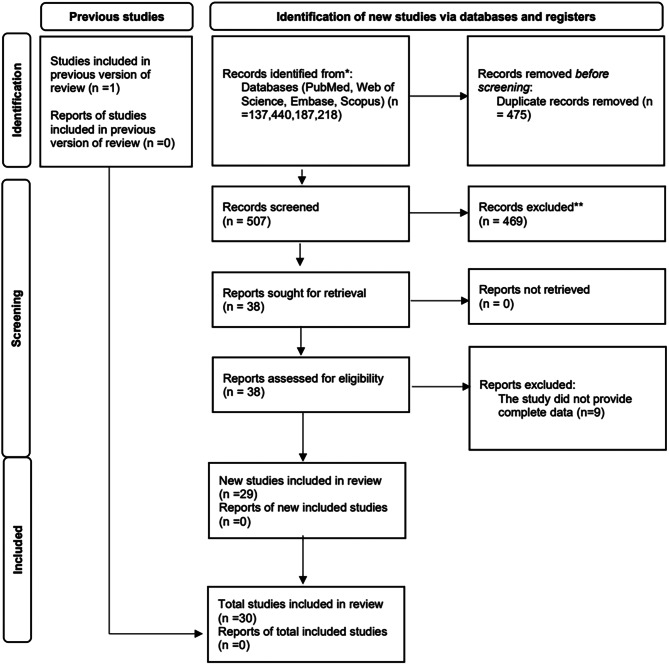
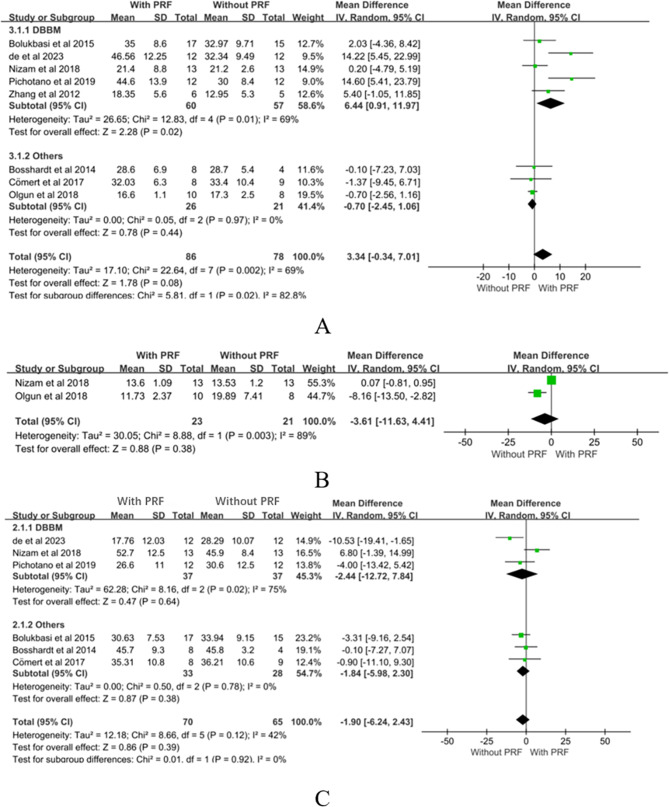
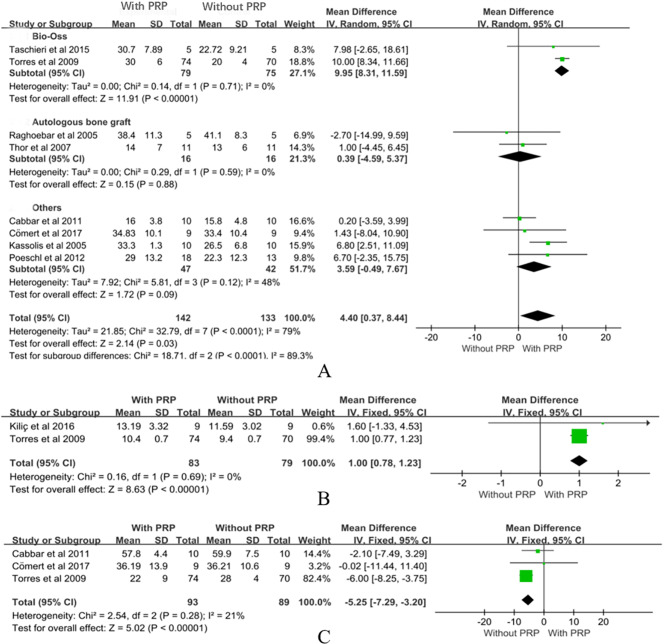
Among the 507 screened articles, 30 studies met the inclusion criteria. The results indicated that the application of PRP significantly increased new bone formation during maxillary sinus floor elevation surgery (primary outcome, MD = 4.40, CI = 0.37 to 8.44, P = 0.03), as well as improving maxillary sinus floor height elevation (secondary outcome, MD = 1.00, CI = 0.78 to 1.23, P < 0.00001). The absence of PRP during surgery had a statistically significant effect on the percentage of soft tissue area (secondary outcome, MD= -5.25, CI= -7.29 to 3.20, P < 0.00001). However, based on the research findings, PRF did not show significant effects on enhancing new bone formation, maxillary sinus floor height elevation, and promoting soft tissue regeneration.
PRP demonstrates efficacy in maxillary sinus floor elevation surgery by enhancing new bone formation and increasing sinus height. Further studies are needed to validate the outcomes of PRF and CGF.
本研究旨在评估富血小板血浆(PRP)、富血小板纤维蛋白(PRF)和浓缩生长因子(CGF)等自体血液制剂在提升上颌窦底手术中的疗效。重点关注它们对新骨形成、上颌窦底高度和软组织愈合的影响。
系统检索 PubMed/MEDLINE、Web of Science、Embase 和 Scopus 数据库,检索时限截至 2024 年 4 月。本系统评价纳入了评估自体血液制剂在上颌窦底提升术中疗效的随机临床试验(RCT)和对照临床试验(CCT)。主要结局测量指标为新骨形成百分比、上颌窦底高度和软组织面积百分比。从入选研究中提取数据并进行分析,以确定自体血液制剂对这些结局的影响。使用 Cochrane 偏倚风险工具和 ROBINS-I 评估偏倚风险,并使用 Review Manager 5.4 软件进行荟萃分析,以计算效应量并整合多项研究的结果。
在 507 篇筛选出的文章中,有 30 项研究符合纳入标准。结果表明,在上颌窦底提升术中应用 PRP 可显著增加新骨形成(主要结局,MD=4.40,CI=0.37 至 8.44,P=0.03),并改善上颌窦底高度提升(次要结局,MD=1.00,CI=0.78 至 1.23,P<0.00001)。手术中不使用 PRP 对软组织面积百分比有显著影响(次要结局,MD=-5.25,CI=-7.29 至 3.20,P<0.00001)。然而,根据研究结果,PRF 对上颌窦底提升术中新骨形成、上颌窦底高度提升和促进软组织再生的效果并不显著。
PRP 通过促进新骨形成和增加窦腔高度在上颌窦底提升手术中显示出疗效。需要进一步研究来验证 PRF 和 CGF 的结果。