Alamoudi Njoud Aydhah, Algabbani Maha F, Al-Heizan Muhammad O, Alhusaini Adel A
Department of Health Rehabilitation Sciences, College of Applied Medical Sciences, King Saud University, Riyadh, Saudi Arabia.
Front Pediatr. 2024 Sep 19;12:1463288. doi: 10.3389/fped.2024.1463288. eCollection 2024.
Physical activity (PA) is paramount for childhood development and growth. However, children diagnosed with Cerebral Palsy (CP) were often considered sedentary, and their physical inactivity was associated with adverse health conditions and complications. Therefore, this study aimed to objectively describe and compare the PA levels and SB levels of children with and without CP of the same age group. It also studied the factors correlating with PA, SB, and step count per day in children with CP.
A cross-sectional study using a wrist-worn accelerometer was conducted. PA and SB were measured over seven consecutive days.
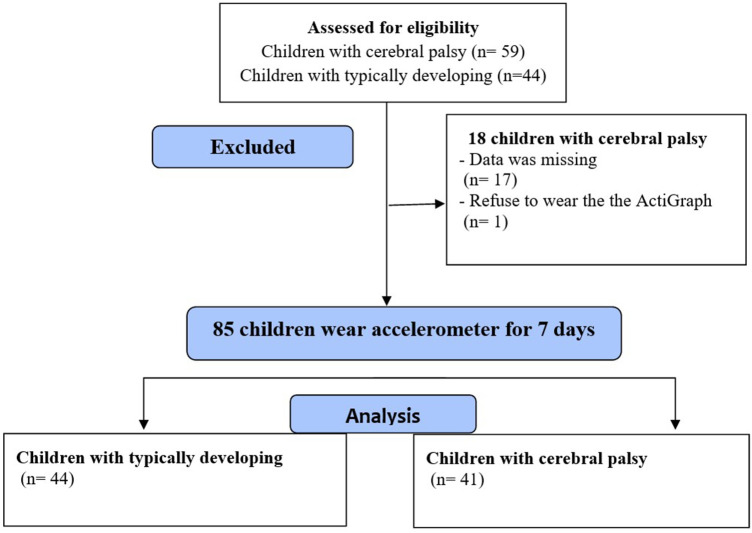
Eighty-five children aged 6-12 years, consisting of 41 children with CP and 44 TD children, participated in this study with a mean age of 9.18 ± 1.95 and 8.45 ± 1.78 years, respectively. According to the gross functional measures, 53.6% of children with CP were classified as first classification. A significant amount of time was spent in SB and Light PA (LPA) by children with CP compared to TD children, and no significant differences were observed in moderate PA (MPA) or step count. Gender mainly affected MPA as girls spent more time in MPA than boys. The age, height, and weight of children with CP correlate significantly with SB. As children's age, height, and weight increase, SB increases. Additionally, children with higher weights have lower step counts per day.
This study showed that children with CP spend more time in LPA and SB than typically developed children. Therefore, concerted efforts are needed to encourage physical activity and reduce the sedentary lifestyle, to take into account the gender and anthropometric measures of children to enhance the quality of life among children with CP, and to consider gender and anthropometric measures of the children.
身体活动对儿童的发育和成长至关重要。然而,被诊断为脑瘫(CP)的儿童通常被认为久坐不动,他们缺乏身体活动与不良健康状况及并发症相关。因此,本研究旨在客观描述和比较同一年龄组有和没有脑瘫的儿童的身体活动水平和久坐行为水平。它还研究了与脑瘫儿童的身体活动、久坐行为和每日步数相关的因素。
采用佩戴在手腕上的加速度计进行横断面研究。连续七天测量身体活动和久坐行为。
85名6至12岁的儿童参与了本研究,其中包括41名脑瘫儿童和44名发育正常(TD)儿童,平均年龄分别为9.18±1.95岁和8.45±1.78岁。根据粗大功能测量,53.6%的脑瘫儿童被归类为一级。与发育正常儿童相比,脑瘫儿童在久坐行为和轻度身体活动(LPA)上花费的时间显著更多,而在中度身体活动(MPA)或步数方面未观察到显著差异。性别主要影响中度身体活动,因为女孩在中度身体活动上花费的时间比男孩多。脑瘫儿童的年龄、身高和体重与久坐行为显著相关。随着儿童年龄、身高和体重的增加,久坐行为增加。此外,体重较高的儿童每日步数较少。
本研究表明,脑瘫儿童在轻度身体活动和久坐行为上花费的时间比发育正常的儿童更多。因此,需要共同努力鼓励身体活动并减少久坐的生活方式,考虑儿童的性别和人体测量指标以提高脑瘫儿童的生活质量,并考虑儿童的性别和人体测量指标。