Cornell Tessa Rose, Fye Biram Laity, Nyassi Edrisa, Ceesay Fatou, Jallow Mahmud, Langendonk R Frèdi, Wootton Dan G, Pinchbeck Gina, Scantlebury Claire Elizabeth
Institute of Infection, Veterinary, and Ecological Sciences (IVES), University of Liverpool, Liverpool, United Kingdom.
Department of Livestock Services (DLS), Ministry of Agriculture, Livestock and Food Security, Abuko, Gambia.
Front Vet Sci. 2024 Sep 19;11:1444887. doi: 10.3389/fvets.2024.1444887. eCollection 2024.
Exposure rates to species, the causative agent of equine epizootic lymphangitis (EL), are unknown amongst working equids in The Gambia. The primary aims of this study were to estimate anti- antibody seroprevalence in the equid population in rural The Gambia and to explore risk factors for seropositivity.
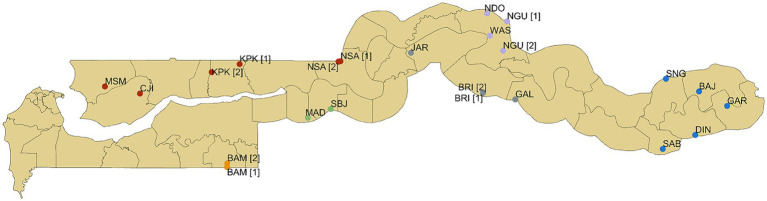
A nationwide cross-sectional study was conducted (February-July 2022), representing baseline measurements of a longitudinal cohort study. Horses ( 463) and donkeys ( = 92) without EL signs were recruited in 18 study sites. Following informed owner consent, equid clinical and management data were recorded. Blood samples were collected by jugular venepuncture, and sera were subject to the IMMY Latex Agglutination test (LAT). Seropositivity risk factors were explored by multi-level, multivariable logistic regression analysis. Study site and household variance were described using a latent-variable approach. Whole blood DNA extractions were subject to nested ITS-PCR to detect var. (HCF), and agreement with LAT results was measured using Cohen's kappa statistic.
Anti- antibody seroprevalence in horses and donkeys was 79.9% [95% confidence interval (CI) 76.0-83.5%] and 46.7% (95% CI 36.3-57.4%), respectively. In , two multivariable models explained the maximum amount of data variability. Model 1 demonstrated increased odds of seropositivity in mares [odds ratio (OR) = 2.90 95% CI 1.70-4.95, < 0.001] and decreased odds in horses <2.5 years (OR = 0.46 95% CI 0.22-0.95, = 0.04; reference: ≥4.5 years). Model 2 demonstrated increased odds in horses recruited during the rainy season (OR = 2.03 95% CI 1.08-3.84, = 0.03) and those owned by farmers reporting previous EL in their equids (OR = 1.87 95% CI 1.04-3.37, = 0.04). Decreased odds were measured in horses <2.5 years (OR = 0.37 95% CI 0.18-0.78, = 0.01) and horses reported to transport firewood (OR = 0.45 95% CI 0.28-0.74, = 0.001). On multivariable analysis of , decreased odds of seropositivity were demonstrated amongst donkeys owned by households which also owned horses (OR = 0.23 95% CI 0.06-0.85, = 0.03). HCF infection prevalence in horses and donkeys was 22.0% ( = 102/463, 95% CI 18.3-26.1%) and 5.4% ( = 5/92, 95% CI 1.8-12.2%), respectively. No significant agreement was measured between LAT and nested ITS-PCR results ( < 0.00).
High spp. exposure was demonstrated amongst equids in The Gambia. Investigation of risk factors, including equid husbandry and management strategies, as well as geoclimatic variations, is warranted. Outcomes may inform sustainable and equitable EL control strategies in The Gambia and comparable settings worldwide.
在冈比亚,工作用马属动物中感染马流行性淋巴管炎(EL)病原体假性皮疽组织胞浆菌的暴露率尚不清楚。本研究的主要目的是估计冈比亚农村马属动物群体中的抗真菌抗体血清阳性率,并探索血清阳性的危险因素。
开展了一项全国性横断面研究(2022年2月至7月),作为一项纵向队列研究的基线测量。在18个研究地点招募了无EL体征的马(n = 463)和驴(n = 92)。在获得主人知情同意后,记录马属动物的临床和管理数据。通过颈静脉穿刺采集血样,血清进行IMMY乳胶凝集试验(LAT)。通过多水平、多变量逻辑回归分析探索血清阳性危险因素。使用潜在变量方法描述研究地点和家庭差异。全血DNA提取后进行巢式ITS-PCR以检测假性皮疽组织胞浆菌变种(HCF),并使用Cohen's kappa统计量测量与LAT结果的一致性。
马和驴的抗真菌抗体血清阳性率分别为79.9% [95%置信区间(CI)76.0 - 83.5%]和46.7%(95% CI 36.3 - 57.4%)。在假性皮疽组织胞浆菌方面,两个多变量模型解释了最大量的数据变异性。模型1显示母马血清阳性的几率增加[优势比(OR)= 2.90,95% CI 1.70 - 4.95,P < 0.001],2.5岁以下的马血清阳性几率降低(OR = 0.46,95% CI 0.22 - 0.95,P = 0.04;参照:≥4.5岁)。模型2显示雨季招募的马血清阳性几率增加(OR = 2.03,95% CI 1.08 - 3.84,P = 0.03)以及报告其马属动物之前患过EL的农民所拥有的马血清阳性几率增加(OR = 1.87,95% CI 1.04 - 3.37,P = 0.04)。2.5岁以下的马(OR = 0.37,95% CI 0.18 - 0.78,P = 0.01)和报告运输柴火的马(OR = 0.45,95% CI 0.28 - 0.74,P = 用马属动物中感染率较高。有必要对包括马属动物饲养和管理策略以及地理气候变异等危险因素进行调查。研究结果可能为冈比亚及全球类似环境下可持续且公平的EL控制策略提供依据。
在冈比亚的马属动物中显示出高假性皮疽组织胞浆菌暴露率。有必要对包括马属动物饲养和管理策略以及地理气候变异等危险因素进行调查。研究结果可能为冈比亚及全球类似环境下可持续且公平的EL控制策略提供依据。