Department of Obstetrics, Gynaecology and Newborn Health, University of Melbourne, Parkville, VIC 3010, Australia.
Gynaecology Research Centre, Royal Women's Hospital, Parkville, VIC 3052, Australia.
Proc Natl Acad Sci U S A. 2024 Oct 8;121(41):e2401071121. doi: 10.1073/pnas.2401071121. Epub 2024 Oct 4.
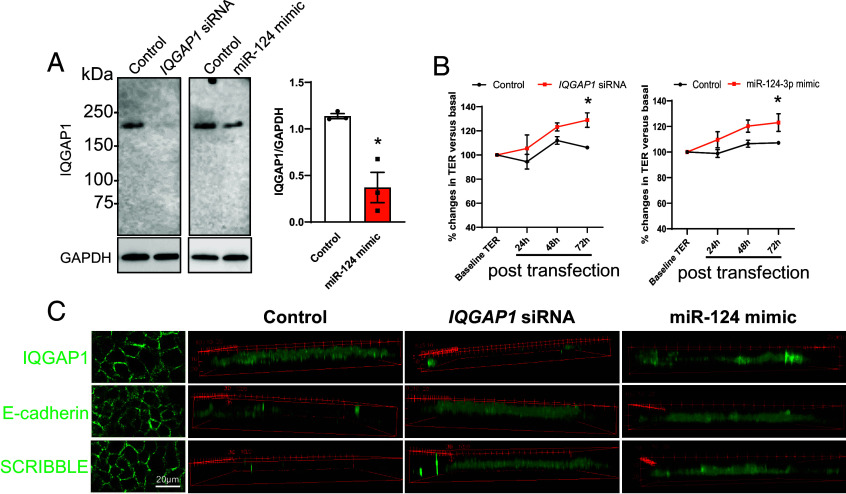
The endometrium undergoes substantial remodeling in each menstrual cycle to become receptive to an implanting embryo. Abnormal endometrial receptivity is one of the major causes of embryo implantation failure and infertility. MicroRNA-124-3p is elevated in both the serum and endometrial tissue of women with chronic endometritis, a condition associated with infertility. MicroRNA-124-3p also has a role in cell adhesion, a key function during receptivity to allow blastocysts to adhere and implant. In this study, we aimed to determine the function of microRNA-124-3p on endometrial epithelial adhesive capacity during receptivity and effect on embryo implantation. Using a unique inducible, uterine epithelial-specific microRNA overexpression mouse model, we demonstrated that elevated uterine epithelial microRNA-124-3p impaired endometrial receptivity by altering genes associated with cell adhesion and polarity. This resulted in embryo implantation failure. Similarly in a second mouse model, increasing microRNA-124-3p expression only in mouse uterine surface (luminal) epithelium impaired receptivity and led to implantation failure. In humans, we demonstrated that microRNA-124-3p was abnormally increased in the endometrial epithelium of women with unexplained infertility during the receptive window. MicroRNA-124-3p overexpression in primary human endometrial epithelial cells (HEECs) impaired primary human embryo trophectoderm attachment in a 3-dimensional culture model of endometrium. Reduction of microRNA-124-3p in HEECs from infertile women normalized HEEC adhesive capacity. Overexpression of microRNA-124-3p or knockdown of its direct target reduced fertile HEEC adhesion and its ability to lose polarity. Collectively, our data highlight that microRNA-124-3p and its protein targets contribute to endometrial receptivity by altering cell polarity and adhesion.
子宫内膜在每个月经周期都会经历大量重塑,以变得能够接受着床胚胎。子宫内膜容受性异常是胚胎着床失败和不孕的主要原因之一。慢性子宫内膜炎患者的血清和子宫内膜组织中 miR-124-3p 水平升高,而慢性子宫内膜炎与不孕有关。miR-124-3p 还在细胞黏附中发挥作用,细胞黏附是接受能力的关键功能,使胚胎能够黏附和着床。在这项研究中,我们旨在确定 miR-124-3p 在接受能力期间对子宫内膜上皮细胞黏附能力的功能及其对胚胎着床的影响。我们使用独特的诱导型、子宫上皮特异性 miR-124-3p 过表达小鼠模型,证明升高的子宫上皮 miR-124-3p 通过改变与细胞黏附和极性相关的基因来损害子宫内膜容受性。这导致胚胎着床失败。同样,在第二个小鼠模型中,仅在小鼠子宫表面(腔上皮)上皮中增加 miR-124-3p 的表达会损害接受能力并导致着床失败。在人类中,我们证明在接受窗口期间,不明原因不孕的妇女的子宫内膜上皮中 miR-124-3p 异常增加。在子宫内膜的三维培养模型中,过表达 miR-124-3p 会损害人原发性子宫内膜上皮细胞(HEEC)中初级人胚胎滋养层的附着。降低不孕妇女 HEEC 中的 miR-124-3p 可使 HEEC 的黏附能力正常化。miR-124-3p 的过表达或其直接靶标的敲低会降低可育 HEEC 的黏附能力及其失去极性的能力。总的来说,我们的数据强调了 miR-124-3p 及其蛋白质靶标通过改变细胞极性和黏附来影响子宫内膜的接受能力。