Campillo Paola, Kesler Alice, Ramírez Camila A, Ramírez Carlos J, Daher Jean Carlo, Grimm Mason, Sabina Michael, Bizanti Anas
Department of Internal Medicine, Lakeland Regional Health Medical Center, Lakeland, Florida, USA.
Melanoma Res. 2025 Feb 1;35(1):24-30. doi: 10.1097/CMR.0000000000001008. Epub 2024 Oct 7.
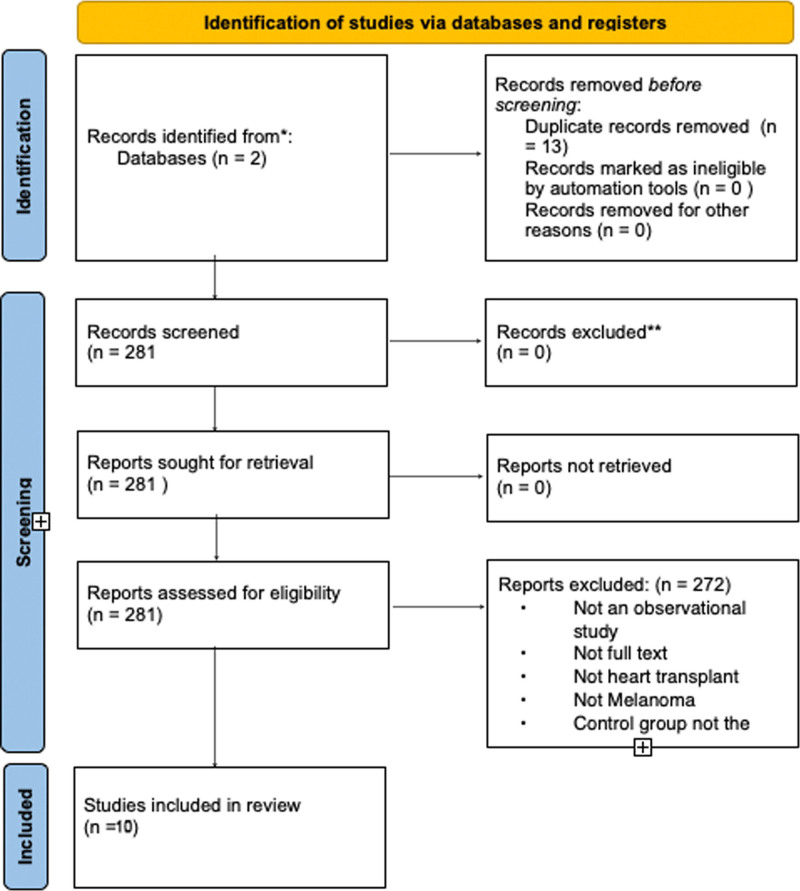
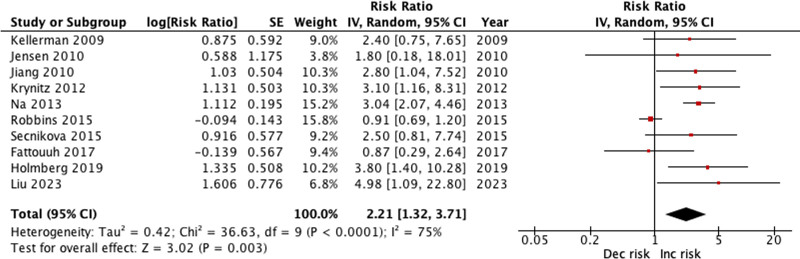
The incidence of heart transplants in the USA has increased by 85.8% since 2011, resulting in a growing population of recipients requiring long-term immunosuppressive therapy. While essential for preventing organ rejection, this therapy significantly increases melanoma risk. This meta-analysis investigates the incidence and risk factors of melanoma in heart transplant recipients. A systematic review and meta-analysis were conducted following Preferred Reporting Items for Systematic Reviews and Meta-Analyses guidelines, including observational studies reporting melanoma incidence in heart transplant recipients. Relative risk (RR) was synthesized from standardized incidence ratios, hazard ratios, incidence rate ratios, and standardized mortality ratios. The meta-analysis incorporated 10 studies, including 22 415 heart transplant recipients. The pooled RR was 2.21 (95% confidence interval: 1.32-3.71; P = 0.003), indicating a significantly elevated melanoma risk. This study highlights the critical need for preventive dermatological strategies in heart transplant recipients and calls for further research into the impact of different immunosuppressive regimens on melanoma risk. Despite limitations, these findings offer valuable insights for optimizing long-term patient care.
自2011年以来,美国心脏移植的发生率增长了85.8%,导致需要长期免疫抑制治疗的受者群体不断扩大。虽然这种治疗对于预防器官排斥至关重要,但它显著增加了患黑色素瘤的风险。这项荟萃分析调查了心脏移植受者中黑色素瘤的发生率和危险因素。按照系统评价和荟萃分析的首选报告项目指南进行了一项系统评价和荟萃分析,纳入了报告心脏移植受者黑色素瘤发生率的观察性研究。相对风险(RR)由标准化发病率比、风险比、发病率比和标准化死亡率比综合得出。该荟萃分析纳入了10项研究,包括22415名心脏移植受者。汇总RR为2.21(95%置信区间:1.32 - 3.71;P = 0.003),表明黑色素瘤风险显著升高。本研究强调了心脏移植受者采取预防性皮肤病学策略的迫切需求,并呼吁进一步研究不同免疫抑制方案对黑色素瘤风险的影响。尽管存在局限性,但这些发现为优化长期患者护理提供了有价值的见解。