• 文献检索
  • 文档翻译
  • 深度研究
  • 学术资讯
  • Suppr Zotero 插件Zotero 插件
  • 邀请有礼
  • 套餐&价格
  • 历史记录
应用&插件
Suppr Zotero 插件Zotero 插件浏览器插件Mac 客户端Windows 客户端微信小程序
定价
高级版会员购买积分包购买API积分包
服务
文献检索文档翻译深度研究API 文档MCP 服务
关于我们
关于 Suppr公司介绍联系我们用户协议隐私条款
关注我们

Suppr 超能文献

核心技术专利:CN118964589B侵权必究
粤ICP备2023148730 号-1Suppr @ 2026

文献检索

告别复杂PubMed语法,用中文像聊天一样搜索,搜遍4000万医学文献。AI智能推荐,让科研检索更轻松。

立即免费搜索

文件翻译

保留排版,准确专业,支持PDF/Word/PPT等文件格式,支持 12+语言互译。

免费翻译文档

深度研究

AI帮你快速写综述,25分钟生成高质量综述,智能提取关键信息,辅助科研写作。

立即免费体验

利用机器学习识别医院运营管理中的关键指标:一项回顾性研究,探讨四种常见算法的可行性和性能。

Leverage machine learning to identify key measures in hospital operations management: a retrospective study to explore feasibility and performance of four common algorithms.

机构信息

Department of Operation Management, Huangshi Central Hospital, Affiliated Hospital of Hubei Polytechnic University, #141 Tianjin Road, Huangshi Port District, Huangshi, 435000, Hubei Province, China.

Center for Health Statistics and Information, National Health Commission of People's Republic of China, #1 Xizhimen Wainan Road, Xicheng District, Beijing, 100810, China.

出版信息

BMC Med Inform Decis Mak. 2024 Oct 4;24(1):286. doi: 10.1186/s12911-024-02689-8.

DOI:10.1186/s12911-024-02689-8
PMID:39367415
原文链接:https://pmc.ncbi.nlm.nih.gov/articles/PMC11451234/
Abstract

BACKGROUND

Measures in operations management are pivotal for monitoring and assessing various aspects of hospital performance. Existing literature highlights the importance of regularly updating key management measures to reflect changing trends and organizational goals. Advancements in machine learning (ML) have presented promising opportunities for enhancing the process of updating operations management measures. However, their specific application and performance remain relatively unexplored. We aimed to investigate the feasibility and effectiveness of using common ML techniques to identify and update key measures in hospital operations management.

METHODS

Historical data on 43 measures on financial balance and quality of care under 4 categories were retrieved from the BI system of a regional health system in Central China. The dataset included 17 surgical and 15 non-surgical departments over 48 months. Four common ML techniques, linear models (LM), random forest (RF), partial least squares (PLS), and neural networks (NN), were used to identify the most important measures. Ordinary least square was employed to investigate the impact of the top 10 measures. A ground truth validation compared the ML-identified key measures against the humanly decided strategic measures from annual meeting minutes.

RESULTS

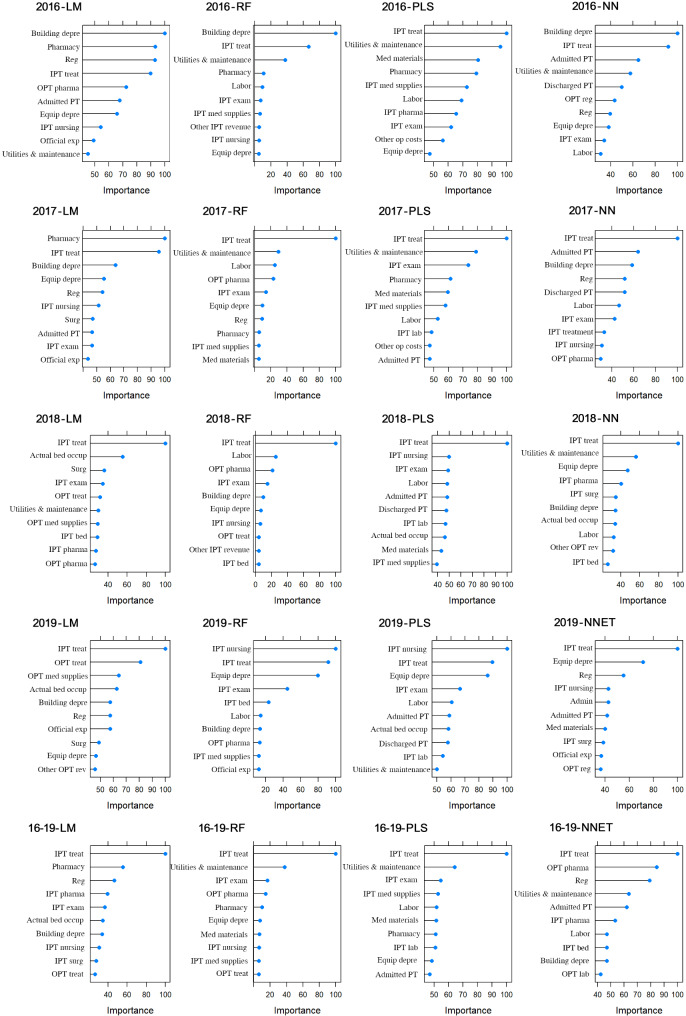
For financial balancing, inpatient treatment revenue was an important measure in 3/4 years, followed by equipment depreciation costs. The measures identified using the same technique differed between years, though RF and PLS yielded relatively consistent results. For quality of care, none of the ML-identified measures repeated over the years. Those consistently important over four years differed almost entirely among four techniques. On ground truth validation, the 2016-2019 ML-identified measures were among the humanly identified measures, with the exception of equipment depreciation from the 2019 dataset. All the ML-identified measures for quality of care failed to coincide with the humanly decided measures.

CONCLUSIONS

Using ML to identify key hospital operational measures is viable but performance of ML techniques vary considerably. RF performs best among the four techniques in identifying key measures in financial balance. None of the ML techniques seem effective for identifying quality of care measures. ML is suggested as a decision support tool to remind and inspire decision-makers in certain aspects of hospital operations management.

摘要

背景

运营管理中的措施对于监测和评估医院绩效的各个方面至关重要。现有文献强调了定期更新关键管理措施以反映不断变化的趋势和组织目标的重要性。机器学习(ML)的进步为增强运营管理措施的更新过程提供了有前景的机会。然而,它们的具体应用和性能仍然相对未知。我们旨在研究使用常见的 ML 技术来识别和更新医院运营管理中的关键措施的可行性和有效性。

方法

从中国中部地区一个区域卫生系统的 BI 系统中检索了 4 个类别下的 43 个财务平衡和护理质量措施的历史数据。数据集包括 17 个外科和 15 个非外科科室,共 48 个月。使用四种常见的 ML 技术,即线性模型(LM)、随机森林(RF)、偏最小二乘法(PLS)和神经网络(NN),来识别最重要的措施。普通最小二乘法用于研究前 10 个措施的影响。一个实地真相验证将 ML 识别的关键措施与年度会议记录中人为决定的战略措施进行了比较。

结果

对于财务平衡,住院治疗收入是 3/4 年内的一个重要措施,其次是设备折旧成本。使用相同技术识别的措施在不同年份有所不同,尽管 RF 和 PLS 产生了相对一致的结果。对于护理质量,ML 识别的措施没有一个多年来重复出现。在四年中始终重要的措施在四种技术之间几乎完全不同。在实地真相验证中,2016-2019 年 ML 识别的措施与人识别的措施在 2019 年的数据集除外。所有用于护理质量的 ML 识别的措施都与人为决定的措施不一致。

结论

使用 ML 识别关键医院运营措施是可行的,但 ML 技术的性能差异很大。在识别财务平衡的关键措施方面,RF 在四种技术中表现最好。在识别护理质量措施方面,没有一种 ML 技术似乎有效。建议将 ML 作为决策支持工具,在医院运营管理的某些方面提醒和激励决策者。
https://cdn.ncbi.nlm.nih.gov/pmc/blobs/8ab8/11451234/a2d2b8a7647d/12911_2024_2689_Fig2_HTML.jpg
https://cdn.ncbi.nlm.nih.gov/pmc/blobs/8ab8/11451234/e7d14ca8c6e9/12911_2024_2689_Fig1_HTML.jpg
https://cdn.ncbi.nlm.nih.gov/pmc/blobs/8ab8/11451234/a2d2b8a7647d/12911_2024_2689_Fig2_HTML.jpg
https://cdn.ncbi.nlm.nih.gov/pmc/blobs/8ab8/11451234/e7d14ca8c6e9/12911_2024_2689_Fig1_HTML.jpg
https://cdn.ncbi.nlm.nih.gov/pmc/blobs/8ab8/11451234/a2d2b8a7647d/12911_2024_2689_Fig2_HTML.jpg

相似文献

1
Leverage machine learning to identify key measures in hospital operations management: a retrospective study to explore feasibility and performance of four common algorithms.利用机器学习识别医院运营管理中的关键指标:一项回顾性研究,探讨四种常见算法的可行性和性能。
BMC Med Inform Decis Mak. 2024 Oct 4;24(1):286. doi: 10.1186/s12911-024-02689-8.
2
Predicting conversion of ambulatory ACDF patients to inpatient: a machine learning approach.预测门诊颈椎前路椎间盘切除融合术患者转为住院患者:一种机器学习方法。
Spine J. 2024 Apr;24(4):563-571. doi: 10.1016/j.spinee.2023.11.010. Epub 2023 Nov 21.
3
Can Machine Learning Algorithms Predict Which Patients Will Achieve Minimally Clinically Important Differences From Total Joint Arthroplasty?机器学习算法能否预测哪些患者将从全关节置换术中获得最小临床重要差异?
Clin Orthop Relat Res. 2019 Jun;477(6):1267-1279. doi: 10.1097/CORR.0000000000000687.
4
Evaluating the performance of machine learning methods and variable selection methods for predicting difficult-to-measure traits in Holstein dairy cattle using milk infrared spectral data.利用牛奶近红外光谱数据评估机器学习方法和变量选择方法在荷斯坦奶牛中预测难以测量性状的性能。
J Dairy Sci. 2021 Jul;104(7):8107-8121. doi: 10.3168/jds.2020-19861. Epub 2021 Apr 15.
5
Inversion model of soil salinity in alfalfa covered farmland based on sensitive variable selection and machine learning algorithms.基于敏感变量选择和机器学习算法的苜蓿农田土壤盐渍化反演模型。
PeerJ. 2024 Sep 26;12:e18186. doi: 10.7717/peerj.18186. eCollection 2024.
6
The future of Cochrane Neonatal.考克兰新生儿协作网的未来。
Early Hum Dev. 2020 Nov;150:105191. doi: 10.1016/j.earlhumdev.2020.105191. Epub 2020 Sep 12.
7
Machine learning algorithms for predicting COVID-19 mortality in Ethiopia.用于预测埃塞俄比亚 COVID-19 死亡率的机器学习算法。
BMC Public Health. 2024 Jun 28;24(1):1728. doi: 10.1186/s12889-024-19196-0.
8
Interpretable machine learning for allergic rhinitis prediction among preschool children in Urumqi, China.中国乌鲁木齐学龄前儿童变应性鼻炎预测的可解释机器学习。
Sci Rep. 2024 Sep 27;14(1):22281. doi: 10.1038/s41598-024-73733-w.
9
Machine Learning Hybrid Model for the Prediction of Chronic Kidney Disease.机器学习混合模型预测慢性肾脏病。
Comput Intell Neurosci. 2023 Mar 14;2023:9266889. doi: 10.1155/2023/9266889. eCollection 2023.
10
Disentangling data dependency using cross-validation strategies to evaluate prediction quality of cattle grazing activities using machine learning algorithms and wearable sensor data.利用交叉验证策略解开数据依赖性,使用机器学习算法和可穿戴传感器数据评估牛放牧活动的预测质量。
J Anim Sci. 2021 Sep 1;99(9). doi: 10.1093/jas/skab206.

本文引用的文献

1
Applying Machine Learning to Healthcare Operations Management: CNN-Based Model for Malaria Diagnosis.将机器学习应用于医疗保健运营管理:基于卷积神经网络的疟疾诊断模型。
Healthcare (Basel). 2023 Jun 16;11(12):1779. doi: 10.3390/healthcare11121779.
2
An integrated framework to evaluate and improve the performance of emergency departments during the COVID-19 pandemic: A mathematical programing approach.一种评估和改进 COVID-19 大流行期间急诊科绩效的综合框架:一种数学规划方法。
Proc Inst Mech Eng H. 2023 Jun;237(6):683-705. doi: 10.1177/09544119231170303. Epub 2023 May 2.
3
Priorities to accelerate workflow automation in health care.
加快医疗保健工作流程自动化的优先事项。
J Am Med Inform Assoc. 2022 Dec 13;30(1):195-201. doi: 10.1093/jamia/ocac197.
4
Machine learning for real-time aggregated prediction of hospital admission for emergency patients.用于急诊患者住院实时汇总预测的机器学习
NPJ Digit Med. 2022 Jul 26;5(1):104. doi: 10.1038/s41746-022-00649-y.
5
Shifting machine learning for healthcare from development to deployment and from models to data.将医疗保健领域的机器学习从开发转移到部署,从模型转移到数据。
Nat Biomed Eng. 2022 Dec;6(12):1330-1345. doi: 10.1038/s41551-022-00898-y. Epub 2022 Jul 4.
6
Identifying indicators influencing emergency department performance during a medical surge: A consensus-based modified fuzzy Delphi approach.确定医疗激增期间影响急诊部门绩效的指标:基于共识的改进型模糊德尔菲法。
PLoS One. 2022 Apr 21;17(4):e0265101. doi: 10.1371/journal.pone.0265101. eCollection 2022.
7
Machine Learning in Healthcare.医疗保健中的机器学习
Curr Genomics. 2021 Dec 16;22(4):291-300. doi: 10.2174/1389202922666210705124359.
8
Identification and Prediction of Chronic Diseases Using Machine Learning Approach.利用机器学习方法识别和预测慢性病。
J Healthc Eng. 2022 Feb 25;2022:2826127. doi: 10.1155/2022/2826127. eCollection 2022.
9
Considerations for the implementation of machine learning into acute care settings.考虑将机器学习应用于急性护理环境的相关因素。
Br Med Bull. 2022 Mar 21;141(1):15-32. doi: 10.1093/bmb/ldac001.
10
Developing a Data-Driven Approach in Order to Improve the Safety and Quality of Patient Care.制定数据驱动方法,以提高患者护理的安全性和质量。
Front Public Health. 2021 May 21;9:667819. doi: 10.3389/fpubh.2021.667819. eCollection 2021.