Kaseb Zeynab, Möller Matthias, Vergara Pedro P, Palensky Peter
Electrical Sustainable Energy, Delft University of Technology, P.O. Box 5031, 2600 GA, Delft, The Netherlands.
Applied Mathematics, Delft University of Technology, P.O. Box 5031, 2600 GA, Delft, The Netherlands.
Sci Rep. 2024 Oct 5;14(1):23216. doi: 10.1038/s41598-024-73512-7.
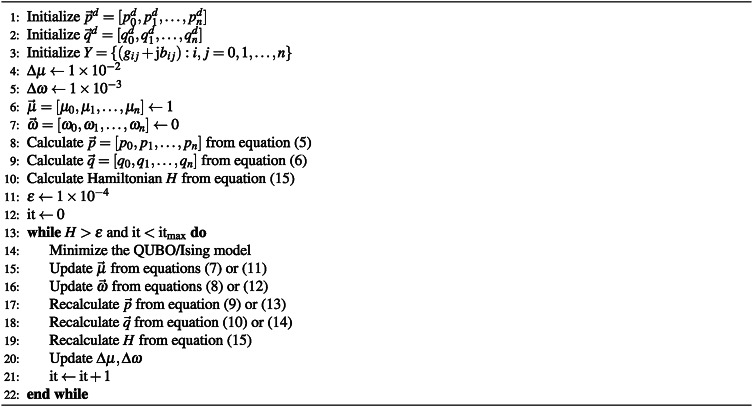
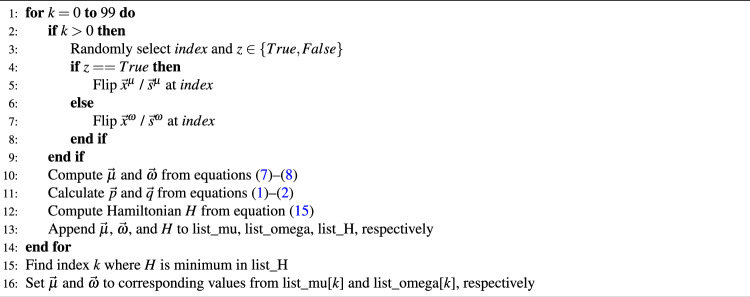
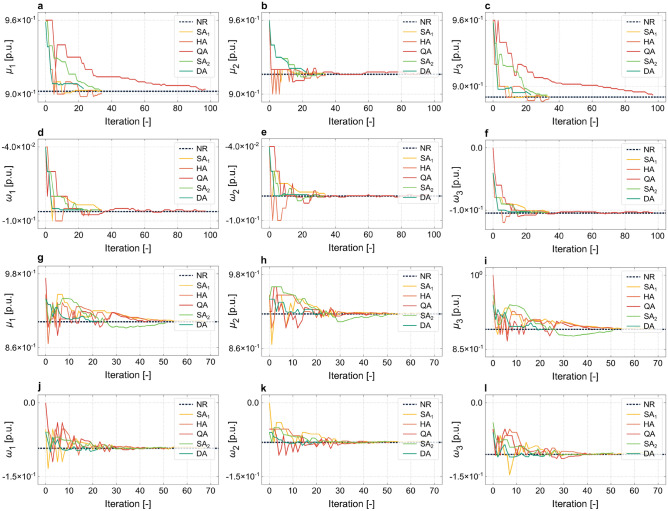
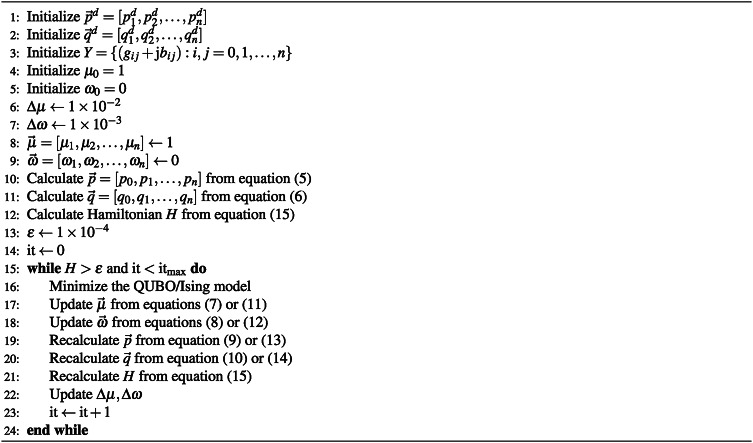
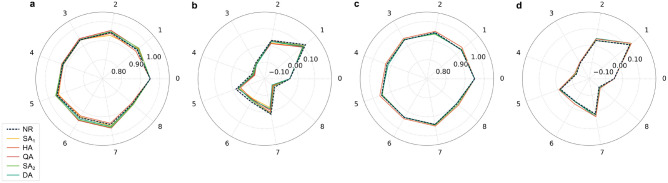
Power flow (PF) analysis is a foundational computational method to study the flow of power in an electrical network. This analysis involves solving a set of non-linear and non-convex differential-algebraic equations. State-of-the-art solvers for PF analysis, therefore, face challenges with scalability and convergence, specifically for large-scale and/or ill-conditioned cases characterized by high penetration of renewable energy sources, among others. The adiabatic quantum computing paradigm has been proven to efficiently find solutions for combinatorial problems in the noisy intermediate-scale quantum (NISQ) era, and it can potentially address the limitations posed by state-of-the-art PF solvers. For the first time, we propose a novel adiabatic quantum computing approach for efficient PF analysis. Our key contributions are (i) a combinatorial PF algorithm and a modified version that aligns with the principles of PF analysis, termed the adiabatic quantum PF algorithm (AQPF), both of which use Quadratic Unconstrained Binary Optimization (QUBO) and Ising model formulations; (ii) a scalability study of the AQPF algorithm; and (iii) an extension of the AQPF algorithm to handle larger problem sizes using a partitioned approach. Numerical experiments are conducted using different test system sizes on D-Wave's Advantage™ quantum annealer, Fujitsu's digital annealer V3, D-Wave's quantum-classical hybrid annealer, and two simulated annealers running on classical computer hardware. The reported results demonstrate the effectiveness and high accuracy of the proposed AQPF algorithm and its potential to speed up the PF analysis process while handling ill-conditioned cases using quantum and quantum-inspired algorithms.
潮流(PF)分析是研究电力网络中功率流动的一种基础计算方法。该分析涉及求解一组非线性和非凸的微分代数方程。因此,用于PF分析的先进求解器在可扩展性和收敛性方面面临挑战,特别是对于以高比例可再生能源等为特征的大规模和/或病态情况。绝热量子计算范式已被证明能在有噪声的中等规模量子(NISQ)时代有效地找到组合问题的解决方案,并且它有可能解决现有先进PF求解器所带来的局限性。我们首次提出了一种用于高效PF分析的新颖绝热量子计算方法。我们的主要贡献包括:(i)一种组合PF算法以及一个符合PF分析原理的修改版本,称为绝热量子PF算法(AQPF),两者均使用二次无约束二元优化(QUBO)和伊辛模型公式;(ii)对AQPF算法的可扩展性研究;以及(iii)使用分区方法将AQPF算法扩展以处理更大的问题规模。我们在D-Wave的Advantage™量子退火器、富士通的数字退火器V3、D-Wave的量子-经典混合退火器以及在经典计算机硬件上运行的两个模拟退火器上,使用不同的测试系统规模进行了数值实验。报告的结果证明了所提出的AQPF算法的有效性和高精度,以及它在使用量子和量子启发算法处理病态情况时加快PF分析过程的潜力。