Date Prasanna, Potok Thomas
Computer Science and Mathematics Division, Oak Ridge National Laboratory, Oak Ridge, 37830, USA.
Sci Rep. 2021 Nov 9;11(1):21905. doi: 10.1038/s41598-021-01445-6.
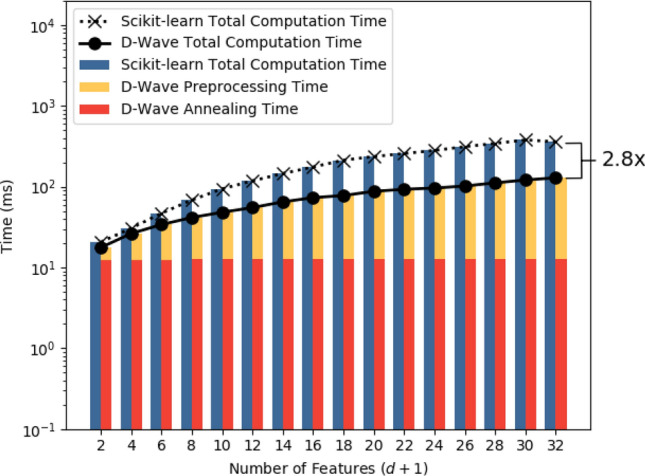
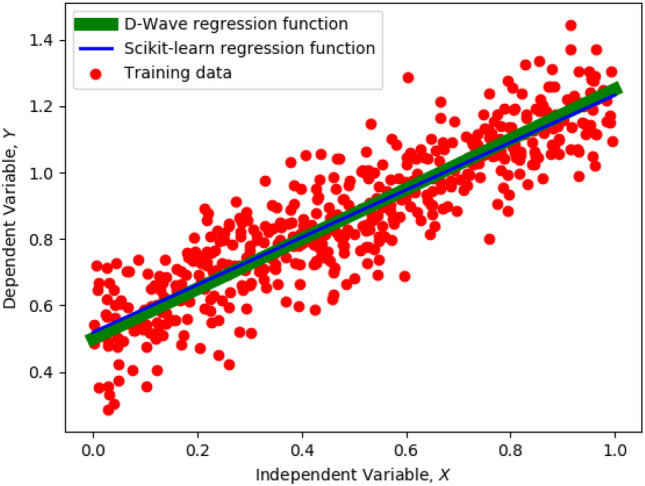
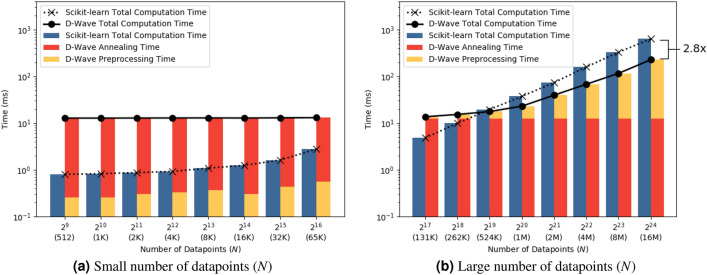
A major challenge in machine learning is the computational expense of training these models. Model training can be viewed as a form of optimization used to fit a machine learning model to a set of data, which can take up significant amount of time on classical computers. Adiabatic quantum computers have been shown to excel at solving optimization problems, and therefore, we believe, present a promising alternative to improve machine learning training times. In this paper, we present an adiabatic quantum computing approach for training a linear regression model. In order to do this, we formulate the regression problem as a quadratic unconstrained binary optimization (QUBO) problem. We analyze our quantum approach theoretically, test it on the D-Wave adiabatic quantum computer and compare its performance to a classical approach that uses the Scikit-learn library in Python. Our analysis shows that the quantum approach attains up to [Formula: see text] speedup over the classical approach on larger datasets, and performs at par with the classical approach on the regression error metric. The quantum approach used the D-Wave 2000Q adiabatic quantum computer, whereas the classical approach used a desktop workstation with an 8-core Intel i9 processor. As such, the results obtained in this work must be interpreted within the context of the specific hardware and software implementations of these machines.
机器学习中的一个主要挑战是训练这些模型的计算成本。模型训练可以看作是一种优化形式,用于使机器学习模型拟合一组数据,这在传统计算机上可能会花费大量时间。绝热量子计算机已被证明在解决优化问题方面表现出色,因此,我们认为它是缩短机器学习训练时间的一种有前途的替代方案。在本文中,我们提出了一种用于训练线性回归模型的绝热量子计算方法。为此,我们将回归问题表述为一个二次无约束二进制优化(QUBO)问题。我们从理论上分析了我们的量子方法,在D-Wave绝热量子计算机上对其进行了测试,并将其性能与使用Python中的Scikit-learn库的经典方法进行了比较。我们的分析表明,在更大的数据集上,量子方法比经典方法实现了高达[公式:见正文]的加速,并且在回归误差指标上与经典方法表现相当。量子方法使用了D-Wave 2000Q绝热量子计算机,而经典方法使用了配备8核英特尔i9处理器的台式工作站。因此,在解释这项工作中获得的结果时,必须结合这些机器的特定硬件和软件实现的背景来进行。