Zhang Bo, Wu Hao, Zhang Cancan, Wan Lin, Yang Guang
Department of Neurology, Boston Children's Hospital, Harvard Medical School, Boston, MA, USA.
Department of Statistics, University of Georgia, Athens, GA, USA.
Neurol Ther. 2024 Dec;13(6):1685-1700. doi: 10.1007/s40120-024-00665-y. Epub 2024 Oct 5.
Autism spectrum disorder (ASD) poses a significant challenge due to its diverse impact on individuals, emphasizing the need for personalized treatment plans. The financial burden of ASD-related healthcare is substantial, necessitating a comprehensive understanding of its prevalence and evolving trends.
This study aims to analyze the prevalence and trends of ASD, treatment patterns, gender differences, and racial-ethnic disparities in the United States from 2017 to 2020, utilizing nationally representative data from the National Survey of Children's Health (NSCH). The NSCH, a leading annual national survey, provided rich data on child health. A total of 108,142 participants aged 3-17 years were included, with ASD prevalence assessed based on self-reported diagnoses.
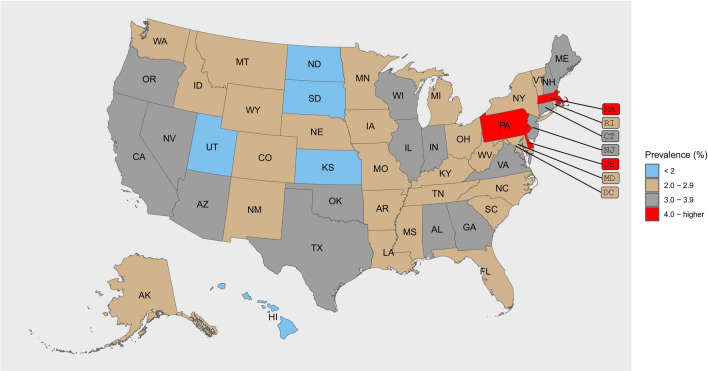
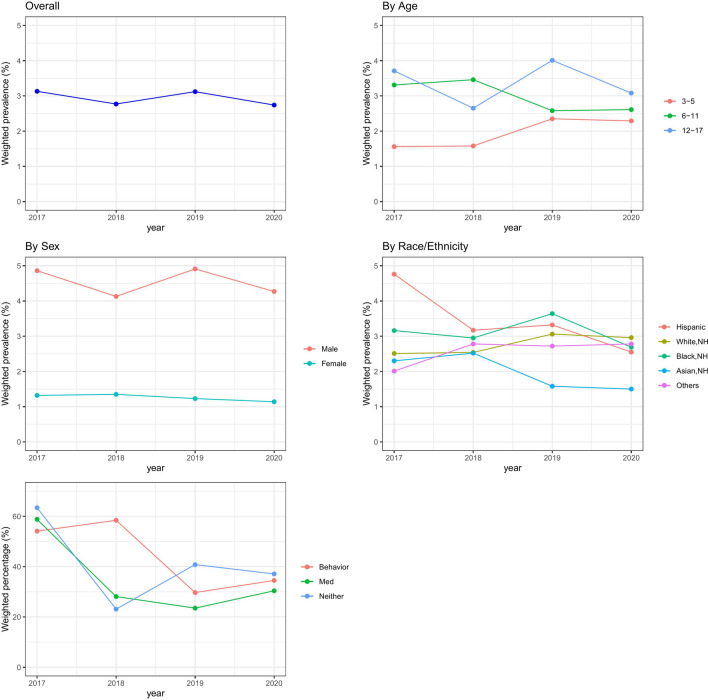
Between 2017 and 2020, ASD prevalence in children aged 3-17 was 2.94% (95% confidence interval: 2.68-3.18). Significant disparities were observed: older age and male gender correlated with higher prevalence, while family income-to-poverty ratio and insurance coverage influenced prevalence. Racial/ethnic disparities existed, with Hispanics showing the highest prevalence. Treatment trends showed stability overall, but age influenced behavioral and medication interventions. The prevalence remained stable from 2017 to 2020, with variations in age groups and a significant increase among non-Hispanic Whites.
This study highlights a higher but stable overall ASD prevalence, with nuanced disparities among different demographic groups. Gender differences persist, emphasizing the need for tailored interventions. Racial-ethnic disparities call for targeted healthcare strategies. The stability in treatment trends underscores the persistent challenge of addressing core ASD symptoms.
自闭症谱系障碍(ASD)因其对个体的多样化影响而构成重大挑战,这凸显了制定个性化治疗方案的必要性。与ASD相关的医疗保健的经济负担相当大,因此有必要全面了解其患病率和演变趋势。
本研究旨在利用来自全国儿童健康调查(NSCH)的具有全国代表性的数据,分析2017年至2020年美国ASD的患病率和趋势、治疗模式、性别差异以及种族/民族差异。NSCH是一项主要的年度全国性调查,提供了丰富的儿童健康数据。共纳入了108142名3至17岁的参与者,根据自我报告的诊断评估ASD患病率。
2017年至2020年期间,3至17岁儿童的ASD患病率为2.94%(95%置信区间:2.68 - 3.18)。观察到显著差异:年龄较大和男性患病率较高,而家庭收入与贫困比率以及保险覆盖范围影响患病率。存在种族/民族差异,西班牙裔的患病率最高。治疗趋势总体稳定,但年龄影响行为和药物干预。2017年至2020年患病率保持稳定,不同年龄组存在差异,非西班牙裔白人中有显著增加。
本研究强调总体ASD患病率较高但稳定,不同人口群体之间存在细微差异。性别差异持续存在,强调需要量身定制干预措施。种族/民族差异要求采取有针对性的医疗保健策略。治疗趋势的稳定性凸显了应对ASD核心症状这一持续存在的挑战。