Department of Pediatrics, Ain-Shams University, Cairo, Egypt.
Department of Clinical Pathology, Faculty of Medicine, Ain-Shams University, Cairo, Egypt.
Int J Immunopathol Pharmacol. 2024 Jan-Dec;38:3946320241291276. doi: 10.1177/03946320241291276.
One of the most common long-term neurological disorders affecting children is epilepsy. Even with effective antiseizure medications, one-third of epileptic patients develop drug-resistant epilepsy (DRE). Numerous treatments have been offered to these DRE patients, though with varying degrees of effectiveness.
This study aimed to evaluate the effectiveness of probiotics in improving the quality of life (QoL) and lowering the severity and frequency of epileptic episodes in DRE patients. As well as to assess the anti-inflammatory effects of probiotics.
DRE patients were daily supplemented with one probiotic for 4 months. During these 4 months, patients continued their routine anti-epileptics with no change in the doses. Before and following the 4-month trial, patients had their QoL evaluated using the validated Arabic version of QoL in epilepsy-31 inventory (QoLIE-31) questionnaire, an electroencephalogram (EEG) examination, and serum soluble CD14 (sCD14) evaluation by ELISA.
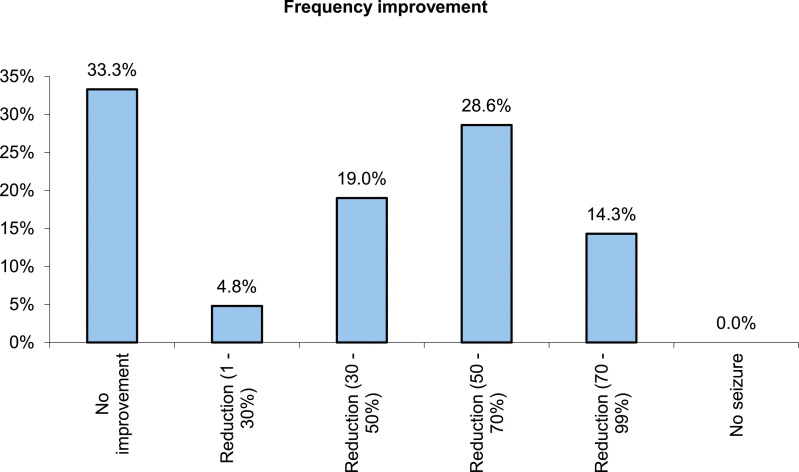
Of the 21 DRE patients who completed the study, 42.9% achieved the therapeutic goal, which was a ≥50% reduction in seizures. After probiotic, there was a significant increase in time elapsed since the last seizure ( = 0.001) and a decrease in seizure duration ( = 0.038), frequency ( = 0.002), and severity by Chalfont Seizure Severity Score ( < 0.001), as compared to pre-probiotic data. Moreover, there was a significant decrease in serum levels of sCD14 ( < 0.001) and a significant improvement in QoL ( < 0.05).
Probiotics may be used as a DRE adjuvant treatment. They can lessen the number and severity of seizures, alleviate the associated inflammation, and enhance the QoL for DRE patients.
影响儿童的最常见长期神经障碍之一是癫痫。即使使用有效的抗癫痫药物,仍有三分之一的癫痫患者发展为难治性癫痫(DRE)。这些 DRE 患者接受了各种治疗方法,但效果不一。
本研究旨在评估益生菌在改善生活质量(QoL)、降低 DRE 患者癫痫发作的严重程度和频率方面的有效性。并评估益生菌的抗炎作用。
DRE 患者每天补充一种益生菌,持续 4 个月。在这 4 个月期间,患者继续常规使用抗癫痫药物,剂量不变。在 4 个月的试验前后,患者使用经过验证的阿拉伯语版癫痫生活质量问卷(QoLIE-31)、脑电图(EEG)检查和酶联免疫吸附试验(ELISA)评估血清可溶性 CD14(sCD14)来评估他们的 QoL。
21 名完成研究的 DRE 患者中,42.9%达到了治疗目标,即癫痫发作减少≥50%。与益生菌前相比,患者最后一次癫痫发作后的时间明显延长( = 0.001),癫痫发作持续时间( = 0.038)、频率( = 0.002)和 Chalfont 癫痫严重程度评分( < 0.001)均有所下降。此外,血清 sCD14 水平显著降低( < 0.001),生活质量显著改善( < 0.05)。
益生菌可作为 DRE 的辅助治疗方法。它们可以减少癫痫发作的次数和严重程度,减轻相关炎症,并提高 DRE 患者的生活质量。