DeLang Matthew D, Ishøi Lasse, Hole Maren Nielsen, Wilson Prince, Segbefia Michael, Thorborg Kristian
Human Performance Group Right to Dream Academy.
Department of Surgery, Orthopedics Unit, Korle Bu Teaching Hospital University of Ghana Medical School.
Int J Sports Phys Ther. 2024 Oct 2;19(10):1188-1196. doi: 10.26603/001c.123510. eCollection 2024.
This study implemented the Copenhagen Adductor Exercise (CAE) and Nordic Hamstring Exercise (NHE) to examine 1) whether CAE and NHE interventions are associated with adductor and hamstring strength gains in youth African male soccer players and 2) whether strength changes after a rest period and secondary intervention.
Pre-post intervention study.
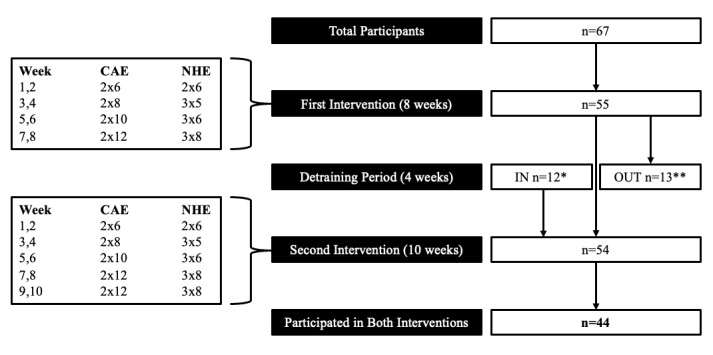
Forty-four African elite male academy players (age 14.7±1.5 [12-18] years) participated in twice weekly CAE and NHE interventions for 8- and 10-week periods separated by a 4-week rest. Long lever adductor squeeze strength and prone isometric hamstring strength were measured with mixed-effects linear regression models to observe strength changes over time.
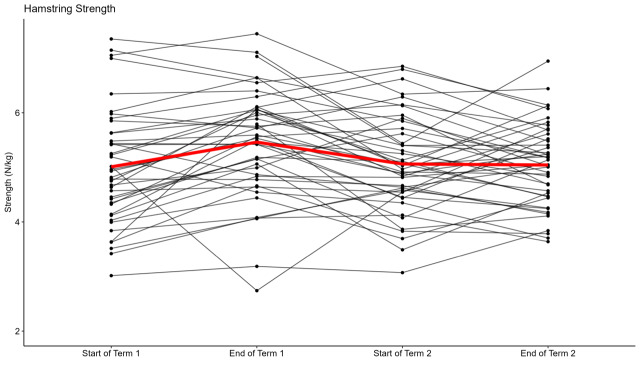
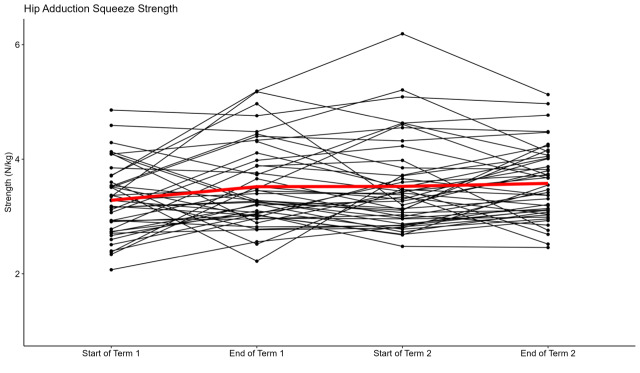
Ninety-six and 95% of CAE and NHE sessions were completed in each intervention, with no adverse events related to the execution of the exercises. Adductor squeeze strength increased during the first intervention (baseline 3.23 [2.99-3.47] N/kg, post-intervention 3.53 [3.30-3.76] N/kg, p=0.911) and was maintained following the rest period (3.52 [3.27-3.76] N/kg, p=0.999) and second intervention (3.60 [3.35-3.84] N/kg, p=0.002). Hamstring strength improved during the first intervention (baseline 4.95 [4.42-5.49] N/kg, post-intervention 5.48 [4.95-6.02] N/kg, p<0.001), decreased to baseline during the rest period (4.98 [4.44-5.53] N/kg, p=0.996), and did not improve during the second intervention (5.01 [4.46-5.55] N/kg, p=0.978).
CAE and NHE interventions can be implemented at an elite African academy with high compliance. Adductor and hamstring strength improved in the first intervention, with no further improvements in the second intervention. Secondary interventions therefore should include higher exercise volume or load to improve longitudinal adductor and hamstring strength.
Level III (Cohort Study).
本研究实施了哥本哈根内收肌练习(CAE)和北欧腿筋练习(NHE),以检验:1)CAE和NHE干预是否与非洲青年男性足球运动员的内收肌和腿筋力量增加有关;2)休息期和二次干预后的力量变化情况。
干预前后研究。
44名非洲精英男子足球学院球员(年龄14.7±1.5[12 - 18]岁)参加了每周两次的CAE和NHE干预,为期8周和10周,中间间隔4周休息期。使用混合效应线性回归模型测量长杠杆内收肌挤压力量和俯卧位等长腿筋力量,以观察力量随时间的变化。
每次干预中,CAE和NHE课程的完成率分别为96%和95%,且未发生与练习执行相关的不良事件。第一次干预期间内收肌挤压力量增加(基线3.23[2.99 - 3.47]N/kg,干预后3.53[3.30 - 3.76]N/kg,p = 0.911),休息期后保持稳定(3.52[3.27 - 3.76]N/kg,p = 0.999),二次干预后进一步增加(3.60[3.35 - 3.84]N/kg,p = 0.002)。腿筋力量在第一次干预期间有所改善(基线4.95[4.42 - 5.49]N/kg,干预后5.48[4.95 - 6.02]N/kg,p<0.001),休息期降至基线水平(4.98[4.44 - 5.53]N/kg,p = 0.996),二次干预期间未改善(5.01[4.46 - 5.55]N/kg,p = 0.978)。
CAE和NHE干预可在非洲精英足球学院以高依从性实施。第一次干预中内收肌和腿筋力量有所改善,二次干预中未进一步改善。因此,二次干预应包括增加运动量或负荷,以提高内收肌和腿筋的纵向力量。
III级(队列研究)。