Department of Surgical Sciences, Section of Transplantation Surgery, Uppsala University, Uppsala, Sweden.
Division of Clinical Epidemiology, Department of Medicine, Solna, Karolinska Institutet (KI), Stockholm, Sweden.
Transpl Int. 2024 Sep 20;37:13173. doi: 10.3389/ti.2024.13173. eCollection 2024.
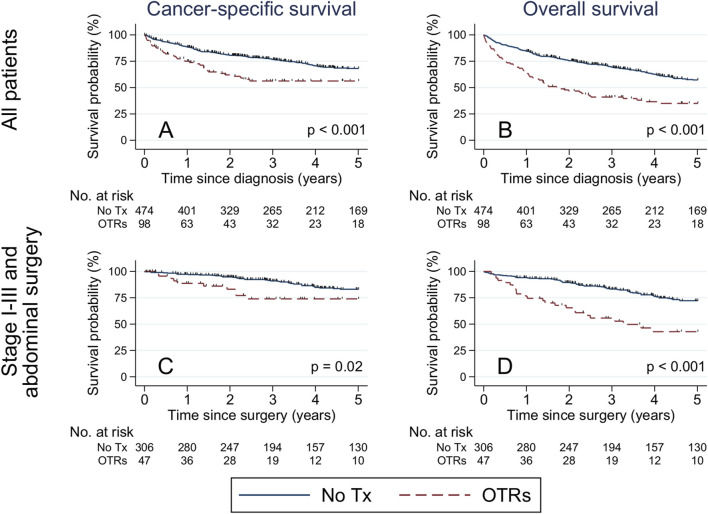
Previous solid organ transplantation has been associated with worse survival among colorectal cancer (CRC) patients. This study investigates the contribution of CRC characteristics and treatment-related factors to the differential survival. Using the Swedish register-linkage CRCBaSe, all patients with solid organ transplantation before CRC diagnosis were identified and matched with non-transplanted CRC patients. Associations between transplantation history and clinical CRC factors and survival were estimated using the Kaplan-Meier estimator and logistic, multinomial, and Cox regression, respectively. Ninety-eight transplanted and 474 non-transplanted CRC patients were followed for 5 years after diagnosis. Among patients with stage I-III cancer, transplanted patients had lower odds of treatment with abdominal surgery [odds ratio (OR):0.27, 95% confidence interval (CI):0.08-0.90], than non-transplanted patients. Among those treated with surgery, transplanted colon cancer patients had lower odds of receiving adjuvant chemotherapy (OR:0.31, 95% CI:0.11-0.85), and transplanted rectal cancer patients had higher rate of relapse (hazard ratio:9.60, 95% CI:1.84-50.1), than non-transplanted patients. Five-year cancer-specific and overall survival was 56% and 35% among transplanted CRC patients, and 68% and 57% among non-transplanted. Accordingly, transplanted CRC patients were treated less intensely than non-transplanted patients, and had worse cancer-specific and overall survival. These patients might benefit from multidisciplinary evaluation including transplantation specialists.
先前的实体器官移植与结直肠癌(CRC)患者的生存率较差有关。本研究调查了 CRC 特征和治疗相关因素对差异生存的贡献。使用瑞典登记链接 CRCBaSe,确定了所有在 CRC 诊断前接受过实体器官移植的患者,并与未接受移植的 CRC 患者进行了匹配。使用 Kaplan-Meier 估计器以及逻辑、多项和 Cox 回归分别估计了移植史与临床 CRC 因素与生存之间的关联。在诊断后 5 年内,对 98 例移植和 474 例未移植的 CRC 患者进行了随访。在 I-III 期癌症患者中,与未接受移植的患者相比,接受移植的患者接受腹部手术治疗的可能性更低[比值比(OR):0.27,95%置信区间(CI):0.08-0.90]。在接受手术治疗的患者中,移植结肠癌患者接受辅助化疗的可能性更低(OR:0.31,95% CI:0.11-0.85),而移植直肠癌患者的复发率更高(风险比:9.60,95% CI:1.84-50.1),而非接受移植的患者。移植 CRC 患者的 5 年癌症特异性和总体生存率分别为 56%和 35%,而非移植 CRC 患者分别为 68%和 57%。因此,与未接受移植的患者相比,接受移植的 CRC 患者接受的治疗强度较低,癌症特异性和总体生存率较差。这些患者可能受益于包括移植专家在内的多学科评估。