Reinders Alexis N, Koshy Matthew, Korpics Mark
Department of Radiation Oncology, University of Illinois College of Medicine at Chicago, Chicago, USA.
Department of Radiation Oncology, University of Chicago, Chicago, USA.
Cureus. 2024 Sep 6;16(9):e68820. doi: 10.7759/cureus.68820. eCollection 2024 Sep.
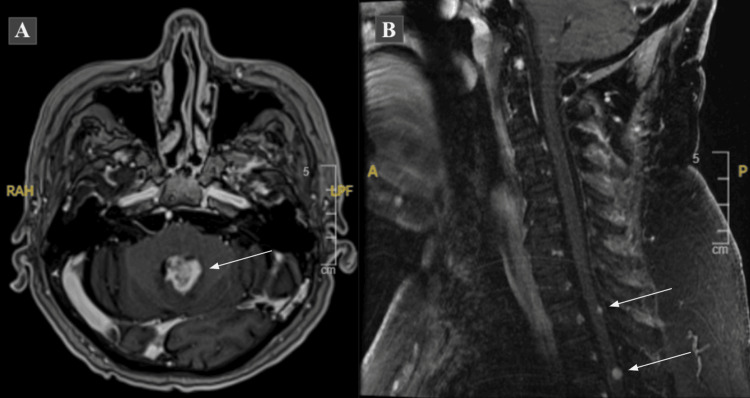
Introduction RTOG 1205 is the only randomized study to evaluate the safety and efficacy of reirradiation (reRT) in recurrent glioblastoma (GBM). While this study showed that reRT was safe and improves progression-free survival (PFS), an improved approach to reRT is still needed. In this study, we report on patterns of failure and outcomes in a cohort of patients with recurrent GBM who underwent reRT. We hypothesize that patients at high risk of leptomeningeal spread (LMS) are not good candidates for reRT due to the risk of treatment-related toxicity without clinical benefit. Methods In this retrospective study, patients with recurrent GBM who underwent reRT at a single institution from 2015-2023 were included. Sociodemographic, treatment, and outcomes data were collected via chart review. Time to progression was defined as the time from the start of reRT to progression per the Response Assessment in Neuro-Oncology (RANO) criteria. Overall survival (OS) was defined as the time from the start of reRT to death. PFS and OS were estimated using the Kaplan-Meier method. Results Thirteen patients with recurrent GBM who underwent reRT were identified. The median age at diagnosis was 58 years. Six patients (46.2%) had tumors that were O-methylguanine-DNA methyltransferase (MGMT) methylated, four (30.8%) were MGMT unmethylated, and three (23.11%) had unknown MGMT status. Eight patients underwent repeat resection after recurrence and before reRT. Most patients (n=7) received 35 Gy in 10 fractions with concurrent bevacizumab, while other patients were treated with 25-40 Gy in 5-15 fractions with grade 1 or less acute toxicity. Three patients were treated with tumor-treating fields. The median follow-up was five months. Median PFS was three months [95% confidence interval (95% CI): one to four months] and median OS was five months (95% CI, 1-8 months) as compared to 7.1 months and 10.1 months, respectively, on RTOG 1205. Five patients developed LMS after reRT, one patient died before progression, and the remaining seven patients all developed progression within one centimeter of the recurrent tumor. Of the patients who developed LMS, all had tumors abutting the ventricles and three underwent resection 2-17 months before reRT. Conclusion Patterns of failure suggest a potential treatment selection approach for patients with recurrent GBM, in which patients at high risk of LMS (tumor abutting ventricles with or without recent surgery) should not undergo reRT, while patients at low risk of LMS are good candidates for reRT. Furthermore, reRT could be administered with reduced margins given that all non-LMS recurrences were within 1cm of the original tumor. Additional studies are needed to validate this approach.
RTOG 1205是唯一一项评估复发性胶质母细胞瘤(GBM)再程放疗(reRT)安全性和疗效的随机研究。虽然该研究表明再程放疗是安全的,并能改善无进展生存期(PFS),但仍需要一种改进的再程放疗方法。在本研究中,我们报告了一组接受再程放疗的复发性GBM患者的失败模式和结局。我们假设,由于存在治疗相关毒性风险且无临床获益,软脑膜播散(LMS)高危患者不是再程放疗的合适人选。方法:在这项回顾性研究中,纳入了2015年至2023年在单一机构接受再程放疗的复发性GBM患者。通过病历审查收集社会人口统计学、治疗和结局数据。疾病进展时间定义为从再程放疗开始至根据神经肿瘤学反应评估(RANO)标准确定的进展时间。总生存期(OS)定义为从再程放疗开始至死亡的时间。采用Kaplan-Meier方法估计PFS和OS。结果:确定了13例接受再程放疗的复发性GBM患者。诊断时的中位年龄为58岁。6例(46.2%)患者的肿瘤为O-甲基鸟嘌呤-DNA甲基转移酶(MGMT)甲基化,4例(30.8%)为MGMT未甲基化,3例(23.11%)MGMT状态未知。8例患者在复发后且在再程放疗前接受了再次切除。大多数患者(n=7)接受了10次分割共35 Gy的放疗并联合贝伐单抗,而其他患者接受了5至15次分割25 - 40 Gy的放疗,急性毒性为1级或更低。3例患者接受了肿瘤治疗电场。中位随访时间为5个月。中位PFS为3个月[95%置信区间(95%CI):1至4个月],中位OS为5个月(95%CI,1 - 8个月),相比之下,RTOG 1205研究中的这两个指标分别为7.1个月和10.1个月。5例患者在再程放疗后发生LMS,1例患者在进展前死亡,其余7例患者均在复发肿瘤1厘米范围内发生进展。在发生LMS的患者中,所有患者的肿瘤均紧邻脑室,3例患者在再程放疗前2至17个月接受了切除。结论:失败模式为复发性GBM患者提示了一种潜在的治疗选择方法,即LMS高危患者(肿瘤紧邻脑室且有或无近期手术史)不应接受再程放疗,而LMS低危患者是再程放疗的合适人选。此外,鉴于所有非LMS复发均在原发肿瘤1厘米范围内,再程放疗可采用更小的边界。需要进一步的研究来验证这种方法。