Kinoshita Ryohei, Quint Jennifer K, Kallis Constantinos, Polkey Michael I
School of Public Health, Faculty of Medicine, Imperial College London, London, UK.
Royal Brompton Hospital, Guys and St Thomas NHS Foundation Trust, London, UK.
Sleep Adv. 2024 Sep 18;5(1):zpae069. doi: 10.1093/sleepadvances/zpae069. eCollection 2024.
Obstructive sleep apnea (OSA) can induce excessive sleepiness, causing work-related injuries and low productivity. Most individuals with OSA in the United Kingdom are undiagnosed, and thus, theoretically, workplace screening, might by identifying these individuals improve both their individual health and overall productivity. However, the prevalence of OSA in different workplaces is unclear. This study aimed to estimate the prevalence of OSA by industries and occupations in England.
The Health Survey for England 2019 dataset was combined with Sleep Heart Health Study dataset. We applied multiple imputation for the combined dataset to estimate OSA in the English population aged 40-64. We estimated the pooled prevalence of OSA by both industry and occupation by separating samples by Standard Industry Classification and Standard Occupation Classification.
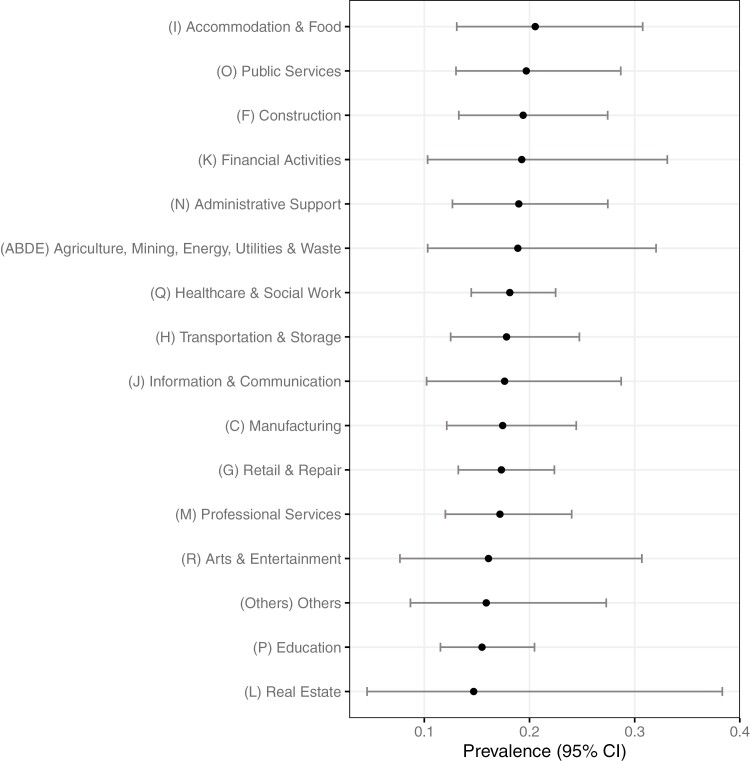
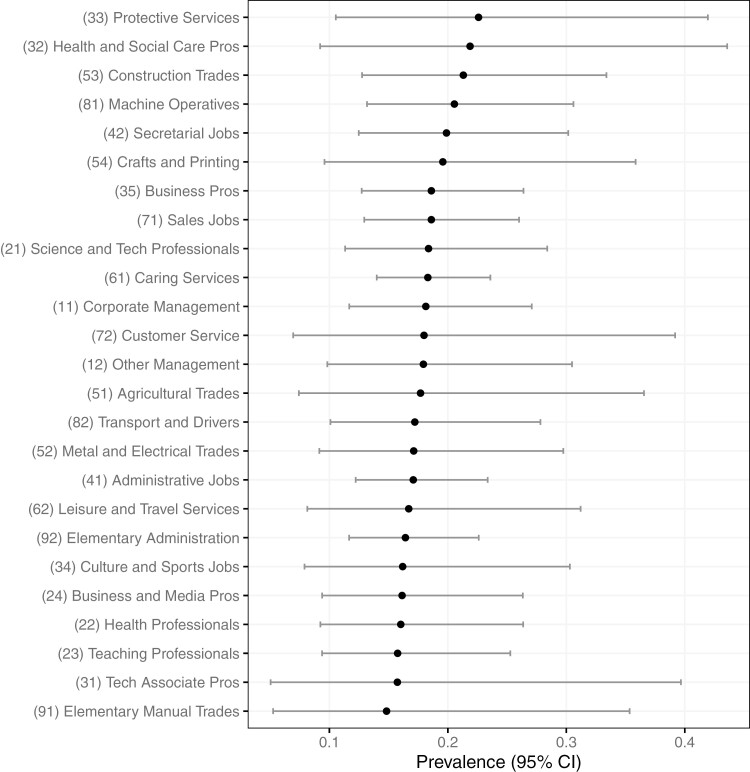
The overall OSA prevalence estimated by imputation for ages 40-64 was 17.8% (95% CI = 15.9% to 19.9%). Separating those samples into industrial/occupational groups, the estimated prevalence of OSA varied widely by industry/occupation. Descriptive analysis revealed that the estimated prevalence of OSA was relatively higher in the Accommodation and food, Public administration and defence; compulsory social security, Construction industries, and Protective service occupations, health and social care associate professionals, and skilled construction and building trades occupations.
In England in 2019, Accommodation and food, Public administration and defence; compulsory social security, Construction industries, and Protective service occupations, health and social care associate professionals, and skilled construction and building trades occupations showed a relatively higher prevalence of OSA indicating that they may be target populations for workplace screening.
阻塞性睡眠呼吸暂停(OSA)可导致过度嗜睡,引发与工作相关的伤害并降低生产力。在英国,大多数患有阻塞性睡眠呼吸暂停的人未被诊断出来,因此,从理论上讲,通过职场筛查识别出这些人可能会改善他们的个人健康状况和整体生产力。然而,不同职场中阻塞性睡眠呼吸暂停的患病率尚不清楚。本研究旨在估计英格兰各行业和职业中阻塞性睡眠呼吸暂停的患病率。
将2019年英格兰健康调查数据集与睡眠心脏健康研究数据集相结合。我们对合并后的数据集应用多重填补法来估计40 - 64岁英国人群中的阻塞性睡眠呼吸暂停情况。我们通过标准产业分类和标准职业分类对样本进行划分,从而按行业和职业估计阻塞性睡眠呼吸暂停的合并患病率。
通过填补法估计的40 - 64岁人群中阻塞性睡眠呼吸暂停的总体患病率为17.8%(95%置信区间 = 15.9%至19.9%)。将这些样本按行业/职业分组后,阻塞性睡眠呼吸暂停的估计患病率因行业/职业的不同而有很大差异。描述性分析显示,在住宿和餐饮、公共管理与国防;义务社会保障、建筑业以及防护服务职业、健康和社会关怀相关专业人员以及熟练的建筑行业职业中,阻塞性睡眠呼吸暂停的估计患病率相对较高。
2019年在英格兰,住宿和餐饮、公共管理与国防;义务社会保障、建筑业以及防护服务职业、健康和社会关怀相关专业人员以及熟练的建筑行业职业的阻塞性睡眠呼吸暂停患病率相对较高,这表明它们可能是职场筛查的目标人群。