Kwon Soonil, Suh Jangwon, Choi Eue-Keun, Kim Jimyeong, Ju Hojin, Ahn Hyo-Jeong, Kim Sunhwa, Lee So-Ryoung, Oh Seil, Rhee Wonjong
Division of Cardiology, Department of Internal Medicine, SMG-SNU Boramae Medical Center, Seoul, Republic of Korea.
Department of Intelligence and Information, Seoul National University, Seoul, Republic of Korea.
Digit Health. 2024 Sep 23;10:20552076241281200. doi: 10.1177/20552076241281200. eCollection 2024 Jan-Dec.
Obtaining tachycardia electrocardiograms (ECGs) in patients with paroxysmal supraventricular tachycardia (PSVT) is often challenging. Sinus rhythm ECGs are of limited predictive value for PSVT types in patients without preexcitation. This study aimed to explore the classification of atrioventricular nodal reentry tachycardia (AVNRT) and concealed atrioventricular reentry tachycardia (AVRT) using sinus rhythm ECGs through deep learning.
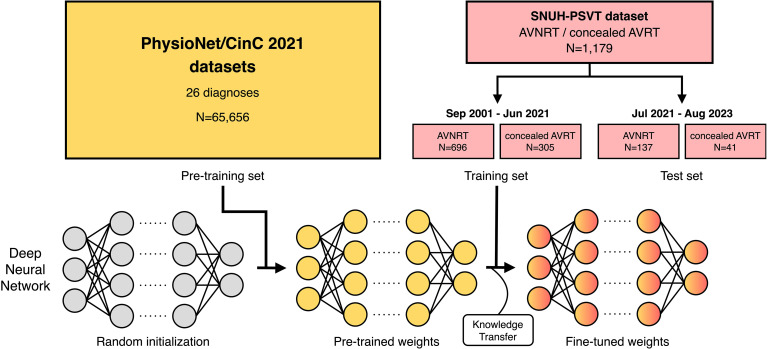
This retrospective study included patients diagnosed with either AVNRT or concealed AVRT, validated through electrophysiological studies. A modified ResNet-34 deep learning model, pre-trained on a public ECG database, was employed to classify sinus rhythm ECGs with underlying AVNRT or concealed AVRT. Various configurations were compared using ten-fold cross-validation on the training set, and the best-performing configuration was tested on the hold-out test set.
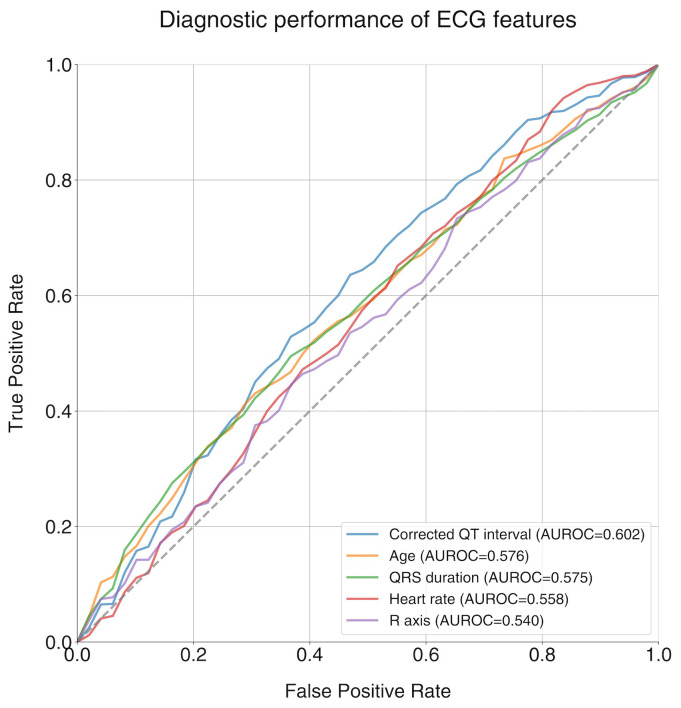
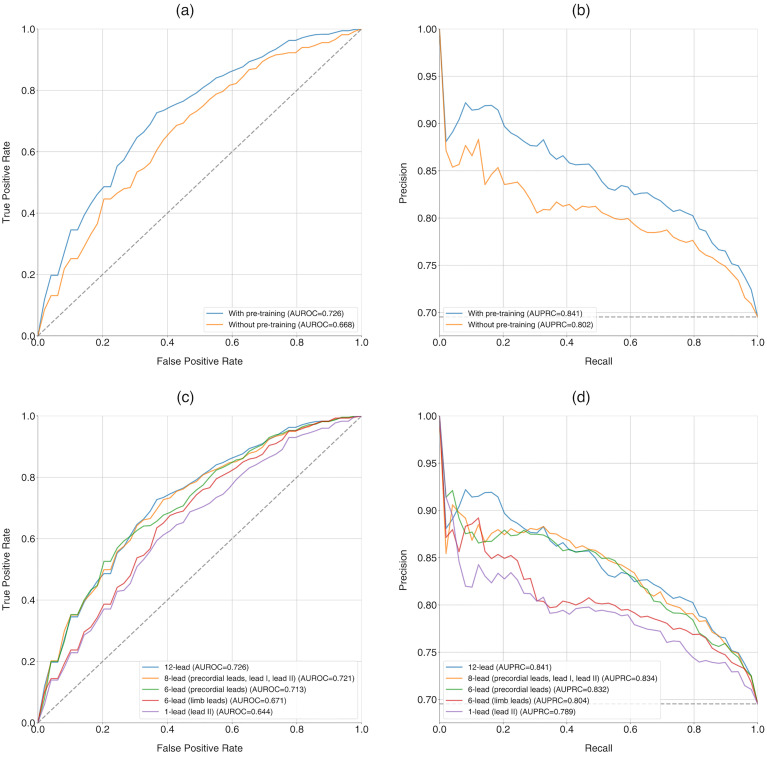
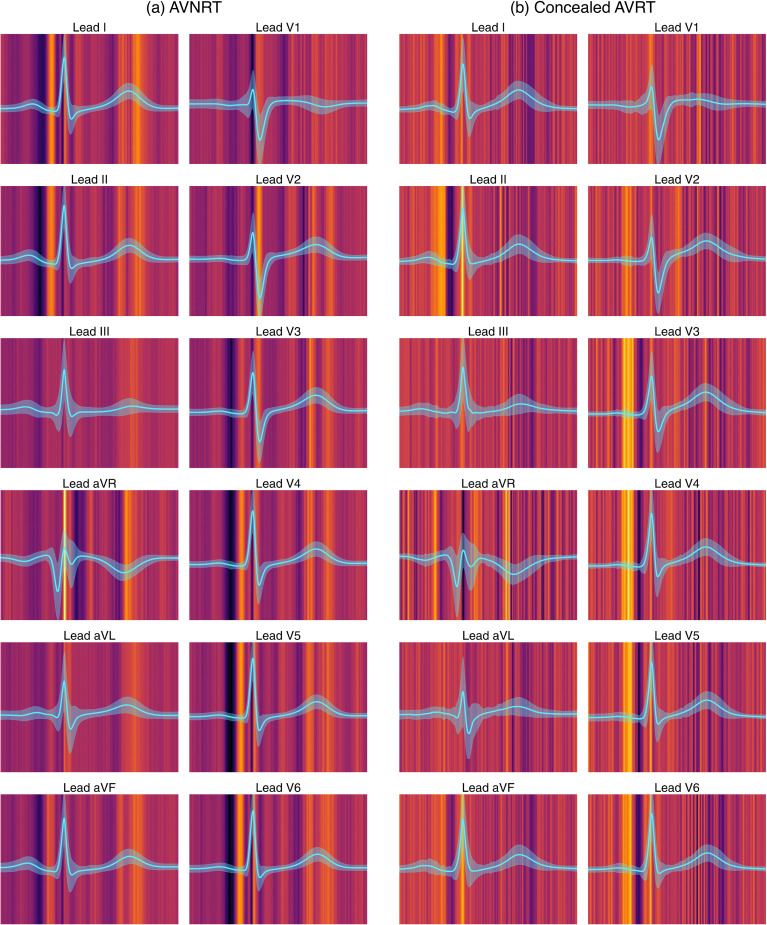
The study analyzed 833 patients with AVNRT and 346 with concealed AVRT. Among ECG features, the corrected QT intervals exhibited the highest area under the receiver operating characteristic curve (AUROC) of 0.602. The performance of the deep learning model significantly improved after pre-training, showing an AUROC of 0.726 compared to 0.668 without pre-training ( < 0.001). No significant difference was found in AUROC between 12-lead and precordial 6-lead ECGs ( = 0.265). On the test set, deep learning achieved modest performance in differentiating the two types of arrhythmias, with an AUROC of 0.708, an AUPRC of 0.875, an F1-score of 0.750, a sensitivity of 0.670, and a specificity of 0.649.
The deep-learning classification of AVNRT and concealed AVRT using sinus rhythm ECGs is feasible, indicating potential for aiding in the non-invasive diagnosis of these arrhythmias.
对阵发性室上性心动过速(PSVT)患者进行心动过速心电图(ECG)检查往往具有挑战性。在无预激的患者中,窦性心律心电图对PSVT类型的预测价值有限。本研究旨在通过深度学习探索利用窦性心律心电图对房室结折返性心动过速(AVNRT)和隐匿性房室折返性心动过速(AVRT)进行分类。
本回顾性研究纳入了经电生理检查确诊为AVNRT或隐匿性AVRT的患者。采用在公共心电图数据库上预训练的改良ResNet-34深度学习模型,对存在潜在AVNRT或隐匿性AVRT的窦性心律心电图进行分类。在训练集上使用十折交叉验证比较各种配置,并在保留测试集上测试性能最佳的配置。
该研究分析了833例AVNRT患者和346例隐匿性AVRT患者。在心电图特征中,校正QT间期在受试者操作特征曲线(AUROC)下的面积最高,为0.602。预训练后深度学习模型的性能显著提高,AUROC为0.726,而未预训练时为0.668(P<0.001)。12导联和胸前6导联心电图的AUROC无显著差异(P=0.265)。在测试集上,深度学习在区分这两种心律失常类型方面表现一般,AUROC为0.708,AUPRC为0.875,F1分数为0.750,敏感性为0.670,特异性为0.649。
利用窦性心律心电图对AVNRT和隐匿性AVRT进行深度学习分类是可行的,表明其在辅助这些心律失常的无创诊断方面具有潜力。