Sabtiu Abdul Rahim Mohammed, Hinne Isaac Amankona, Sraku Isaac Kwame, Doe Richard Tettey, Attah Simon Kwaku, Aboagye-Antwi Fred, Afrane Yaw Asare
University of Ghana.
University of Nevada.
Res Sq. 2024 Sep 20:rs.3.rs-4953028. doi: 10.21203/rs.3.rs-4953028/v1.
Malaria is more prevalent in rural areas due to fewer mosquito breeding habitats in urban settings. However, urban factors such as irrigated farming, open sewers, and discarded containers create mosquito breeding sites. This study investigates the diversity and distribution of larval habitats and the impact of physicochemical characteristics on the presence and density of s.l. larvae in Accra, Ghana.
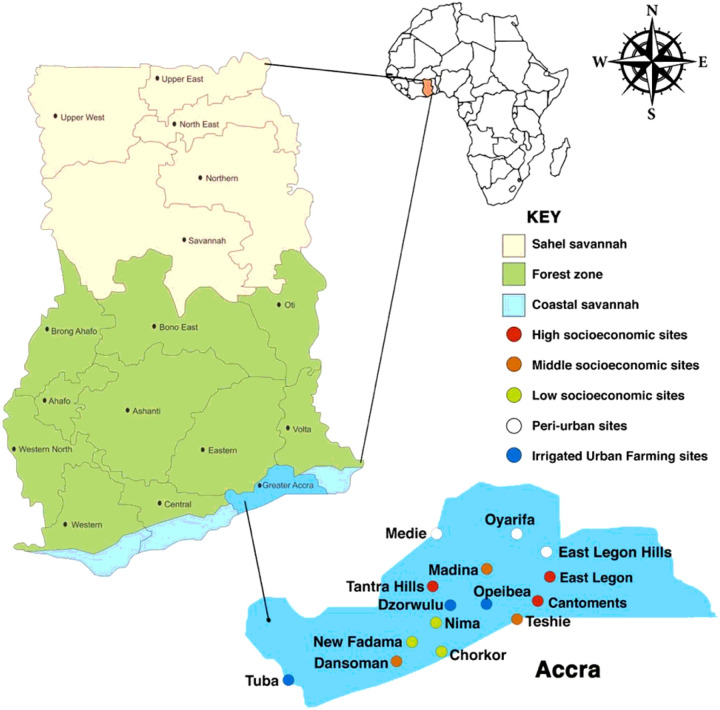
Larval surveys and collections were conducted at fifteen locations in Accra, divided into five categories: Irrigated Urban Farming (IUF), Lower Socioeconomic Status (LS), Middle Socioeconomic Status (MS), High Socioeconomic Status (HS), and Peri-urban (PU) areas. Physicochemical parameters were measured, and species identification was performed using morphological and molecular methods.
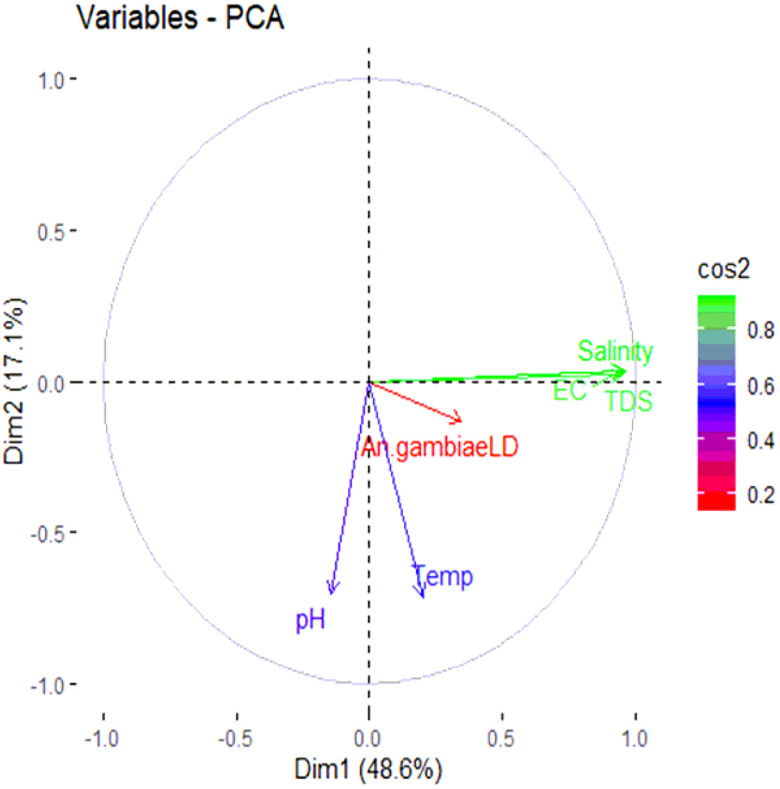
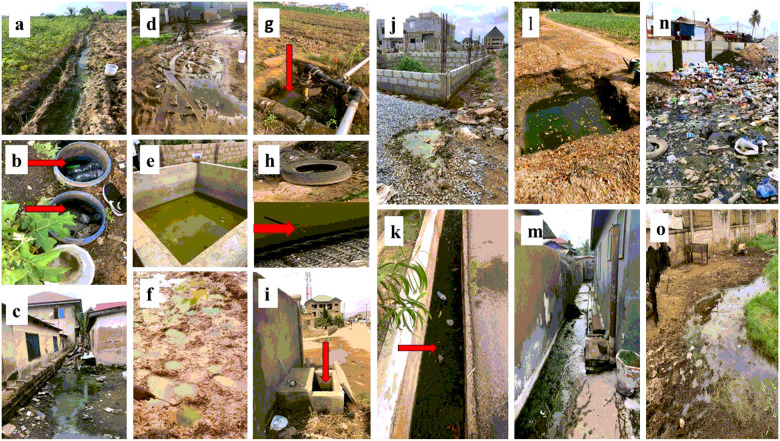
A total of 727 breeding habitats were identified, with 65.34% (475/727) positive for Anopheles larvae. Drainage ditches were the most common habitat type (48.21%, 229/475). The highest abundance of s.l. was found in IUF sites (6,244/22,919), especially during the rainy season (77.01%, 17,650/22,919; R = 3.46, P = 0.000). Polluted habitats, including household effluents, had higher ammonium levels (3.4 mg/L NH -N) compared to unpolluted ones (1.3 mg/L NH -N). Other distinguishing parameters included dissolved oxygen (34% vs 52.9%), conductivity (5106 μS/cm vs 2049 μS/cm), and total dissolved solids (3181 mg/L vs 1255 mg/L). The predominant malaria vector was (54.4%, 368/677). Additionally, the invasive previously unreported in Ghana, was detected.
Malaria vectors breed in diverse and often polluted urban habitats, with high larval densities in urban agricultural areas. The detection of the invasive highlights the need for continuous monitoring and vector control strategies in urban settings.
由于城市地区蚊虫滋生栖息地较少,疟疾在农村地区更为普遍。然而,诸如灌溉农业、露天下水道和废弃容器等城市因素会形成蚊虫滋生场所。本研究调查了加纳阿克拉幼虫栖息地的多样性和分布,以及理化特性对按蚊幼虫存在和密度的影响。
在阿克拉的15个地点进行幼虫调查和采集,分为五类:城市灌溉农业(IUF)、低社会经济地位(LS)、中等社会经济地位(MS)、高社会经济地位(HS)和城郊(PU)地区。测量理化参数,并使用形态学和分子方法进行物种鉴定。
共识别出727个滋生栖息地,其中65.34%(475/727)的按蚊幼虫呈阳性。排水沟是最常见的栖息地类型(48.21%,229/475)。在城市灌溉农业地区发现按蚊幼虫的丰度最高(6244/22919),尤其是在雨季(77.01%,17650/22919;R = 3.46,P = 0.000)。与未受污染的栖息地(1.3 mg/L NH₃-N)相比,包括家庭污水在内的受污染栖息地铵含量更高(3.4 mg/L NH₃-N)。其他显著参数包括溶解氧(34%对52.9%)、电导率(5106 μS/cm对2049 μS/cm)和总溶解固体(3181 mg/L对1255 mg/L)。主要的疟疾传播媒介是(54.4%,368/677)。此外,还检测到了在加纳此前未报告过的入侵物种。
疟疾传播媒介在多样且常受污染的城市栖息地繁殖,城市农业地区幼虫密度很高。入侵物种的检测凸显了在城市环境中持续监测和媒介控制策略的必要性。