
加纳不同生态区幼虫栖息地多样性与疟蚊物种分布
Larval habitat diversity and Anopheles mosquito species distribution in different ecological zones in Ghana.
机构信息
Department of Medical Microbiology, University of Ghana Medical School, University of Ghana, Korle-Bu, Accra, Ghana.
Department of Epidemiology, Noguchi Memorial Institute of Medical Research, College of Health Sciences, University of Ghana, Legon, Ghana.
出版信息
Parasit Vectors. 2021 Apr 7;14(1):193. doi: 10.1186/s13071-021-04701-w.
BACKGROUND
Understanding the ecology of larval malaria and lymphatic filariasis mosquitoes in a changing environment is important in developing effective control tools or programmes. This study characterized the breeding habitats of Anopheles mosquitoes in rural communities in different ecological zones in Ghana during the dry and rainy seasons.
METHODS
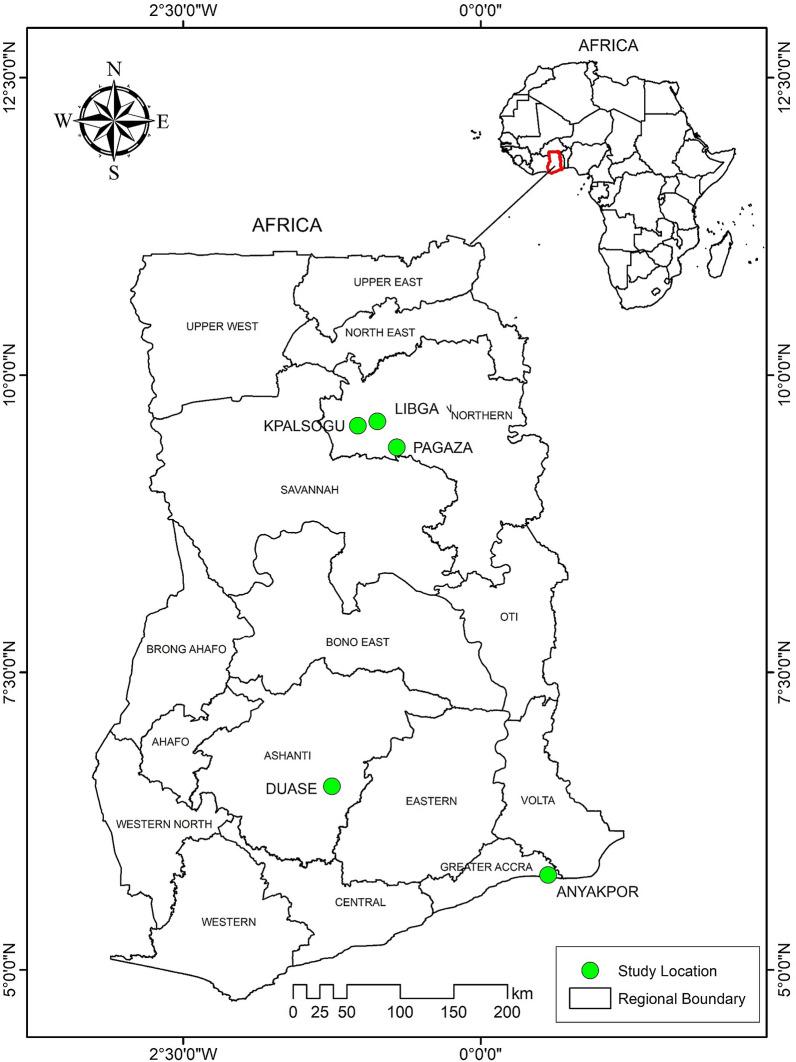
The spatio-temporal distribution, species composition, and abundance of larval Anopheles mosquitoes in breeding habitats were studied in five locations in three ecological zones of Ghana. These were Anyakpor (coastal savannah area), Duase (forest area), and Libga, Pagaza, and Kpalsogu (Sahel savannah area). Larvae were collected using standard dippers and were raised in the insectary for identification.
RESULTS
Out of a total of 7984 mosquito larvae collected, 2152 (27.26%) were anophelines and were more abundant in the rainy season (70.82%) than in the dry season (29.18%). The anophelines comprised 2128 (98.88%) An. gambiae s.l., 16 (0.74%) An. rufipes, and 8 (0.37%) An. pharoensis. In the coastal savannah and forest zones, dug-out wells were the most productive habitat during the dry (1.59 larvae/dip and 1.47 larvae/dip) and rainy seasons (11.28 larvae/dip and 2.05 larvae/dip). Swamps and furrows were the most productive habitats in the Sahel savannah zone during the dry (0.25 larvae/dip) and rainy (2.14 larvae/dip) seasons, respectively. Anopheles coluzzii was the most abundant sibling species in all the ecological zones. Anopheles melas and An. arabiensis were encountered only in the coastal savannah and the Sahel savannah areas, respectively. Larval habitat types influenced the presence of larvae as well as larval density (p < 0.001). The land-use type affected the presence of Anopheles larvae (p = 0.001), while vegetation cover influenced larval density (p < 0.05).
CONCLUSION
The most productive habitats were dug-out wells in the coastal savannah and forest zones, and furrows from irrigated canals in the Sahel savannah zone. Anopheles coluzzii was the predominant vector species in all the ecological zones. The abundance of Anopheles breeding habitats and larvae were influenced by anthropogenic activities. Encouraging people whose activities create the larval habitats to become involved in larval source management such as habitat manipulation to stop mosquito breeding will be important for malaria and lymphatic filariasis control.
背景
了解幼虫疟疾和淋巴丝虫病蚊子在变化环境中的生态是开发有效控制工具或计划的重要组成部分。本研究在加纳的三个生态区的五个地点描述了在旱季和雨季中农村社区中疟蚊的滋生地。
方法
在加纳的三个生态区的五个地点研究了幼虫疟蚊在滋生地的时空分布、物种组成和丰度。这些地点是 Anyakpor(沿海热带稀树草原区)、Duase(森林区)以及 Libga、Pagaza 和 Kpalsogu(萨赫勒热带稀树草原区)。使用标准的舀水器收集幼虫,并在昆虫室中进行鉴定。
结果
在总共收集的 7984 只蚊子幼虫中,2152 只(27.26%)为疟蚊,在雨季(70.82%)比在旱季(29.18%)更为丰富。疟蚊包括 2128 只(98.88%)冈比亚按蚊 s.l.、16 只(0.74%)红带按蚊和 8 只(0.37%)斑氏按蚊。在沿海热带稀树草原区和森林区,旱季(每勺 1.59 条幼虫和每勺 1.47 条幼虫)和雨季(每勺 11.28 条幼虫和每勺 2.05 条幼虫),挖出的水井是最具生产力的栖息地。在萨赫勒热带稀树草原区,旱季(每勺 0.25 条幼虫)和雨季(每勺 2.14 条幼虫),沼泽和沟渠是最具生产力的栖息地。在所有生态区中,斑氏按蚊是最丰富的亲缘种。在沿海热带稀树草原区和萨赫勒热带稀树草原区,分别发现了疟蚊和阿蚊。幼虫滋生地类型以及幼虫密度均影响幼虫的存在(p < 0.001)。土地利用类型影响疟蚊幼虫的存在(p = 0.001),而植被覆盖影响幼虫密度(p < 0.05)。
结论
在沿海热带稀树草原区和森林区,最具生产力的栖息地是挖出的水井,而在萨赫勒热带稀树草原区,最具生产力的栖息地是灌溉渠的沟渠。在所有生态区中,斑氏按蚊都是主要的传播媒介。疟蚊滋生地和幼虫的丰度受到人为活动的影响。鼓励那些创造幼虫栖息地的活动的人参与幼虫源管理,例如栖息地操纵以阻止蚊子滋生,这对疟疾和淋巴丝虫病的控制非常重要。

 Zotero 插件