Department of Health Management, The Second Hospital of Hebei Medical University, Shijiazhuang, China.
Department of Human Resource management, The Second Hospital of Hebei Medical University, Shijiazhuang, China.
PLoS One. 2024 Oct 7;19(10):e0311491. doi: 10.1371/journal.pone.0311491. eCollection 2024.
Reducing exposure to risk factors and screening represent 2 major approaches to gastric cancer (GC) prevention, but public knowledge GC risk factors and screening behaviour remain unknown. We aimed to investigate public awareness of GC risk factors, adherence to screening, and barriers hindering screening practices in China.
This community-based household survey was conducted within Shijiazhuang, China, and 1490 residents were recruited through a multistage stratified cluster random sampling approach. A self-administered questionnaire was completed which consisted of three sections: demographics, awareness of GC risk factors, and personal screening behaviours. Factors associated with knowledge of risk factors and screening behaviours were evaluated using binary logistic regression analysis.
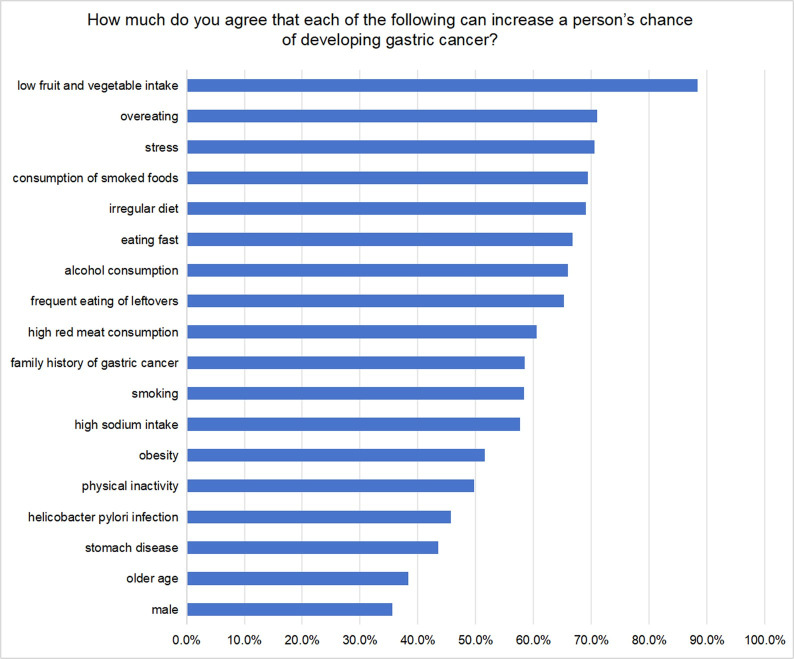
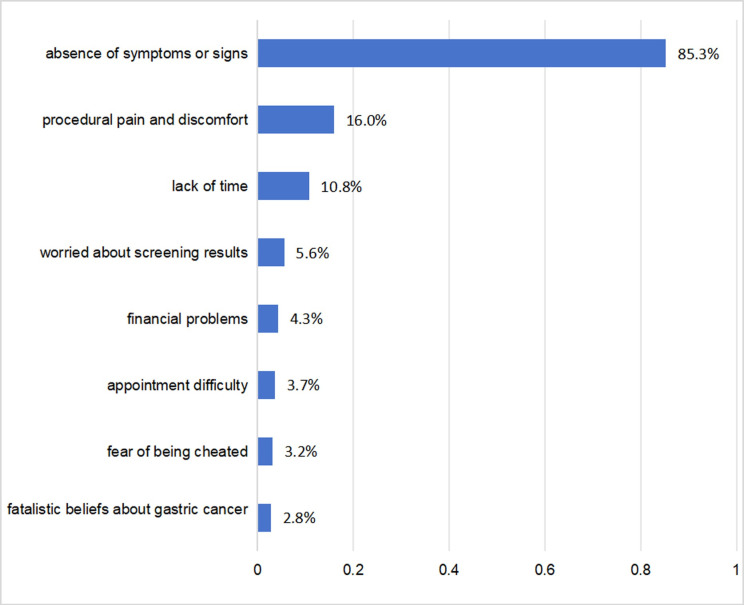
The mean risk factor awareness score of 12 (7, 15) revealed insufficient knowledge in 51.1% of participants. Dietary lifestyle factors were better understood than physical activity and weight-related factors. Marital status (OR 1.967; 95% CI 1.415 to 2.734), higher income (OR 1.197; 95% CI 1.010 to 1.418), and a history of upper gastrointestinal problems (OR 0.048; 95% CI 1.002 to 1.311) were associated with higher awareness. Merely 21.5% underwent GC screening, with higher rates linked to older age (OR 1.642; 95% CI 1.418 to 1.902), higher education (OR 1.398; 95% CI 1.176 to 1.662), a history of upper gastrointestinal problems (OR 3.842; 95% CI 2.833 to 5.209), and moderate (OR 2.077; 95% CI 1.352 to 3.191) and high (OR 2.529; 95% CI 1.311 to 4.878) perceived GC risk. Notably, participants commonly refused gastroscopy due to the absence of symptoms or signs.
In Shijiazhuang, more than half of participants demonstrated inadequate knowledge of GC risk factors, and screening participation rates were remarkably low. This emphasizes the need for targeted interventions to enhance GC awareness and significantly improve screening rates.
降低胃癌(GC)的风险因素暴露和筛查是预防胃癌的两种主要方法,但公众对胃癌风险因素和筛查行为的了解仍不清楚。本研究旨在调查中国公众对 GC 风险因素的认识、对筛查的依从性以及阻碍筛查实践的障碍。
本研究采用基于社区的家庭调查,在中国石家庄市招募了 1490 名居民,采用多阶段分层聚类随机抽样方法。通过自填式问卷完成调查,问卷分为三部分:人口统计学、GC 风险因素认知和个人筛查行为。采用二项逻辑回归分析评估与风险因素认知和筛查行为相关的因素。
12(7,15)分的平均风险因素知晓得分表明,51.1%的参与者知识不足。饮食生活方式因素的认知优于体力活动和体重相关因素。婚姻状况(OR 1.967;95%CI 1.415 至 2.734)、较高收入(OR 1.197;95%CI 1.010 至 1.418)和上消化道问题史(OR 0.048;95%CI 1.002 至 1.311)与更高的知晓率相关。仅有 21.5%的人接受了 GC 筛查,较高的筛查率与年龄较大(OR 1.642;95%CI 1.418 至 1.902)、较高的教育程度(OR 1.398;95%CI 1.176 至 1.662)、上消化道问题史(OR 3.842;95%CI 2.833 至 5.209)、中危(OR 2.077;95%CI 1.352 至 3.191)和高危(OR 2.529;95%CI 1.311 至 4.878)的 GC 风险感知相关。值得注意的是,参与者因无症状或体征而普遍拒绝进行胃镜检查。
在石家庄市,超过一半的参与者对 GC 风险因素的认识不足,筛查参与率极低。这表明需要采取有针对性的干预措施来提高 GC 意识,并显著提高筛查率。