Nomura Motoo, Yamaguchi Toshifumi, Chin Keisho, Hato Shinji, Kato Ken, Baba Eishi, Matsubara Hisahiro, Mukaida Hidenori, Yoshii Takako, Tsuda Masahiro, Tsubosa Yasuhiro, Kitagawa Yuko, Oze Isao, Ishikawa Hideki, Muto Manabu
Department of Clinical Oncology, Kyoto University Hospital, Kyoto, Japan.
Department of Head and Neck Oncology and Innovative Treatment, Graduate School of Medicine, Kyoto University, Kyoto, Japan.
Ann Surg Oncol. 2025 Jan;32(1):302-311. doi: 10.1245/s10434-024-16325-2. Epub 2024 Oct 7.
Neoadjuvant chemotherapy followed by surgery (NAC-S) is the standard therapy for locally advanced esophageal squamous cell carcinoma (ESCC) in Japan.
The aim of this phase II trial was to assess the efficacy and safety of the addition of adjuvant S-1 after R0 resection in ESCC patients who received NAC-S.
Key eligibility criteria included clinical stage IB-III (without T4 disease) ESCC, age 20-75 years, and an Eastern Cooperative Oncology Group (ECOG) performance status of 0 or 1. Patients received adjuvant therapy with four cycles of S-1 (80 mg/m/day) administered orally for 4 weeks of 6-week cycles. The primary endpoint was 3 year relapse-free survival (RFS). If the lower confidence limit for 3 year RFS was >50%, we judged that the primary endpoint of this study was met.
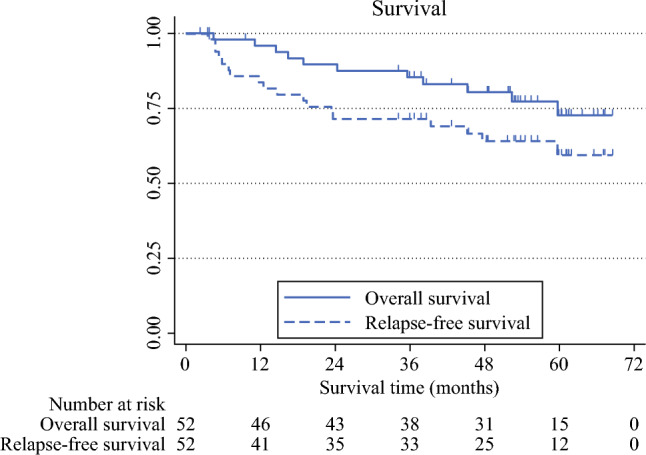
A total of 52 patients were enrolled between January 2016 and January 2019. Two patients were excluded from analysis; five patients were determined to have R1 or R2 resection, and seven patients did not receive adjuvant S-1. The 3-year RFS and overall survival rates in the intention-to-treat population were 72.3% (90% confidence interval [CI] 59.9-81.5) and 85.0% (90% CI 73.9-91.6), indicating that the primary endpoint was met. Grade ≥3 adverse events with an incidence ≥10% included neutropenia (13.2%), anorexia (13.2%), and diarrhea (10.5%). There were no treatment-related deaths.
Adjuvant S-1 after NAC-S showed promising efficacy with a manageable safety profile for patients with resectable ESCC and warrants further evaluation in larger studies.
新辅助化疗后手术(NAC-S)是日本局部晚期食管鳞状细胞癌(ESCC)的标准治疗方法。
本II期试验的目的是评估在接受NAC-S的ESCC患者中,R0切除术后加用辅助性S-1的疗效和安全性。
主要入选标准包括临床分期为IB-III期(无T4期疾病)的ESCC、年龄20-75岁、东部肿瘤协作组(ECOG)体能状态为0或1。患者接受辅助治疗,口服S-1(80mg/m²/天),每6周为一个周期,共4周,进行4个周期。主要终点是3年无复发生存期(RFS)。如果3年RFS的下限置信区间>50%,则判定本研究的主要终点达到。
2016年1月至2019年1月共纳入52例患者。2例患者被排除在分析之外;5例患者被判定为R1或R2切除,7例患者未接受辅助性S-1治疗。意向性分析人群的3年RFS率和总生存率分别为72.3%(90%置信区间[CI]59.9-81.5)和85.0%(90%CI 73.9-91.6),表明达到了主要终点。发生率≥10%的≥3级不良事件包括中性粒细胞减少(13.2%)、厌食(13.2%)和腹泻(10.5%)。没有与治疗相关的死亡。
NAC-S后辅助性S-1对可切除的ESCC患者显示出有前景的疗效,安全性可控,值得在更大规模的研究中进一步评估。