Department of Neurology, Harbin 242 Hospital, Harbin, Heilongjiang, China.
Department of Neurology, Xuanwu Hospital, Capital Medical University, Beijing, China.
Front Immunol. 2024 Sep 23;15:1414653. doi: 10.3389/fimmu.2024.1414653. eCollection 2024.
Previous studies have shown that gut microbiota dysbiosis could affect clinical prognosis through an unknown mechanism. However, the causal relationship between the gut microbiota and the functional outcome after ischemic stroke remains unclear. We aimed to investigate the causal association between the gut microbiota and the functional outcome after ischemic stroke using Mendelian randomization (MR).
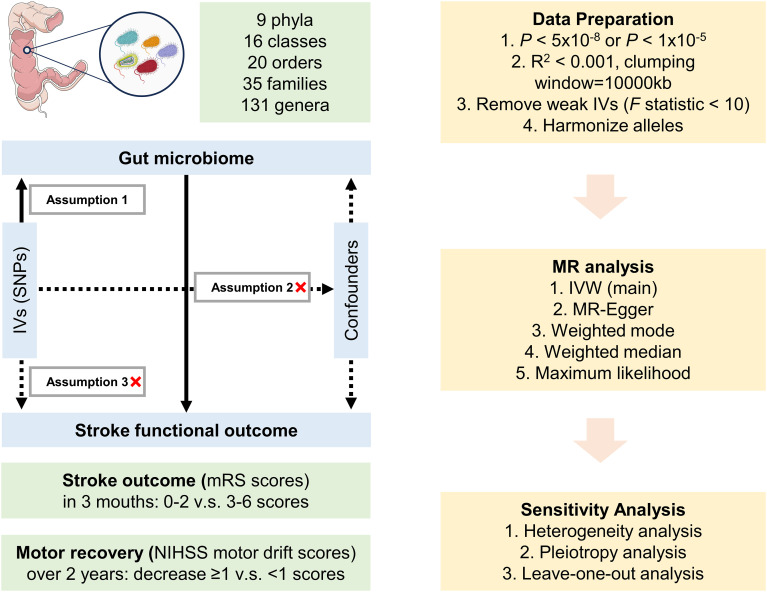
Genetic instrumental variables associated with 211 bacterial traits were obtained from the MiBioGen consortium ( = 18,340). Data from genome-wide association studies (GWAS) for functional outcome after ischemic stroke were obtained from two phenotypes (i.e., overall stroke outcome and motor recovery). The inverse variance weighted method was used to estimate the causal association. Enrichment analysis was conducted based on the results of the MR analyses.
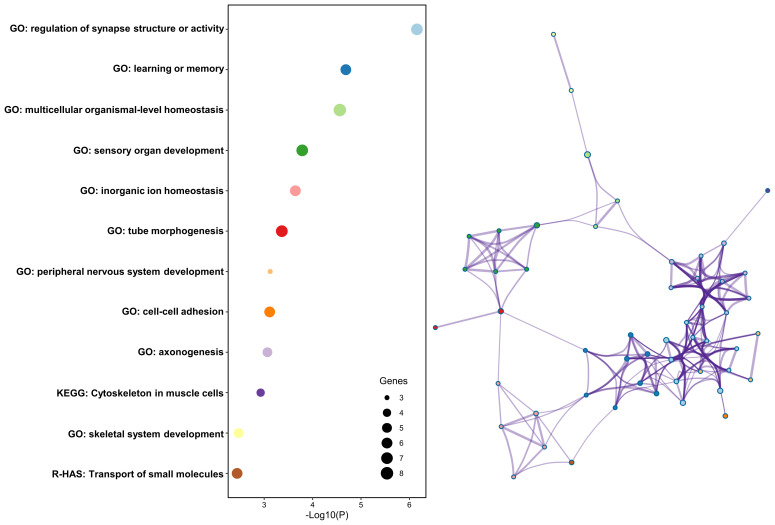
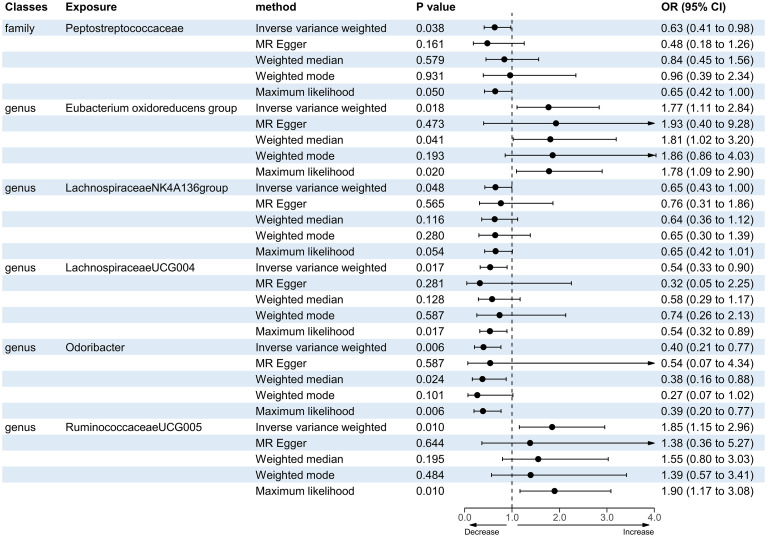
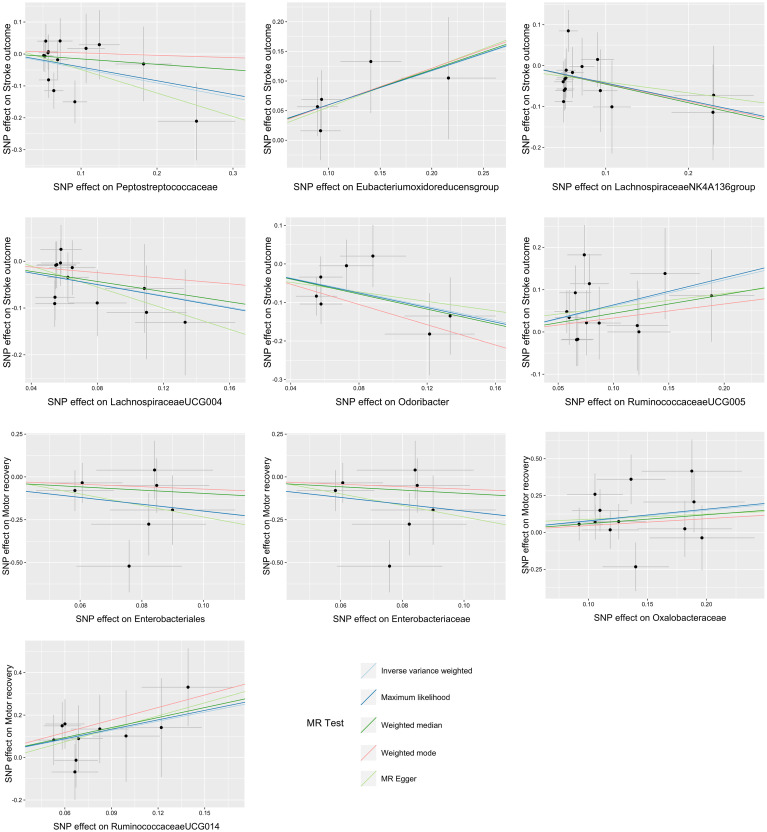
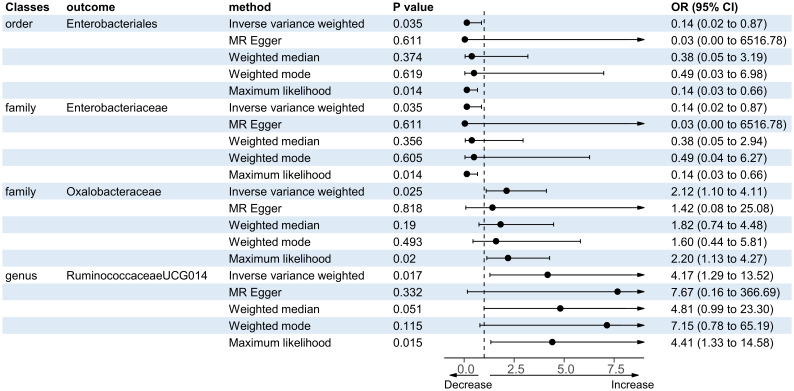
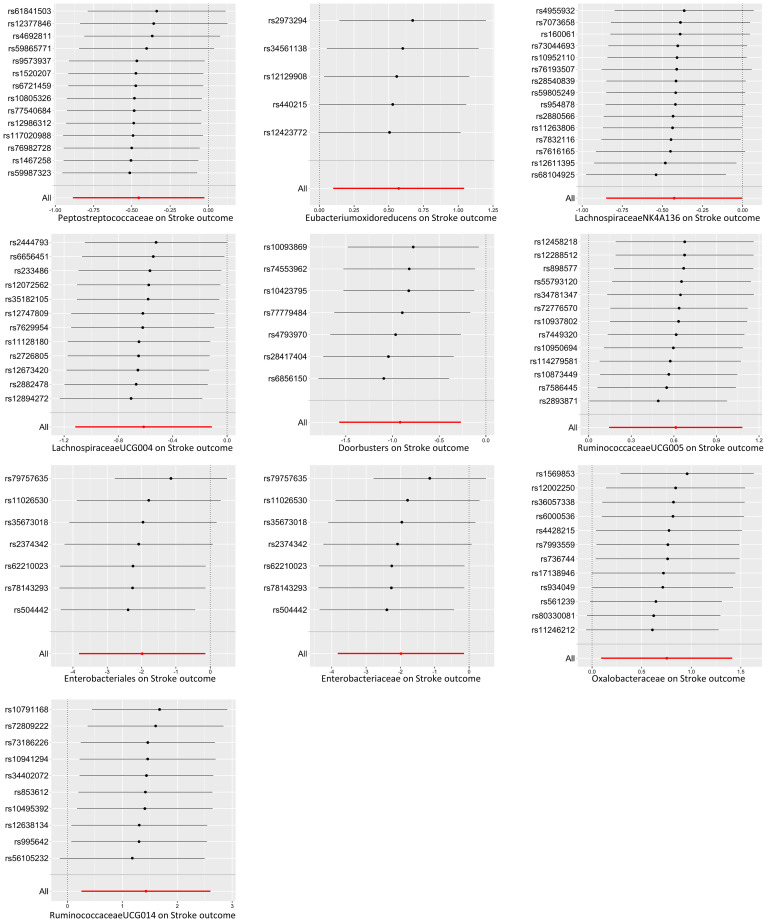
The genetically predicted family Peptostreptococcaceae (OR = 0.63, 95% CI = 0.41-0.98, = 0.038) and the genera (OR = 0.65, 95% CI = 0.43-1.00, = 0.048), (OR = 0.54, 95% CI = 0.33-0.90, = 0.017), and (OR = 0.40, 95% CI = 0.21-0.77, = 0.006) presented a suggestive association with favorable functional outcome, while the genera (OR = 1.77, 95% CI = 1.11-2.84, = 0.018) and (OR = 1.85, 95% CI = 1.15-2.96, = 0.010) were associated with unfavorable functional outcome. The genetically predicted family Oxalobacteraceae (OR = 2.12, 95% CI = 1.10-4.11, = 0.025) and the genus (OR = 4.17, 95% CI = 1.29-13.52, = 0.017) showed a suggestive association with motor recovery, while the order Enterobacteriales (OR = 0.14, 95% CI = 0.02-0.87, = 0.035) and the family Enterobacteriaceae (OR = 0.14, 95% CI = 0.02-0.87, = 0.035) were associated with motor weakness. Enrichment analysis revealed that regulation of the synapse structure or activity may be involved in the effect of the gut microbiota on the functional outcome after ischemic stroke.
This study provides genetic support that the gut microbiota, especially those associated with short-chain fatty acids, could affect stroke prognosis by mediating synapse function. Our findings suggest that modifying the composition of the gut microbiota could improve the prognosis of ischemic stroke.
先前的研究表明,肠道微生物群落失调可能通过未知机制影响临床预后。然而,肠道微生物群与缺血性卒中后功能结局之间的因果关系仍不清楚。我们旨在使用孟德尔随机化(MR)研究肠道微生物群与缺血性卒中后功能结局之间的因果关系。
从 MiBioGen 联盟获得与 211 种细菌特征相关的遗传工具变量(n=18340)。从两种表型(即整体卒中结局和运动恢复)的全基因组关联研究(GWAS)中获取缺血性卒中后功能结局的遗传预测数据。采用逆方差加权法估计因果关系。基于 MR 分析结果进行富集分析。
遗传预测的家族 Peptostreptococcaceae(OR=0.63,95%CI=0.41-0.98,P=0.038)和属(OR=0.65,95%CI=0.43-1.00,P=0.048)、(OR=0.54,95%CI=0.33-0.90,P=0.017)和(OR=0.40,95%CI=0.21-0.77,P=0.006)与良好的功能结局呈显著相关,而属(OR=1.77,95%CI=1.11-2.84,P=0.018)和(OR=1.85,95%CI=1.15-2.96,P=0.010)与不良的功能结局相关。遗传预测的家族 Oxalobacteraceae(OR=2.12,95%CI=1.10-4.11,P=0.025)和属(OR=4.17,95%CI=1.29-13.52,P=0.017)与运动恢复呈显著相关,而目 Enterobacteriales(OR=0.14,95%CI=0.02-0.87,P=0.035)和科 Enterobacteriaceae(OR=0.14,95%CI=0.02-0.87,P=0.035)与运动无力相关。富集分析表明,突触结构或活动的调节可能参与了肠道微生物群对缺血性卒中后功能结局的影响。
本研究提供了遗传证据,表明肠道微生物群,特别是与短链脂肪酸相关的肠道微生物群,可能通过调节突触功能影响卒中预后。我们的研究结果表明,改变肠道微生物群的组成可能改善缺血性卒中的预后。