Xie Huijia, Chen Jiaxin, Chen Qionglei, Zhao Yiting, Liu Jiaming, Sun Jing, Hu Xuezhen
Department of Geriatrics, The Second Affiliated Hospital and Yuying Children's Hospital of Wenzhou Medical University, Wenzhou 325027, China.
Department of Preventive Medicine, School of Public Health and Management, Wenzhou Medical University, Wenzhou 325035, China.
Diagnostics (Basel). 2023 Sep 17;13(18):2970. doi: 10.3390/diagnostics13182970.
Gut microbiota have been associated with many psychiatric disorders. However, the changes in the composition of gut microbiota in patients with post-stroke sleep disorders (PSSDs) remain unclear. Here, we determined the gut microbial signature of PSSD patients.
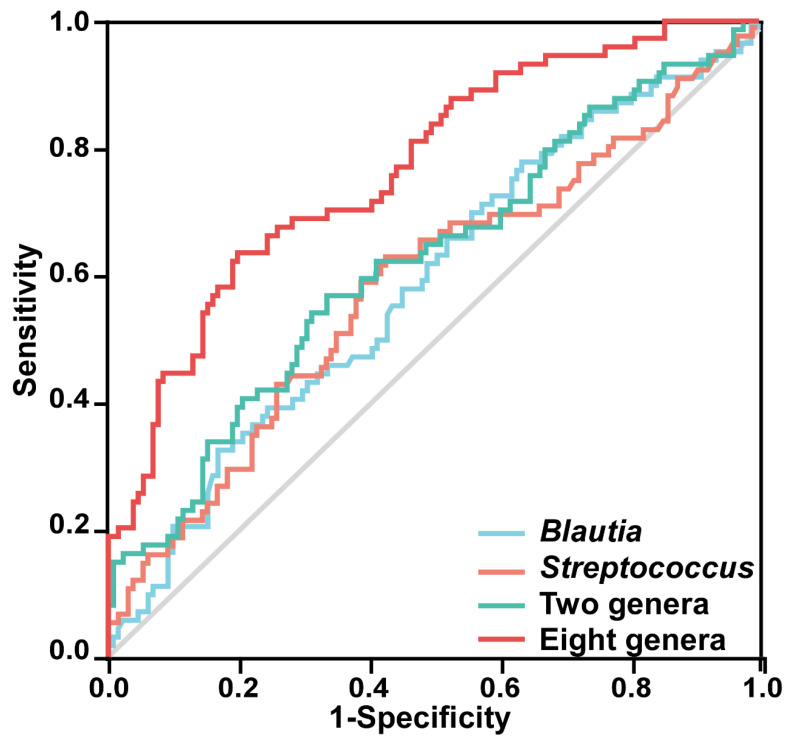
Fecal samples of 205 patients with ischemic stroke were collected within 24 h of admission and were further analyzed using 16 s RNA gene sequencing followed by bioinformatic analysis. The diversity, community composition, and differential microbes of gut microbiota were assessed. The outcome of sleep disorders was determined by the Pittsburgh Sleep Quality Index (PSQI) at 3 months after admission. The diagnostic performance of microbial characteristics in predicting PSSDs was assessed by receiver operating characteristic (ROC) curves.
Our results showed that the composition and structure of microbiota in patients with PSSDs were different from those without sleep disorders (PSNSDs). Moreover, the linear discriminant analysis effect size (LEfSe) showed significant differences in gut-associated bacteria, such as species of , , , , and . We further managed to identify the optimal microbiota signature and revealed that the predictive model with eight operational-taxonomic-unit-based biomarkers achieved a high accuracy in PSSD prediction (AUC = 0.768). and were considered to be the key microbiome signatures for patients with PSSD.
These findings indicated that a specific gut microbial signature was an important predictor of PSSDs, which highlighted the potential of microbiota as a promising biomarker for detecting PSSD patients.
肠道微生物群与多种精神疾病有关。然而,中风后睡眠障碍(PSSD)患者肠道微生物群组成的变化仍不清楚。在此,我们确定了PSSD患者的肠道微生物特征。
收集205例缺血性中风患者入院后24小时内的粪便样本,采用16s RNA基因测序及生物信息学分析进一步分析。评估肠道微生物群的多样性、群落组成和差异微生物。睡眠障碍的结果通过入院后3个月的匹兹堡睡眠质量指数(PSQI)确定。通过受试者工作特征(ROC)曲线评估微生物特征预测PSSD的诊断性能。
我们的结果表明,PSSD患者的微生物群组成和结构与无睡眠障碍(PSNSD)的患者不同。此外,线性判别分析效应大小(LEfSe)显示肠道相关细菌存在显著差异,如 、 、 、 、 和 的物种。我们进一步确定了最佳微生物群特征,并发现基于八个操作分类单元的生物标志物的预测模型在PSSD预测中具有较高的准确性(AUC = 0.768)。 和 被认为是PSSD患者的关键微生物组特征。
这些发现表明,特定的肠道微生物特征是PSSD的重要预测指标,这突出了微生物群作为检测PSSD患者的有前景生物标志物的潜力。