Li Xiongxiong, Wang Yanchi, Xu Jinlong, Yang Qitian, Sha Yuzhu, Jiao Ting, Zhao Shengguo
College of Animal Science and Technology, Gansu Agricultural University, Lanzhou, 730070, China.
College of Grassland Science, Key Laboratory of Grassland Ecosystem, Gansu Agricultural University, Lanzhou, 730070, China.
Curr Res Food Sci. 2024 Sep 11;9:100845. doi: 10.1016/j.crfs.2024.100845. eCollection 2024.
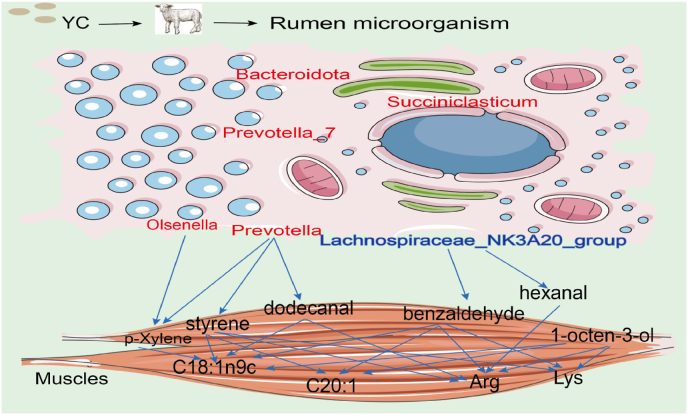
Since the banning of antibiotics, the use of feed additives to improve meat quality to satisfy people's pursuit of high quality has become a research hotspot. Yeast culture (YC) is rich in proteins, mannan oligosaccharides, peptides, and yeast cell metabolites, etc., and its use as a feed additive has a positive impact on improving meat quality. So the study aimed to provide a theoretical basis for YC improving mutton flavor and quality by detecting and analyzing the effects of YC on muscle physicochemical properties, amino acids, fatty acids, flavor composition, expression of related genes, and rumen microbiota of lambs. A total of 20 crossbred F1 weaned lambs (Australian white sheep♂ × Hu sheep♀; average 23.38 ± 1.17 kg) were randomly assigned to 2 groups, the control group (CON) and the 1.0% YC supplemented group (YC) (n = 10), and were reared in separate pens. The experiment had a pre-feeding period of 10 d and a treatment period of 60 d. After the experiment, 6 lambs in each group were randomly selected for slaughtering. The results showed that dietary YC supplementation increased rumen total VFA and acetate concentrations ( < 0.05), and muscle carcass fat (GR), a∗ value, intramuscular fat (IMF), lysine (Lys), arginine (Arg), nonessential amino acid (NEAA), oleic acid (C18:1n9c), and eicosanoic acid (C20:1) contents were significantly increased ( < 0.05), while cooking loss and γ-linolenic acid (C18: 3n6) were decreased ( < 0.05). Furthermore, we found that dietary YC improved the types of flavor compounds, and the key flavor substances such as hexanal, nonanal, styrene, benzaldehyde, p-xylene, and 1-octen-3-ol contents were changed ( < 0.05). Additionally, the expression of fat metabolism related genes , , and were increased. Adding 1% YC to lamb diets increased profits by 47.70 CNY per sheep after 60 d of fattening. All of which indicated that YC could improve meat quality, especially flavor, which may be related to the regulation of the relative abundance of rumen microorganisms , , and .
自抗生素被禁用以来,使用饲料添加剂来改善肉质以满足人们对高品质的追求已成为一个研究热点。酵母培养物(YC)富含蛋白质、甘露寡糖、肽和酵母细胞代谢产物等,将其用作饲料添加剂对改善肉质有积极影响。因此,本研究旨在通过检测和分析YC对羔羊肌肉理化性质、氨基酸、脂肪酸、风味成分、相关基因表达及瘤胃微生物群的影响,为YC改善羊肉风味和品质提供理论依据。选取20只杂交F1代断奶羔羊(澳洲白羊♂×湖羊♀;平均体重23.38±1.17 kg),随机分为2组,即对照组(CON)和1.0% YC添加组(YC)(n = 10),分别在单独的栏舍中饲养。试验预饲期为10 d,处理期为60 d。试验结束后,每组随机选取6只羔羊进行屠宰。结果表明,日粮中添加YC可提高瘤胃总挥发性脂肪酸(VFA)和乙酸盐浓度(P<0.05),肌肉胴体脂肪(GR)、a*值、肌内脂肪(IMF)、赖氨酸(Lys)、精氨酸(Arg)、非必需氨基酸(NEAA)、油酸(C18:1n9c)和二十碳烯酸(C20:1)含量显著增加(P<0.05),而蒸煮损失和γ-亚麻酸(C18:3n6)含量降低(P<0.05)。此外,我们发现日粮中添加YC改善了风味化合物的种类,己醛、壬醛、苯乙烯、苯甲醛、对二甲苯和1-辛烯-3-醇等关键风味物质的含量发生了变化(P<0.05)。此外,脂肪代谢相关基因 、 和 的表达增加。育肥60 d后,在羔羊日粮中添加1% YC可使每只羊的利润增加47.70元。所有这些表明,YC可改善肉质,尤其是风味,这可能与瘤胃微生物 、 、 和 的相对丰度调节有关。