Arruda Igor Falco, Millar Patricia Riddell, Balaro Mário Felipe Alvarez, Bonifácio Thamires Francisco, Ramos Raissa Cristina Ferreira, Amendoeira Maria Regina Reis
Toxoplasmosis and Other Protozoan Diseases Laboratory, Oswaldo Cruz Institute-Fiocruz, Rio de Janeiro, Brazil.
Microbiology and Parasitology Department, Biomedical Institute-Fluminense Federal University, Niterói, Brazil.
J Parasitol Res. 2024 Jun 26;2024:6895089. doi: 10.1155/2024/6895089. eCollection 2024.
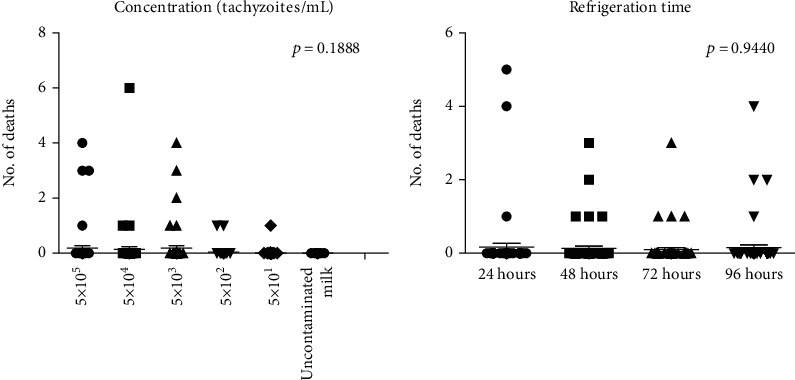
is a zoonotic parasite with global distribution capable of infecting homeothermic animals. Transmission of protozoan to humans includes ingestion of water and raw food contaminated with sporulated oocysts, ingestion of raw or undercooked meat with tissue cysts, and tachyzoites' transplacental transmission. Fresh goat milk intake has already been linked to human toxoplasmosis outbreaks, but little is known about the infectious potential of this biological sample. Accordingly, the aim of the present study is to assess the survival and infectivity of tachyzoites in fresh goat milk samples through an experimental protocol to detect this parasite via bioassay carried out with a murine model, DNA amplification, and serology. Swiss Webster mice were inoculated with fresh goat milk samples contaminated with different RH strain tachyzoite concentrations per milliliter and stored for different refrigeration times. Animals showing clinical signs compatible to toxoplasmosis were euthanized. Milk samples contaminated with high parasitic loads and kept for a shorter refrigeration time were the most lethal ones. No significant differences were observed between mean death rates recorded for different goat milk contamination concentrations ( = 0.1888), and for the refrigeration time, contaminated milk samples were kept under ( = 0.9440). DNA was amplified in all contaminated milk samples, but only one of the surviving mice was serologically positive. Results of the present study have shown survival and infectivity in fresh goat milk samples, and it highlights its significant risk for public health. Therefore, molecular methods must be the tests of choice when milk samples are used to assess infection caused by protozoan in goats' dairy products.
是一种具有全球分布的人畜共患寄生虫,能够感染恒温动物。原生动物向人类的传播途径包括摄入被孢子化卵囊污染的水和生食、摄入带有组织包囊的生肉或未煮熟的肉,以及速殖子的胎盘传播。摄入新鲜山羊奶已与人类弓形虫病暴发有关,但对这种生物样本的感染潜力知之甚少。因此,本研究的目的是通过一项实验方案,利用小鼠模型、DNA扩增和血清学检测这种寄生虫,来评估新鲜山羊奶样本中速殖子的存活和感染性。将瑞士韦伯斯特小鼠接种每毫升含有不同RH株速殖子浓度的新鲜山羊奶样本,并在不同的冷藏时间下保存。出现与弓形虫病相符临床症状的动物实施安乐死。寄生虫负荷高且冷藏时间短的牛奶样本致死性最强。不同山羊奶污染浓度的平均死亡率之间未观察到显著差异(=0.1888),对于冷藏时间,污染的牛奶样本保存时间之间也未观察到显著差异(=0.9440)。所有污染的牛奶样本中均扩增出DNA,但仅一只存活小鼠血清学呈阳性。本研究结果表明新鲜山羊奶样本中存在速殖子存活和感染性,突出了其对公共卫生的重大风险。因此,当使用牛奶样本评估山羊乳制品中原生动物引起的感染时,分子方法必须是首选检测方法。