Université Lille, CHRU Lille, 42 Rue Paul Duez, Lille, France.
Karolinska University Hospital, Akademiska stråket 13, G4:04, 17176, Stockholm, Sweden.
Am J Clin Dermatol. 2024 Nov;25(6):987-996. doi: 10.1007/s40257-024-00885-w. Epub 2024 Oct 8.
The phase III KEYNOTE-913 study was conducted to evaluate the efficacy and safety of pembrolizumab as first-line therapy in patients with advanced Merkel cell carcinoma (MCC).
The aim was to report results from the primary analysis of KEYNOTE-913.
Patients with recurrent locally advanced or metastatic MCC received pembrolizumab 200 mg intravenously every 3 weeks for up to 35 treatments (~ 2 years). The primary end point was objective response rate (ORR) per Response Evaluation Criteria in Solid Tumors, version 1.1 (RECIST v1.1) by blinded independent central review (BICR). Secondary end points were duration of response (DOR) and progression-free survival (PFS) per RECIST v1.1 by BICR, overall survival (OS), and safety and tolerability.
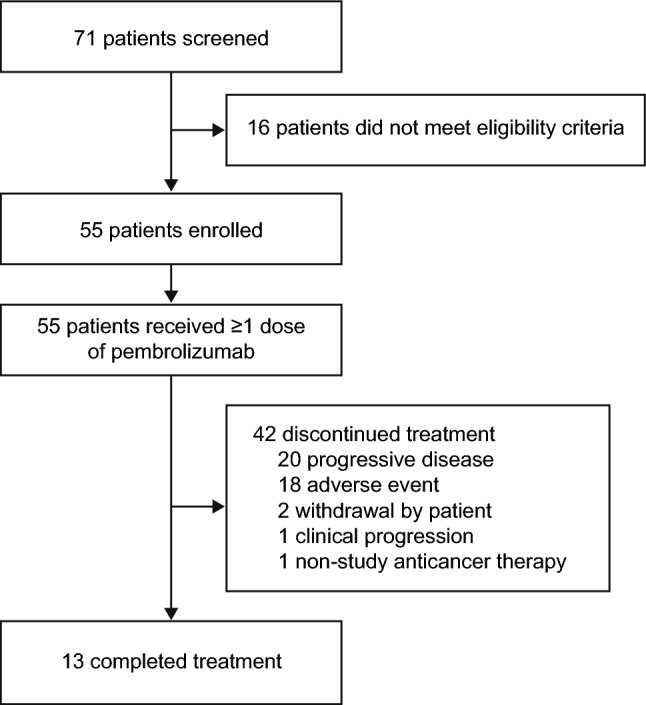
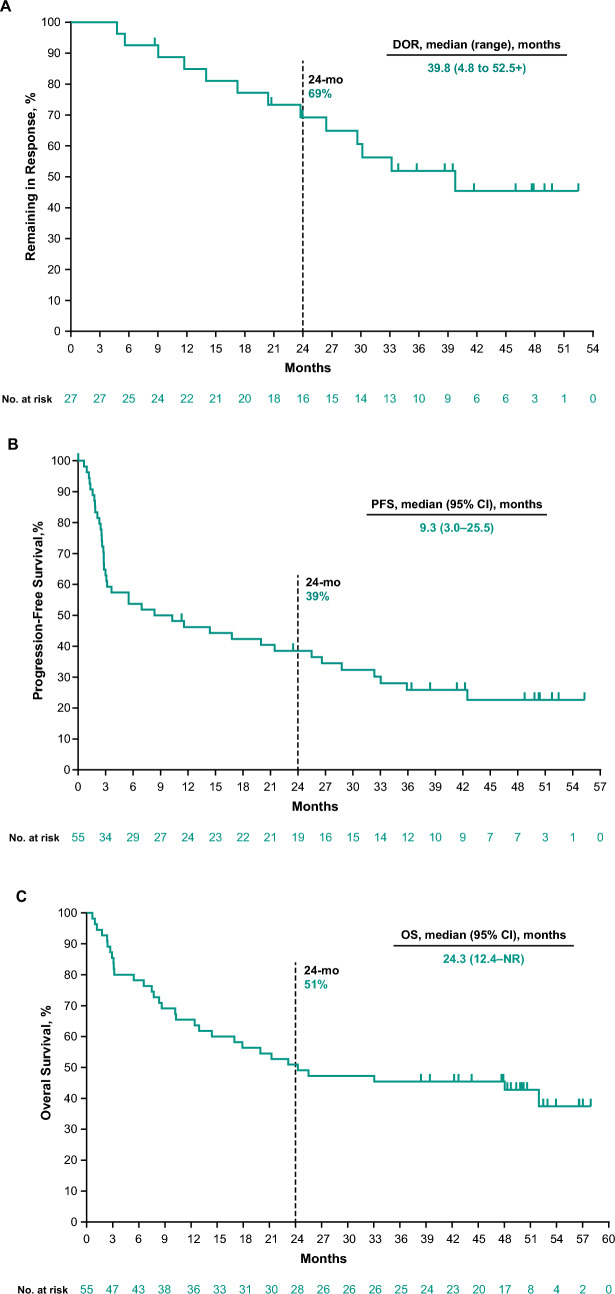
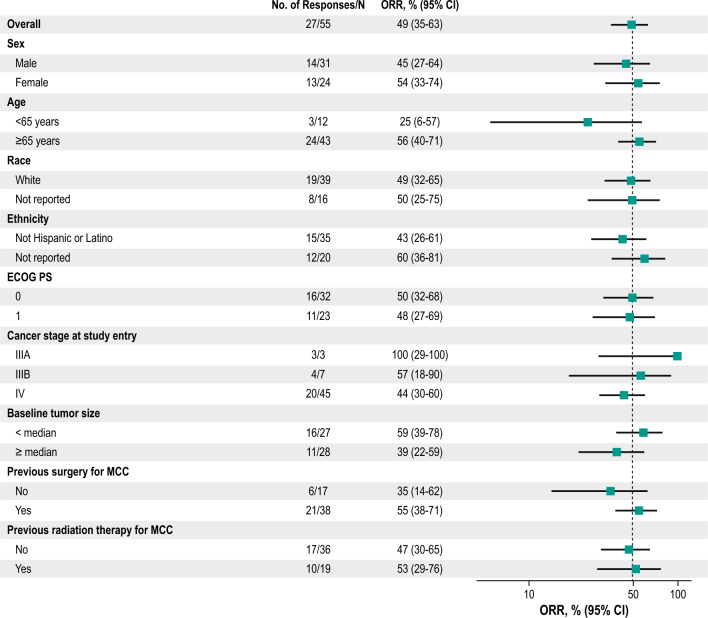
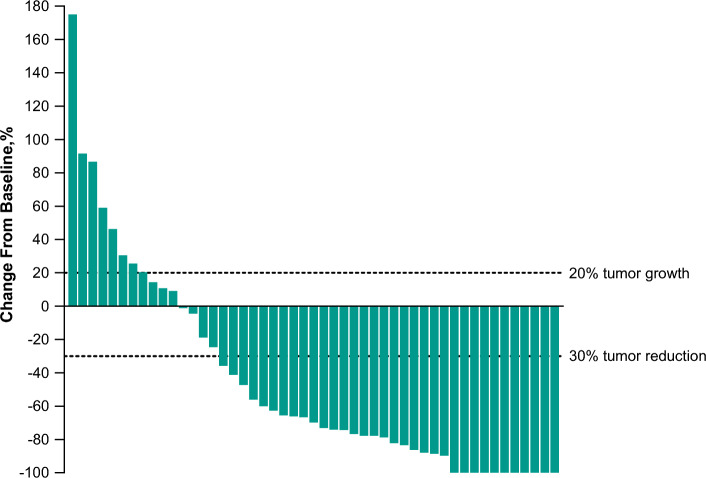
Fifty-five patients were treated with pembrolizumab. The median time from first dose to data cutoff (February 15, 2024) was 50.3 months (range 38.7-59.4). The ORR was 49% (95% confidence interval [CI] 35-63), with 12 complete responses and 15 partial responses. The median DOR was 39.8 months (range 4.8-52.5+), and the 24-month DOR rate was 69%. The median PFS was 9.3 months (95% CI 3-26), and the 24-month PFS rate was 39%. The median OS was 24.3 months (95% CI 12.4 to not reached), and the 24-month OS rate was 51%. Any-grade treatment-related adverse events (AEs) occurred in 38 patients (69%); 13 patients (24%) experienced grade 3-5 AEs. The most common treatment-related AEs were fatigue (n = 12 [22%]), pruritus (n = 12 [22%]), and lipase increase (n = 10 [18%]). One patient died of treatment-related Guillain-Barré syndrome.
Pembrolizumab provided durable antitumor activity and promising survival and had a manageable safety profile in patients with recurrent locally advanced or metastatic MCC, supporting its use in this population.
Clinicaltrials.gov, NCT03783078.
III 期 KEYNOTE-913 研究旨在评估帕博利珠单抗作为晚期 Merkel 细胞癌(MCC)患者一线治疗的疗效和安全性。
报告 KEYNOTE-913 主要分析结果。
复发性局部晚期或转移性 MCC 患者接受帕博利珠单抗 200mg 静脉注射,每 3 周一次,最多 35 次治疗(约 2 年)。主要终点是盲法独立中心评价(BICR)根据实体瘤反应评价标准 1.1 版(RECIST v1.1)评估的客观缓解率(ORR)。次要终点是 BICR 评估的缓解持续时间(DOR)和无进展生存期(PFS),RECIST v1.1 总生存期(OS)和安全性及耐受性。
55 例患者接受了帕博利珠单抗治疗。从首次剂量到数据截止日期(2024 年 2 月 15 日)的中位时间为 50.3 个月(范围 38.7-59.4)。ORR 为 49%(95%置信区间[CI]35-63%),完全缓解 12 例,部分缓解 15 例。DOR 的中位时间为 39.8 个月(范围 4.8-52.5+),24 个月 DOR 率为 69%。中位 PFS 为 9.3 个月(95%CI3-26),24 个月 PFS 率为 39%。中位 OS 为 24.3 个月(95%CI12.4-未达到),24 个月 OS 率为 51%。任何级别与治疗相关的不良事件(AE)发生在 38 例患者(69%)中;13 例患者(24%)发生 3-5 级 AE。最常见的治疗相关 AE 是疲劳(n=12[22%])、瘙痒(n=12[22%])和脂肪酶升高(n=10[18%])。1 例患者死于治疗相关的格林-巴利综合征。
帕博利珠单抗为复发性局部晚期或转移性 MCC 患者提供了持久的抗肿瘤活性和有前景的生存,并具有可管理的安全性,支持其在该人群中的应用。
Clinicaltrials.gov,NCT03783078。