Miranda Marcos C, Kepl Elizabeth, Navarro Mary Jane, Chen Chengbo, Johnson Max, Sprouse Kaitlin R, Stewart Cameron, Palser Anne, Valdez Adian, Pettie Deleah, Sydeman Claire, Ogohara Cassandra, Kraft John C, Pham Minh, Murphy Michael, Wrenn Sam, Fiala Brooke, Ravichandran Rashmi, Ellis Daniel, Carter Lauren, Corti Davide, Kellam Paul, Lee Kelly, Walls Alexandra C, Veesler David, King Neil P
Department of Biochemistry, University of Washington, Seattle, WA, USA.
Institute for Protein Design, University of Washington, Seattle, WA, USA.
NPJ Vaccines. 2024 Oct 8;9(1):184. doi: 10.1038/s41541-024-00982-1.
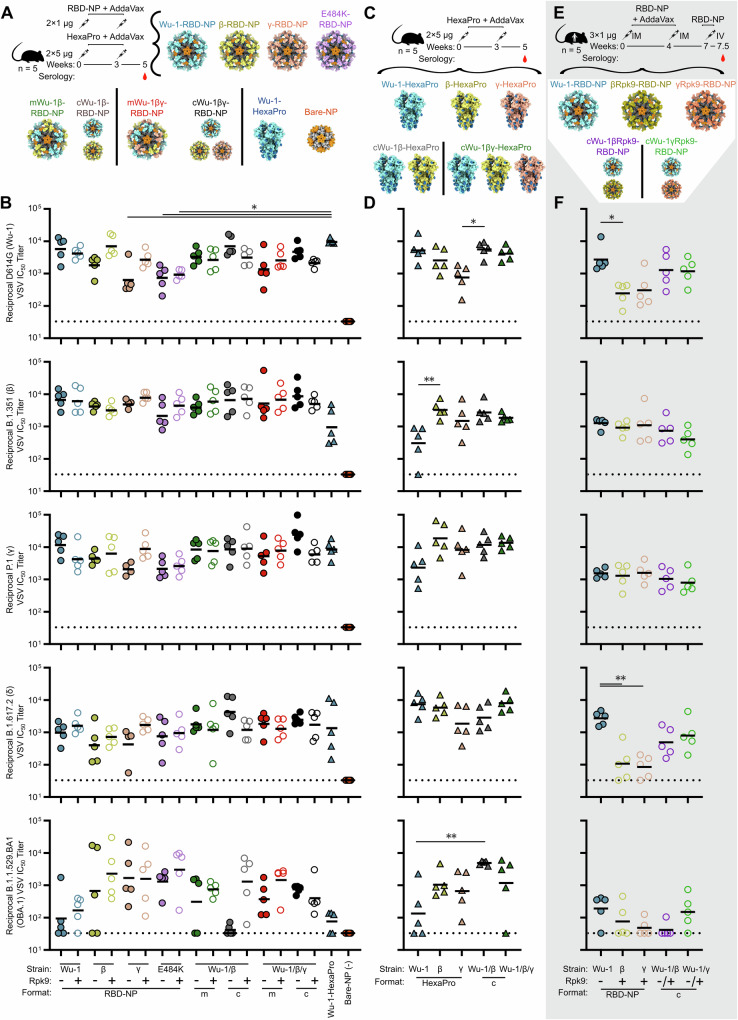
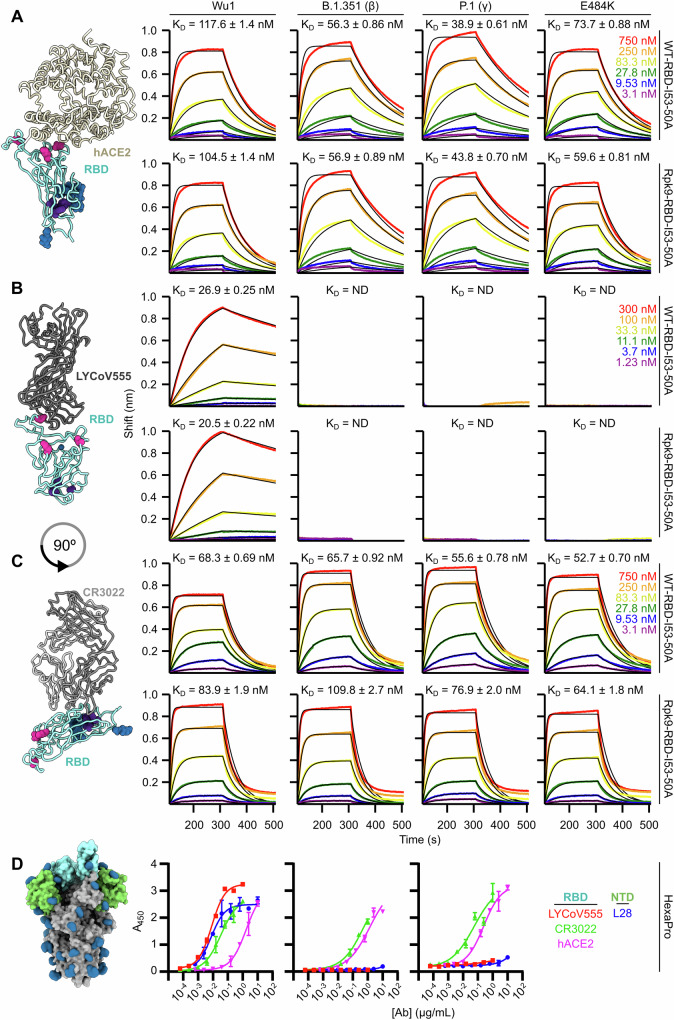
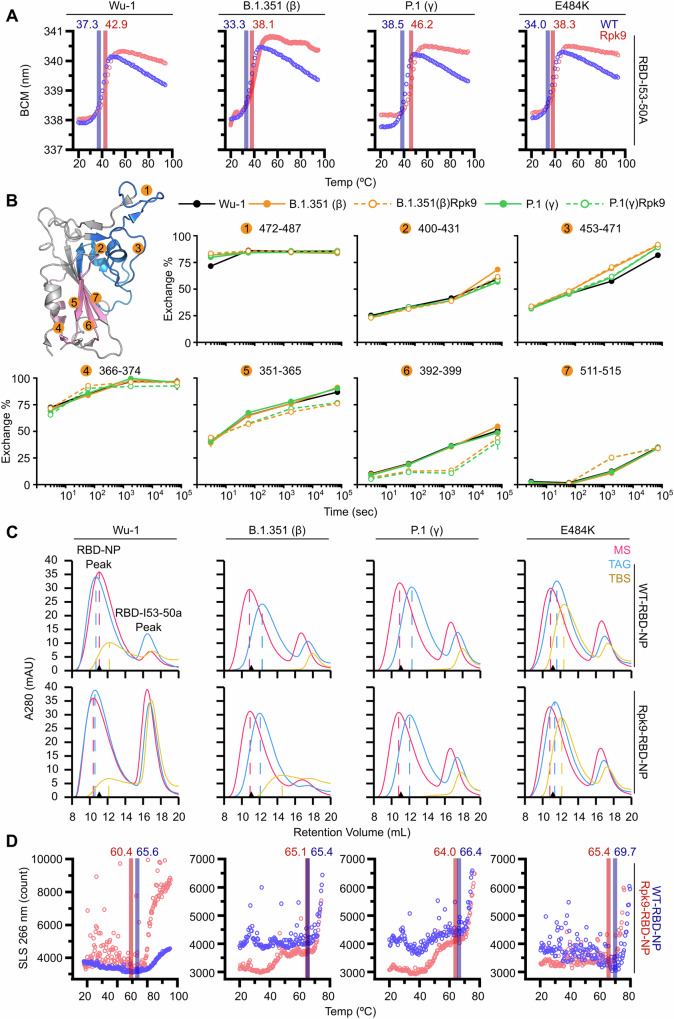
We previously described a two-component protein nanoparticle vaccine platform that displays 60 copies of the SARS-CoV-2 spike protein RBD (RBD-NP). The vaccine, when adjuvanted with AS03, was shown to elicit robust neutralizing antibody and CD4 T cell responses in Phase I/II clinical trials, met its primary co-endpoints in a Phase III trial, and has been licensed by multiple regulatory authorities under the brand name SKYCovione. Here we characterize the biophysical properties, stability, antigenicity, and immunogenicity of RBD-NP immunogens incorporating mutations from the B.1.351 (β) and P.1 (γ) variants of concern (VOCs) that emerged in 2020. We also show that the RBD-NP platform can be adapted to the Omicron strains BA.5 and XBB.1.5. We compare β and γ variant and E484K point mutant nanoparticle immunogens to the nanoparticle displaying the Wu-1 RBD, as well as to soluble prefusion-stabilized (HexaPro) spike trimers harboring VOC-derived mutations. We find the properties of immunogens based on different SARS-CoV-2 variants can differ substantially, which could affect the viability of variant vaccine development. Introducing stabilizing mutations in the linoleic acid binding site of the RBD-NPs resulted in increased physical stability compared to versions lacking the stabilizing mutations without deleteriously affecting immunogenicity. The RBD-NP immunogens and HexaPro trimers, as well as combinations of VOC-based immunogens, elicited comparable levels of neutralizing antibodies against distinct VOCs. Our results demonstrate that RBD-NP-based vaccines can elicit neutralizing antibody responses against SARS-CoV-2 variants and can be rapidly designed and stabilized, demonstrating the potential of two-component RBD-NPs as a platform for the development of broadly protective coronavirus vaccines.
我们之前描述了一种双组分蛋白质纳米颗粒疫苗平台,该平台展示60个拷贝的SARS-CoV-2刺突蛋白受体结合域(RBD-NP)。在I/II期临床试验中,该疫苗与AS03佐剂联合使用时,可引发强烈的中和抗体和CD4 T细胞反应,在III期试验中达到其主要共同终点,并且已被多个监管机构以SKYCovione品牌批准上市。在此,我们对包含2020年出现的值得关注的B.1.351(β)和P.1(γ)变异株(VOCs)突变的RBD-NP免疫原的生物物理特性、稳定性、抗原性和免疫原性进行了表征。我们还表明,RBD-NP平台可适用于奥密克戎毒株BA.5和XBB.1.5。我们将β和γ变异株以及E484K点突变纳米颗粒免疫原与展示Wu-1 RBD的纳米颗粒以及携带VOC衍生突变的可溶性预融合稳定化(HexaPro)刺突三聚体进行了比较。我们发现基于不同SARS-CoV-2变异株的免疫原特性可能有很大差异,这可能会影响变异株疫苗开发的可行性。与缺乏稳定突变的版本相比,在RBD-NPs的亚油酸结合位点引入稳定突变可提高物理稳定性,且不会对免疫原性产生有害影响。RBD-NP免疫原和HexaPro三聚体,以及基于VOC的免疫原组合,引发了针对不同VOCs的相当水平的中和抗体。我们的结果表明,基于RBD-NP的疫苗可引发针对SARS-CoV-2变异株的中和抗体反应,并且可以快速设计和稳定化,证明了双组分RBD-NPs作为开发广泛保护性冠状病毒疫苗平台的潜力。