Department of Neurosurgery, Oslo University Hospital Ullevål, Nydalen, PO Box 4956, NO-0424, Oslo, Norway.
Department of Surgery/Orthopaedics, Finnmark Health Trust, Hammerfest, Norway.
Acta Neurochir (Wien). 2024 Oct 9;166(1):398. doi: 10.1007/s00701-024-06294-6.
This study explores the protective capabilities of bicycle helmets on serious head injury among bicyclists hospitalized in a Norwegian level 1 trauma centre.
Information on helmet use, demographic variables, Abbreviated Injury Scale (AIS) and surgical procedure codes was retrieved from the Oslo University Hospital Trauma Registry for patients with bicycle-related injuries from 2005 through 2016. Outcomes were serious head injury defined as maximum AIS severity score ≥ 3 in the AIS region Head, any cranial neurosurgical procedure, and 30-day mortality.
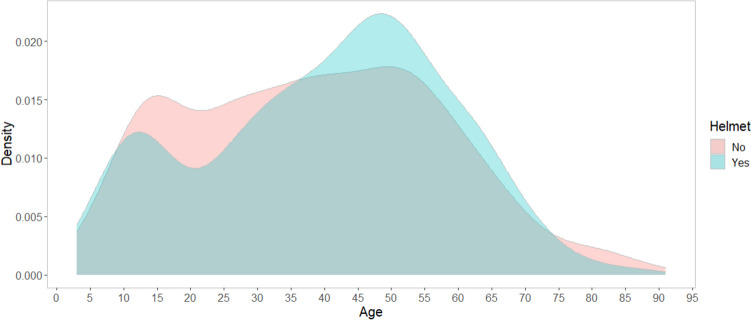
A total of 1256 hospitalized bicyclists were included. The median age was 41 years (quartiles 26-53), 73% were male, 5.3% had severe pre-injury comorbidities, and 54% wore a helmet at the time of injury. Serious head injury occurred in 30%, 9% underwent a cranial neurosurgical procedure, and 30-day mortality was 2%. Compared to non-helmeted bicyclists, helmeted bicyclists were older (43 years, quartiles 27-54, vs. 38 years, quartiles 23-53, p = 0.05), less often crashed during night-time (21% vs. 38%, p < 0.001), less frequently had serious head injury (22% vs. 38%, OR 0.29, 95% CI 0.22-0.39), and less often underwent cranial neurosurgery (6% vs. 14%, OR 0.36, 95% CI 0.24-0.54). No statistically significant difference in 30-day mortality between the two groups was found (1.5% vs. 2.9%, OR 0.50, 95% CI 0.22-1.11).
Helmet use was associated with fewer and less severe head injuries and fewer neurosurgical procedures. This adds evidence to the protective capabilities of bicycle helmets.
本研究旨在探讨在挪威一级创伤中心住院的自行车骑手群体中,自行车头盔对严重头部损伤的保护作用。
从奥斯陆大学医院创伤登记处获取了 2005 年至 2016 年期间与自行车相关损伤的患者的头盔使用、人口统计学变量、损伤严重程度评分(Abbreviated Injury Scale,AIS)和手术程序代码信息。结局为严重头部损伤,定义为 AIS 头部区域的最大 AIS 严重程度评分≥3、任何颅脑神经外科手术以及 30 天死亡率。
共纳入 1256 例住院自行车骑手。中位数年龄为 41 岁(四分位间距 26-53 岁),73%为男性,5.3%存在严重的预先存在的合并症,54%在受伤时戴头盔。30%发生严重头部损伤,9%接受颅脑神经外科手术,30 天死亡率为 2%。与未戴头盔的自行车骑手相比,戴头盔的自行车骑手年龄更大(43 岁,四分位间距 27-54,vs. 38 岁,四分位间距 23-53,p=0.05),夜间(夜间 21%vs. 38%,p<0.001)发生事故的频率较低,严重头部损伤的发生率较低(22%vs. 38%,OR 0.29,95%CI 0.22-0.39),颅脑神经外科手术的发生率也较低(6%vs. 14%,OR 0.36,95%CI 0.24-0.54)。两组之间 30 天死亡率无统计学差异(1.5%vs. 2.9%,OR 0.50,95%CI 0.22-1.11)。
头盔的使用与较少和较轻的头部损伤以及较少的神经外科手术相关。这为自行车头盔的保护作用提供了证据。