
如果呼气时间足够短,可以避免呼气终末伤:在气道压力释放通气期间通过反演模型和振荡测量法得到的证据。
Atelectrauma can be avoided if expiration is sufficiently brief: evidence from inverse modeling and oscillometry during airway pressure release ventilation.
机构信息
Department of Medicine, University of Vermont, University of Vermont Larner College of Medicine, 149 Beaumont Avenue, Burlington, VT, 05405, USA.
Departments of Anesthesia, Biomedical Engineering, and Radiology, University of Iowa, Iowa City, IA, 52242, USA.
出版信息
Crit Care. 2024 Oct 8;28(1):329. doi: 10.1186/s13054-024-05112-w.
BACKGROUND
Airway pressure release ventilation (APRV) has been shown to be protective against atelectrauma if expirations are brief. We hypothesize that this is protective because epithelial surfaces are not given enough time to come together and adhere during expiration, thereby avoiding their highly damaging forced separation during inspiration.
METHODS
We investigated this hypothesis in a porcine model of ARDS induced by Tween lavage. Animals were ventilated with APRV in 4 groups based on whether inspiratory pressure was 28 or 40 cmHO, and whether expiration was terminated when end-expiratory flow reached either 75% (a shorter expiration) or 25% (a longer expiration) of its initial peak value. A mathematical model of respiratory system mechanics that included a volume-dependent elastance term characterized by the parameter was fit to airway pressure-flow data obtained each hour for 6 h post-Tween injury during both expiration and inspiration. We also measured respiratory system impedance between 5 and 19 Hz continuously through inspiration at the same time points from which we derived a time-course for respiratory system resistance ( ).
RESULTS
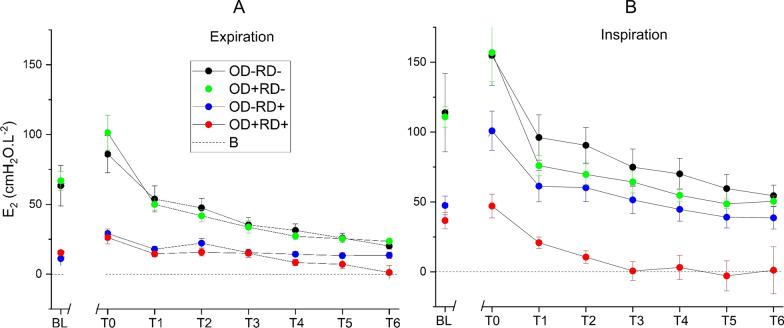
during both expiration and inspiration was significantly different between the two longer expiration versus the two shorter expiration groups (ANOVA, p < 0.001). We found that was most depressed during inspiration in the higher-pressure group receiving the longer expiration, suggesting that reflects a balance between strain stiffening of the lung parenchyma and ongoing recruitment as lung volume increases. We also found in this group that increased progressively during the first 0.5 s of inspiration and then began to decrease again as inspiration continued, which we interpret as corresponding to the point when continuing derecruitment was reversed by progressive lung inflation.
CONCLUSIONS
These findings support the hypothesis that sufficiently short expiratory durations protect against atelectrauma because they do not give derecruitment enough time to manifest. This suggests a means for the personalized adjustment of mechanical ventilation.
背景
如果呼气时间较短,气道压力释放通气(APRV)已被证明可防止肺泡萎陷伤。我们假设这是一种保护机制,因为在呼气过程中上皮表面没有足够的时间相互靠拢和黏附,从而避免了在吸气过程中因强烈牵拉而造成的高度破坏性分离。
方法
我们通过 Tween 灌洗诱导的 ARDS 猪模型来研究这一假说。根据吸气压力为 28 或 40cmH2O 以及呼气结束时的终末呼气流量达到初始峰值的 75%(较短呼气)或 25%(较长呼气),将动物分为 4 组进行 APRV 通气。我们将一个包含容积依赖性弹性参数的呼吸力学数学模型拟合到 Tween 损伤后 6 小时内每小时获得的气道压力-流量数据中,包括呼气和吸气。我们还在同一时间点通过吸气连续测量呼吸阻抗(5 至 19Hz),并从该数据中推导出呼吸阻力( )的时间过程。
结果
在呼气和吸气过程中,两种较长呼气与两种较短呼气之间的 存在显著差异(方差分析,p<0.001)。我们发现,在接受较长呼气的高压组中,在吸气过程中 受到最大抑制,这表明 反映了肺实质应变变硬与肺容积增加时持续复张之间的平衡。我们还发现,在该组中,在最初的 0.5s 吸气过程中 逐渐增加,然后随着吸气的继续再次开始下降,我们将其解释为对应于持续去复张被逐渐充气复张逆转的点。
结论
这些发现支持了这样一种假说,即足够短的呼气时间可以防止肺泡萎陷伤,因为它们不会给去复张足够的时间表现出来。这为个性化调整机械通气提供了一种方法。


 Zotero 插件