Qu Jixin, Nair Adithya, Muir George W, Loveday Kate A, Yang Zidi, Nourafkan Ehsan, Welbourne Emma N, Maamra Mabrouka, Dickman Mark J, Kis Zoltán
School of Chemical, Materials and Biological Engineering, University of Sheffield, Sir Robert Hadfield Building, Mappin Street, Sheffield S1 3JD, UK.
Department of Chemical Engineering, Imperial College London, Roderic Hill Building, South Kensington Campus, London SW7 2AZ, UK.
Mol Ther Nucleic Acids. 2024 Sep 11;35(4):102333. doi: 10.1016/j.omtn.2024.102333. eCollection 2024 Dec 10.
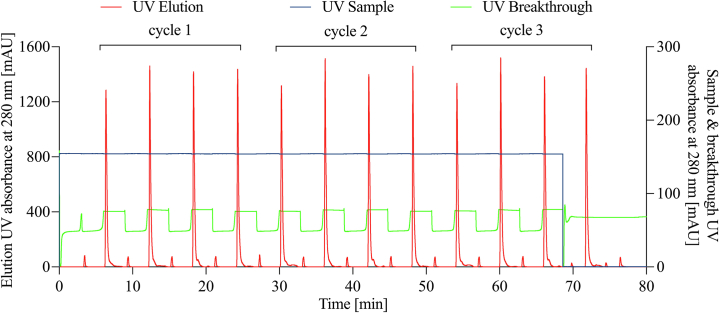
Oligo-deoxythymidine (oligo-dT) ligand-based affinity chromatography is a robust method for purifying mRNA drug substances within the manufacturing process of mRNA-based products, including vaccines and therapeutics. However, the conventional batch mode of operation for oligo-dT chromatography has certain drawbacks that reduce the productivity of this process. Here, we report a new continuous oligo-dT chromatography process for the purification of transcribed mRNA, which reduces losses, improves the efficiency of oligo-dT resin use, and intensifies the chromatography process. Furthermore, the quality by design (QbD) framework was used to establish a design space for the newly developed method. The optimization of process parameters (PPs), including salt type, salt concentration, load flow rate and mRNA load concentration both in batch and the continuous mode, achieved a greater than 90% yield (mRNA recovery) along with greater than 95% mRNA integrity and greater than 99% purity. The productivity of continuous chromatography was estimated to be 5.75-fold higher, and the operating cost was estimated 15% lower, when compared with batch chromatography. Moreover, the QbD framework was further used to map the relationship between critical quality attributes and key performance indicators as a function of critical process parameters and critical material attributes.
基于寡聚脱氧胸苷酸(oligo-dT)配体的亲和色谱法是在基于mRNA的产品(包括疫苗和治疗药物)制造过程中纯化mRNA原料药的一种可靠方法。然而,传统的oligo-dT色谱批次操作模式存在某些缺点,会降低该过程的生产率。在此,我们报告了一种用于纯化转录mRNA的新型连续oligo-dT色谱方法,该方法减少了损失,提高了oligo-dT树脂的使用效率,并强化了色谱过程。此外,采用质量源于设计(QbD)框架为新开发的方法建立了设计空间。对工艺参数(PPs)进行优化,包括盐类型、盐浓度、上样流速以及批次和连续模式下的mRNA上样浓度,实现了大于90%的收率(mRNA回收率),同时mRNA完整性大于95%,纯度大于99%。与批次色谱相比,连续色谱的生产率估计高出5.75倍,运营成本估计低15%。此外,QbD框架还进一步用于绘制关键质量属性与关键性能指标之间的关系,作为关键工艺参数和关键物料属性的函数。