Zhou Hongwei
School of Economics and Management, Lanzhou University of Technology, Lanzhou, 730050, China.
Claro M. Recto Academy of Advanced Studies, Lyceum of the Philippines University, Intramuros, Manila, Philippines.
Heliyon. 2024 Sep 5;10(19):e37495. doi: 10.1016/j.heliyon.2024.e37495. eCollection 2024 Oct 15.
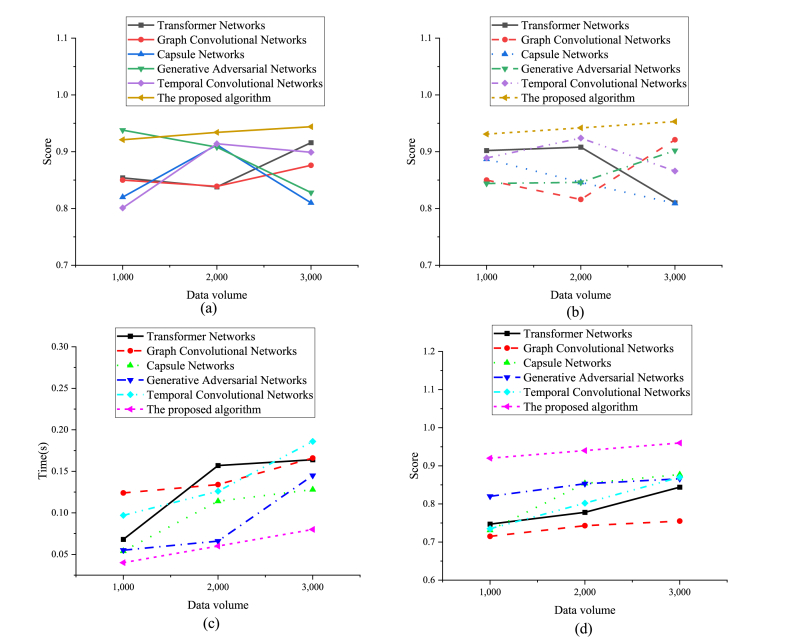
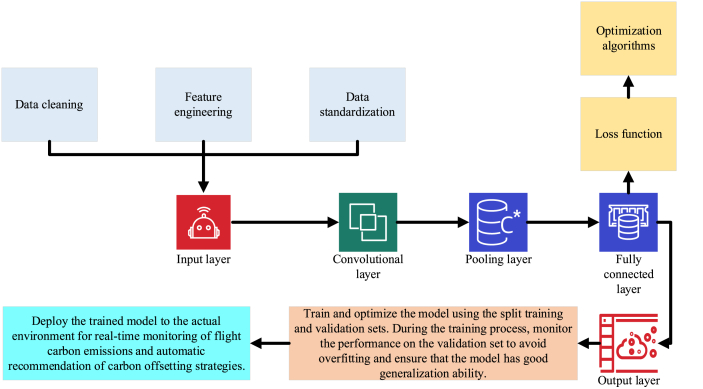
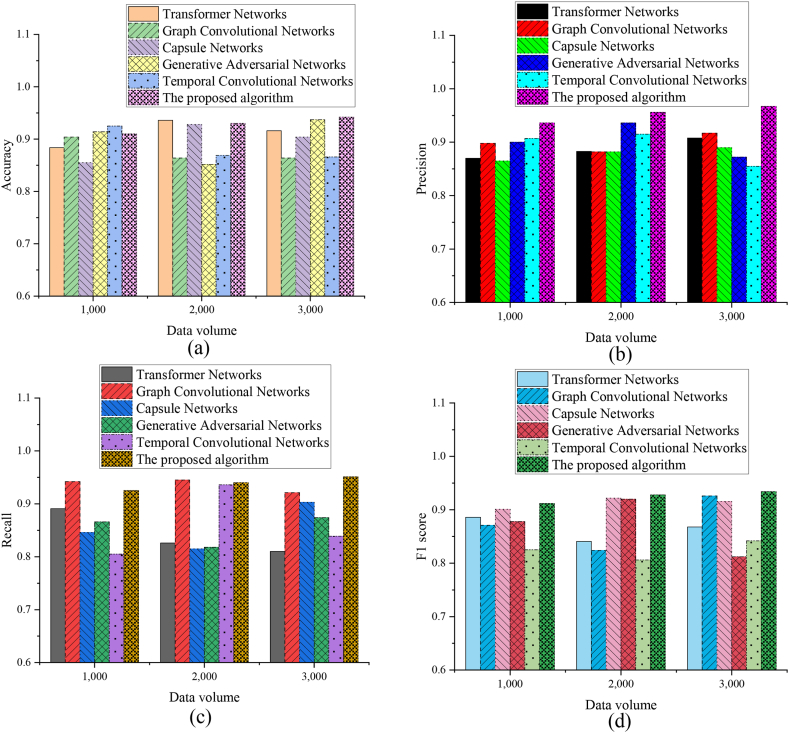
To more effectively address the issue of carbon emissions in the aviation industry, this study first analyzes the current development status of carbon offset and carbon neutrality strategies in the aviation industry, as well as examines the existing relevant research findings. Then, optimizations are made to the Convolutional Neural Network to improve the accuracy and efficiency of the prediction model. These optimizations include architectural improvements, the use of attention mechanisms to more accurately focus on important features, as well as the adoption of multiscale feature extraction and advanced optimization algorithms to enhance the model's learning ability and convergence speed. These comprehensive improvements not only enhance the model's generalization ability but also significantly improve its applicability in complex environments. Finally, by comparing the performance of Transformer Networks, Graph Convolutional Networks, Capsule Networks, Generative Adversarial Networks, Temporal Convolutional Networks, and the proposed optimization algorithm on datasets of airline carbon emissions and fuel usage, the performance of the proposed optimization algorithm is validated through comparison of accuracy, precision, recall, and F1-score calculated from the data. Simultaneously, simulation experiments are conducted to validate the effectiveness and feasibility of the proposed optimization algorithm by comparing prediction stability, strategy adaptability, response time, and long-term effectiveness. The experimental results show that the accuracy, precision, recall, and F1-score of the proposed optimized model reach up to 0.942, 0.967, 0.951, and 0.934 respectively, all higher than those of the compared models, validating the good performance of the proposed optimized model. In the comparison of simulation experiments, the scores of prediction stability and strategy adaptability of the proposed optimized model reach up to 0.944 and 0.953 respectively, much higher than those of other models. The response time is only 0.04s when the data volume is 1000, and the computational advantage of the proposed optimized model becomes more apparent with the increase in data volume. In the comparison of long-term effectiveness, the advantage of the proposed optimized model in this aspect also becomes more obvious with the increase in data volume. Through simulation experiments, the performance of the model in actual application scenarios is further evaluated to ensure its practicability. Therefore, this study not only provides a new optimization tool for carbon emission strategies in the aviation industry but also has certain significance for research on environmental sustainability.
为了更有效地解决航空业碳排放问题,本研究首先分析了航空业碳抵消和碳中和战略的当前发展状况,并审视了现有的相关研究成果。然后,对卷积神经网络进行优化,以提高预测模型的准确性和效率。这些优化包括架构改进、使用注意力机制更准确地聚焦重要特征,以及采用多尺度特征提取和先进的优化算法来增强模型的学习能力和收敛速度。这些全面改进不仅增强了模型的泛化能力,还显著提高了其在复杂环境中的适用性。最后,通过比较Transformer Networks、图卷积网络、胶囊网络、生成对抗网络、时间卷积网络以及所提出的优化算法在航空公司碳排放和燃料使用数据集上的性能,通过比较从数据计算得出的准确率、精确率、召回率和F1分数来验证所提出优化算法的性能。同时,进行模拟实验,通过比较预测稳定性、策略适应性、响应时间和长期有效性来验证所提出优化算法的有效性和可行性。实验结果表明,所提出的优化模型的准确率、精确率、召回率和F1分数分别达到0.942、0.967、0.951和0.934,均高于对比模型,验证了所提出优化模型的良好性能。在模拟实验比较中,所提出优化模型的预测稳定性和策略适应性分数分别达到0.944和0.953,远高于其他模型。当数据量为1000时,响应时间仅为0.04秒,并且随着数据量的增加,所提出优化模型的计算优势变得更加明显。在长期有效性比较中,随着数据量的增加,所提出优化模型在这方面的优势也变得更加明显。通过模拟实验,进一步评估了模型在实际应用场景中的性能,以确保其实用性。因此,本研究不仅为航空业碳排放战略提供了一种新的优化工具,而且对环境可持续性研究具有一定意义。