Parkinson Lindsey V, Geueke Birgit, Muncke Jane
Food Packaging Forum Foundation, Zürich, Switzerland.
Front Toxicol. 2024 Sep 24;6:1440331. doi: 10.3389/ftox.2024.1440331. eCollection 2024.
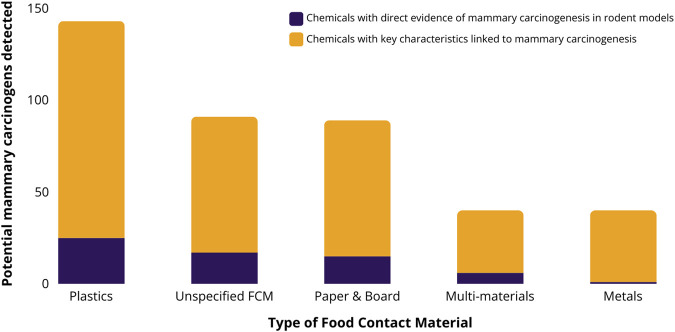
Many nations have food contact material (FCM) legislation purporting to protect citizens from hazardous chemicals, often specifically by regulating genotoxic carcinogens. Despite such regulations, cancers that are associated with harmful chemical exposures are highly prevalent, especially breast cancer. Using the novel Key Characteristics of Toxicants framework, Kay et al. found 921 substances that are potential mammary carcinogens. By comparing Kay et al.'s chemicals list with our own Database on migrating and extractable food contact chemicals (FCCmigex), we found that 189 (21%) of the potential mammary carcinogens have been measured in FCMs. When limiting these results to migration studies published in 2020-2022, 76 potential mammary carcinogens have been detected to migrate from FCMs sold in markets across the globe, under realistic conditions of use. This implies that chronic exposure of the entire population to potential mammary carcinogens from FCMs is the norm and highlights an important, but currently underappreciated opportunity for prevention. Reducing population-wide exposure to potential mammary carcinogens can be achieved by science-based policy amendments addressing the assessment and management of food contact chemicals.
许多国家都有食品接触材料(FCM)法规,旨在保护公民免受有害化学物质的侵害,通常具体是通过对基因毒性致癌物进行监管。尽管有这些规定,但与有害化学物质接触相关的癌症却非常普遍,尤其是乳腺癌。利用新颖的毒物关键特性框架,凯等人发现了921种潜在的乳腺致癌物。通过将凯等人的化学物质清单与我们自己的食品接触迁移和可提取化学物质数据库(FCCmigex)进行比较,我们发现189种(21%)潜在的乳腺致癌物已在食品接触材料中被检测到。当将这些结果限制在2020年至2022年发表的迁移研究时,在全球市场上销售的食品接触材料在实际使用条件下,已检测到76种潜在的乳腺致癌物会迁移出来。这意味着整个人口长期接触食品接触材料中的潜在乳腺致癌物是常态,并凸显了一个重要但目前未得到充分重视的预防机会。通过基于科学的政策修订来解决食品接触化学物质的评估和管理问题,可以减少全人群对潜在乳腺致癌物的接触。