Division of the National Toxicology Program, National Institute of Environmental Health Sciences, National Institutes of Health, Department of Health and Human Services, Research Triangle Park, North Carolina, USA.
Translational Safety & Bioanalytical Sciences, Amgen Research, South San Francisco, California, USA.
Environ Health Perspect. 2022 Oct;130(10):105001. doi: 10.1289/EHP10800. Epub 2022 Oct 6.
Key characteristics (KCs), properties of agents or exposures that confer potential hazard, have been developed for carcinogens and other toxicant classes. KCs have been used in the systematic assessment of hazards and to identify assay and data gaps that limit screening and risk assessment. Many of the mechanisms through which pharmaceuticals and occupational or environmental agents modulate immune function are well recognized. Thus KCs could be identified for immunoactive substances and applied to improve hazard assessment of immunodulatory agents.
The goal was to generate a consensus-based synthesis of scientific evidence describing the KCs of agents known to cause immunotoxicity and potential applications, such as assays to measure the KCs.
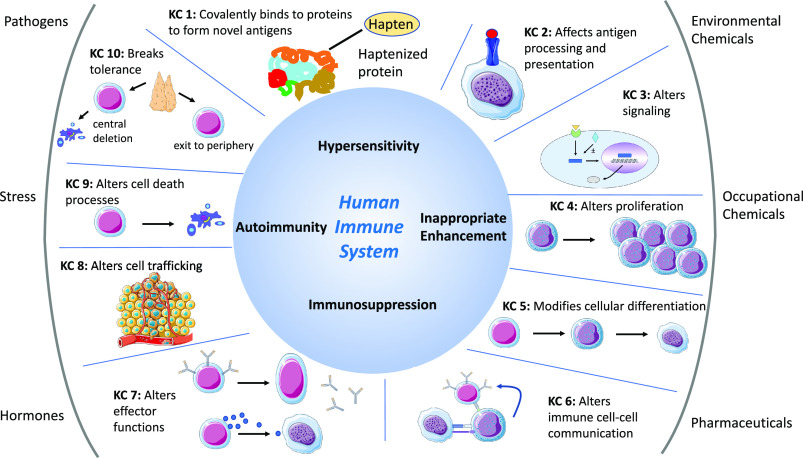
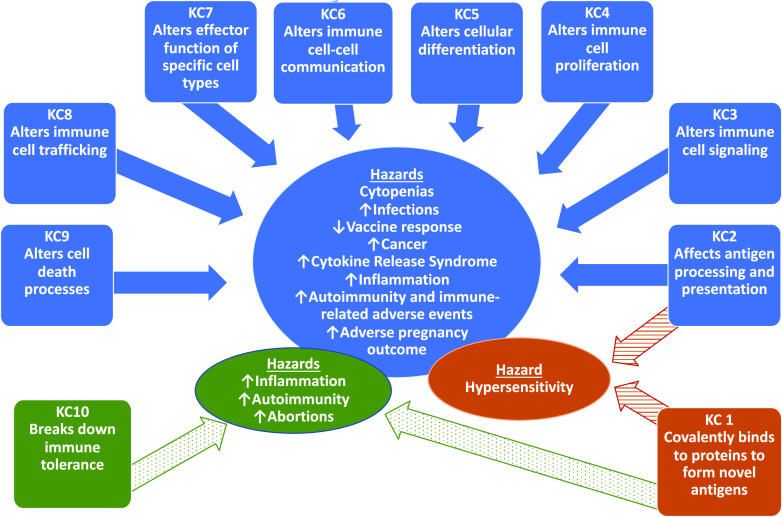
A committee of 18 experts with diverse specialties identified 10 KCs of immunotoxic agents, namely, 1) covalently binds to proteins to form novel antigens, 2) affects antigen processing and presentation, 3) alters immune cell signaling, 4) alters immune cell proliferation, 5) modifies cellular differentiation, 6) alters immune cell-cell communication, 7) alters effector function of specific cell types, 8) alters immune cell trafficking, 9) alters cell death processes, and 10) breaks down immune tolerance. The group considered how these KCs could influence immune processes and contribute to hypersensitivity, inappropriate enhancement, immunosuppression, or autoimmunity.
KCs can be used to improve efforts to identify agents that cause immunotoxicity via one or more mechanisms, to develop better testing and biomarker approaches to evaluate immunotoxicity, and to enable a more comprehensive and mechanistic understanding of adverse effects of exposures on the immune system. https://doi.org/10.1289/EHP10800.
关键特征(KCs)是赋予潜在危害的物质、药物或暴露因素的特性,已经为致癌物质和其他毒物类别开发出来。KCs 已被用于系统评估危害,并确定限制筛选和风险评估的检测和数据差距。许多药物和职业或环境因素调节免疫功能的机制已经得到很好的认识。因此,可以为免疫活性物质确定 KCs,并应用于改善免疫调节药物的危害评估。
目标是生成一个基于共识的科学证据综合,描述已知引起免疫毒性的物质和潜在应用的 KCs,例如用于测量 KCs 的检测方法。
一个由 18 名具有不同专业知识的专家组成的委员会确定了 10 种免疫毒性物质的 KCs,即 1)与蛋白质共价结合形成新的抗原,2)影响抗原处理和呈递,3)改变免疫细胞信号转导,4)改变免疫细胞增殖,5)改变细胞分化,6)改变免疫细胞间通讯,7)改变特定细胞类型的效应功能,8)改变免疫细胞迁移,9)改变细胞死亡过程,10)打破免疫耐受。该小组考虑了这些 KCs 如何影响免疫过程,并导致过敏反应、不适当增强、免疫抑制或自身免疫。
KCs 可用于通过一种或多种机制改进识别导致免疫毒性的物质的努力,开发更好的检测和生物标志物方法来评估免疫毒性,并使人们对暴露于免疫系统的不良影响有更全面和更具机制的理解。https://doi.org/10.1289/EHP10800.