Blatný Jan, Astermark Jan, Catarino Cristina, Dolan Gerry, Fijnvandraat Karin, Hermans Cédric, Holstein Katharina, Jiménez-Yuste Víctor, Klamroth Robert, Lavin Michelle, Lenting Peter J, Lobet Sébastien, Mancuso Maria Elisa, Motwani Jayashree, O'Donnell James S, Königs Christoph
Hospital Bory, Nemocnica Bory, a.s., Ivana Kadlečíka 2, Bratislava 841 06, Slovakia.
University Hospital Brno, Masaryk University, Brno, Czech Republic.
Ther Adv Hematol. 2024 Sep 30;15:20406207241285143. doi: 10.1177/20406207241285143. eCollection 2024.
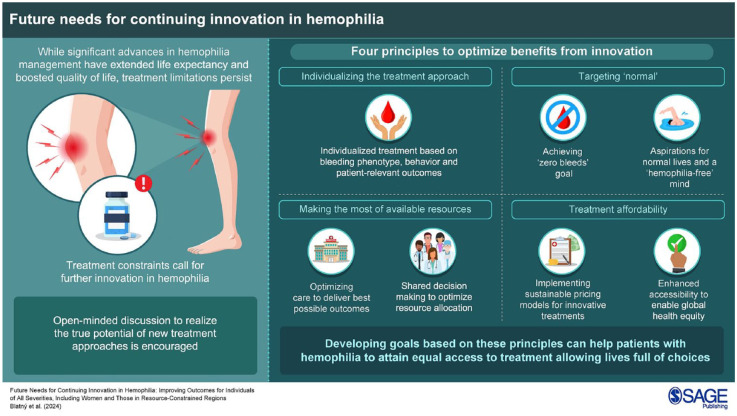
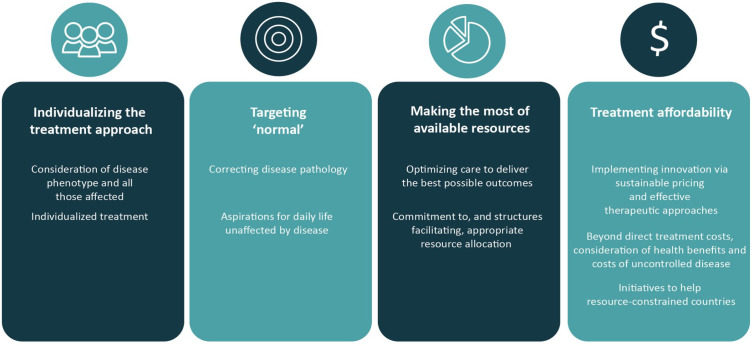
Over recent decades, management of people with hemophilia (PwH) has been greatly improved by scientific advances that have resulted in a rich and varied therapeutic landscape. Nevertheless, treatment limitations continue to drive innovation, and emerging options have the potential to realize further improvement. We advocate four general principles to optimize benefits from innovation: individualizing the treatment approach, targeting 'normal,' making the most of available resources, and considering treatment affordability. Ultimately, all PwH-men and women, of all ages and severities, and worldwide-should have access to treatment that fully prevents bleeding, while allowing personal, social, family, and professional lives of choice. Clearly, we are not there yet, but developing goals/milestones based on the principles we describe may help to achieve this.
近几十年来,科学进步极大地改善了血友病患者(PwH)的管理,带来了丰富多样的治疗前景。然而,治疗局限性仍在推动创新,新出现的选择有可能实现进一步改善。我们倡导四项一般原则以优化创新带来的益处:使治疗方法个体化、以“正常”为目标、充分利用现有资源以及考虑治疗的可承受性。最终,所有血友病患者——无论年龄、严重程度,无论男性还是女性,无论身处世界何地——都应能够获得能完全预防出血的治疗,同时能自主选择个人、社交、家庭和职业生活。显然,我们尚未达到这一目标,但基于我们所描述的原则制定目标/里程碑可能有助于实现这一点。