Wu Yuanshan, Barrere Victor, Han Aiguo, Chang Eric Y, Andre Michael, Shah Sameer B
Research Service, VA San Diego Healthcare System, San Diego, California, USA.
Department of Bioengineering, University of California, San Diego, California, USA.
J Ultrasound Med. 2025 Jan;44(1):97-109. doi: 10.1002/jum.16585. Epub 2024 Oct 9.
Peripheral nerves remain a challenging target for medical imaging, given their size, anatomical complexity, and structural heterogeneity. Quantitative ultrasound (QUS) applies a set of techniques to estimate tissue acoustic parameters independent of the imaging platform. Many useful medical and laboratory applications for QUS have been reported, but challenges remain for deployment in vivo, especially for heterogeneous tissues. Several phenomena introduce variability in attenuation estimates, which may influence the estimation of other QUS parameters. For example, estimating the backscatter coefficient (BSC) requires compensation for the attenuation of overlying tissues between the transducer and the underlying tissue of interest. The purpose of this study is to extend prior studies by investigating the efficacy of several analytical methods of estimating attenuation compensation on QUS outcomes in the human median nerve.
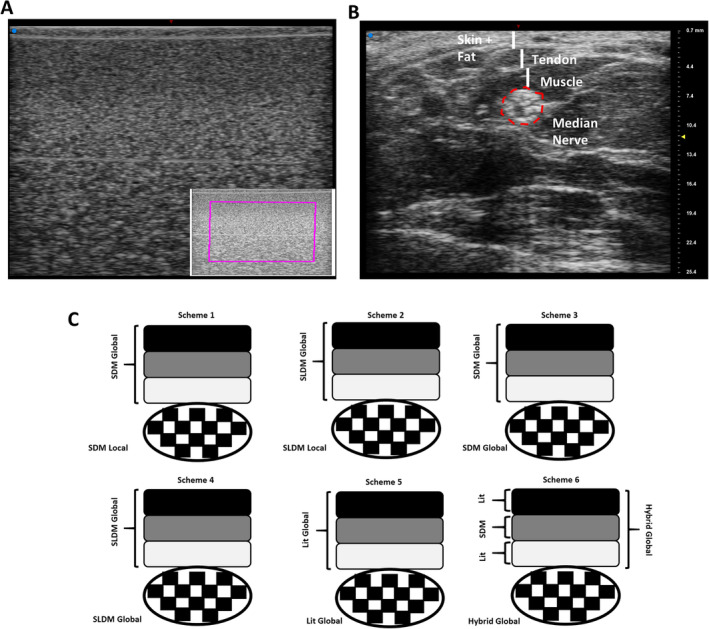
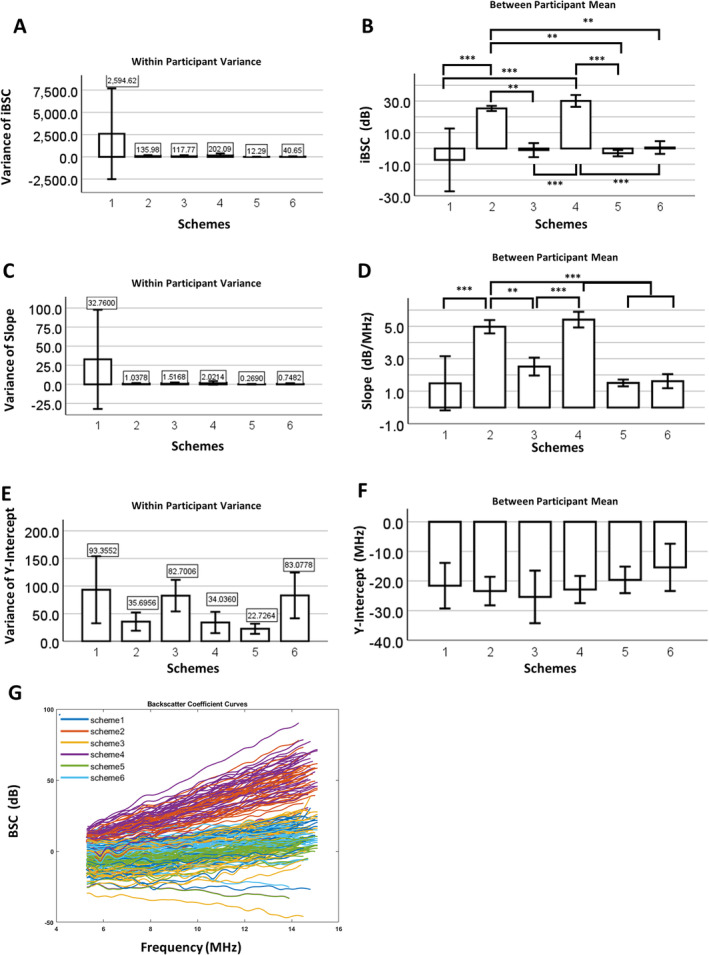
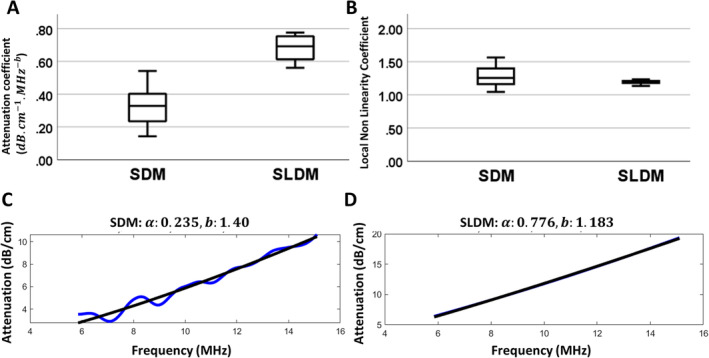
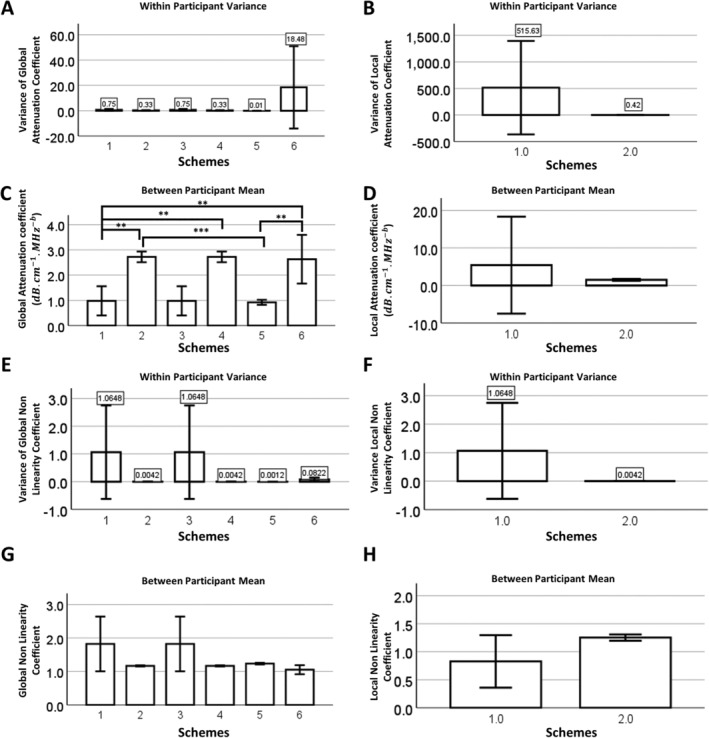
Median nerves were imaged at the volar wrist in vivo and beam-formed radiofrequency (RF) data were acquired. Six analytical approaches for attenuation compensation were compared: 1-2) attenuation estimated by applying spectral difference method (SDM) and spectral log difference method (SLDM) independently to regions of interest (ROIs) overlying the nerve and to the nerve ROI itself; 3-4) attenuation estimation by applying SDM and SLDM to ROIs overlying the nerve, and transferring these properties to the nerve ROI; and 5-6) methods that apply previously published values of tissue attenuation to the measured thickness of each overlying tissue. Mean between-subject estimates of BSC-related outcomes as well as within-subject variability of these outcomes were compared among the 6 methods.
Compensating for attenuation using SLDM and values from the literature reduced variability in BSC-based outcomes, compared to SDM. Variability in attenuation coefficients contributes substantially to variability in backscatter measurements.
This work has implications for the application of QUS to in vivo diagnostic assessments in peripheral nerves and possibly other heterogeneous tissues.
鉴于周围神经的大小、解剖复杂性和结构异质性,其仍然是医学成像的一个具有挑战性的目标。定量超声(QUS)应用一组技术来估计与成像平台无关的组织声学参数。已经报道了QUS的许多有用的医学和实验室应用,但在体内部署仍然存在挑战,特别是对于异质组织。几种现象会在衰减估计中引入变异性,这可能会影响其他QUS参数的估计。例如,估计背向散射系数(BSC)需要补偿换能器与感兴趣的下层组织之间上层组织的衰减。本研究的目的是通过研究几种估计衰减补偿的分析方法对人体正中神经QUS结果的有效性来扩展先前的研究。
在体内对掌侧腕部的正中神经进行成像,并采集波束形成的射频(RF)数据。比较了六种衰减补偿的分析方法:1 - 2)分别对神经上方的感兴趣区域(ROI)和神经ROI本身应用谱差法(SDM)和谱对数差法(SLDM)估计衰减;3 - 4)对神经上方的ROI应用SDM和SLDM估计衰减,并将这些特性转移到神经ROI;5 - 6)将先前公布的组织衰减值应用于每个上层组织测量厚度的方法。在这六种方法中比较了BSC相关结果的受试者间平均估计值以及这些结果的受试者内变异性。
与SDM相比,使用SLDM和文献值补偿衰减降低了基于BSC的结果的变异性。衰减系数的变异性对背向散射测量的变异性有很大贡献。
这项工作对外周神经以及可能其他异质组织的体内诊断评估中QUS的应用具有启示意义。