Lee Kimberley T, Bulls Hailey W, Hoogland Aasha I, James Brian W, Colon-Echevarria Claudia B, Jim Heather S L
Department of Breast Oncology, H. Lee Moffitt Cancer Center and Research Institute, Tampa, FL 33612, USA.
Section of Palliative Care and Medical Ethics, Division of General Internal Medicine, Department of Medicine, University of Pittsburgh, Pittsburgh, PA 15213, USA.
Cancers (Basel). 2024 Jul 18;16(14):2571. doi: 10.3390/cancers16142571.
Chemotherapy-induced peripheral neuropathy (CIPN) is a common and debilitating symptom experienced by cancer survivors. Despite the burden of CIPN-related symptoms, interventions remain limited.
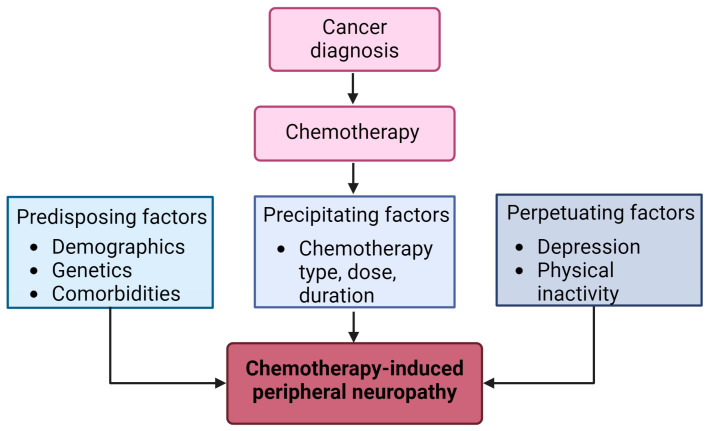
This narrative review seeks to propose a framework for CIPN predisposing, precipitating, and perpetuating factors (3Ps), which will provide a foundation for future research and clinical interventions aimed at mitigating CIPN-related symptoms and morbidity.
A comprehensive literature search was performed using PubMed, guided by keywords related to "chemotherapy-induced peripheral neuropathy." Studies were limited to those with full text available in English.
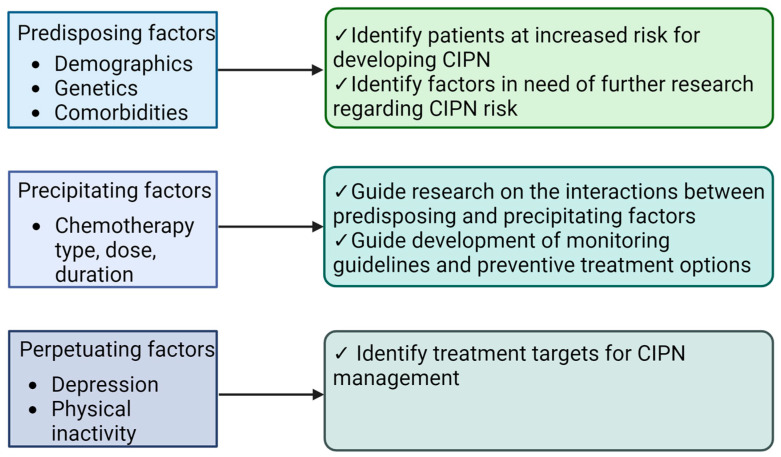
Predisposing factors outlined in this framework, such as older age and comorbid conditions, can be used to identify patients who have a higher risk of developing CIPN. The major precipitating factor of CIPN is the delivery of chemotherapy to peripheral nerves, which may be mitigated via cryotherapy or compression therapy during chemotherapy. Perpetuating factors can offer insight into psychological, cognitive, and behavioral modifications that could be treatment targets for CIPN management.
The proposed 3P model can guide the development of effective interventions for CIPN by suggesting modifiable psychological and behavioral treatment targets that may mitigate the impact of CIPN for cancer patients.
化疗引起的周围神经病变(CIPN)是癌症幸存者常见且使人衰弱的症状。尽管CIPN相关症状负担沉重,但干预措施仍然有限。
本叙述性综述旨在提出一个CIPN易感、促发和持续因素(3P)框架,这将为未来旨在减轻CIPN相关症状和发病率的研究及临床干预提供基础。
以与“化疗引起的周围神经病变”相关的关键词为指导,使用PubMed进行全面的文献检索。研究限于那些有英文全文的文献。
该框架中概述的易感因素,如老年和合并症,可用于识别发生CIPN风险较高的患者。CIPN的主要促发因素是化疗药物作用于周围神经,这可在化疗期间通过冷冻疗法或压迫疗法减轻。持续因素可以为心理、认知和行为改变提供见解,这些改变可能是CIPN管理的治疗靶点。
所提出的3P模型可以通过提出可改变的心理和行为治疗靶点来指导CIPN有效干预措施的开发,这些靶点可能减轻CIPN对癌症患者的影响。