R&D division Genoplan Korea Inc, Seoul, 06611, Republic of Korea.
Commun Biol. 2024 Oct 9;7(1):1289. doi: 10.1038/s42003-024-06995-9.
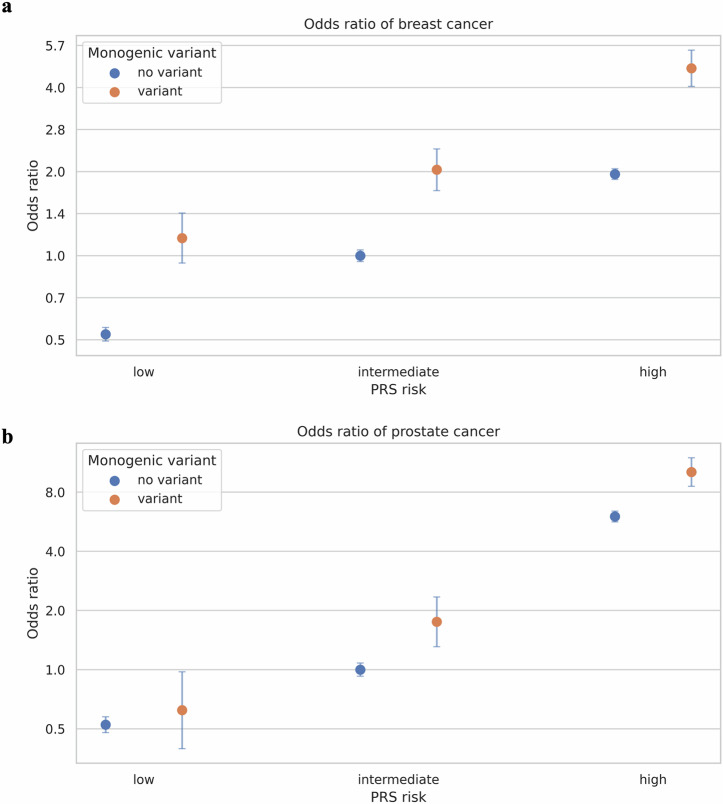
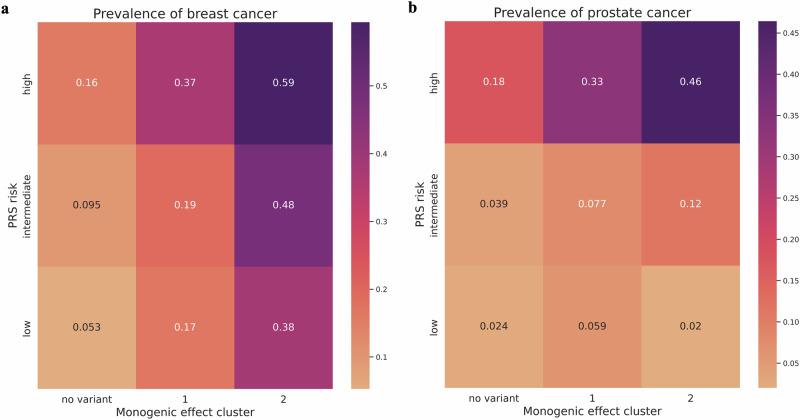
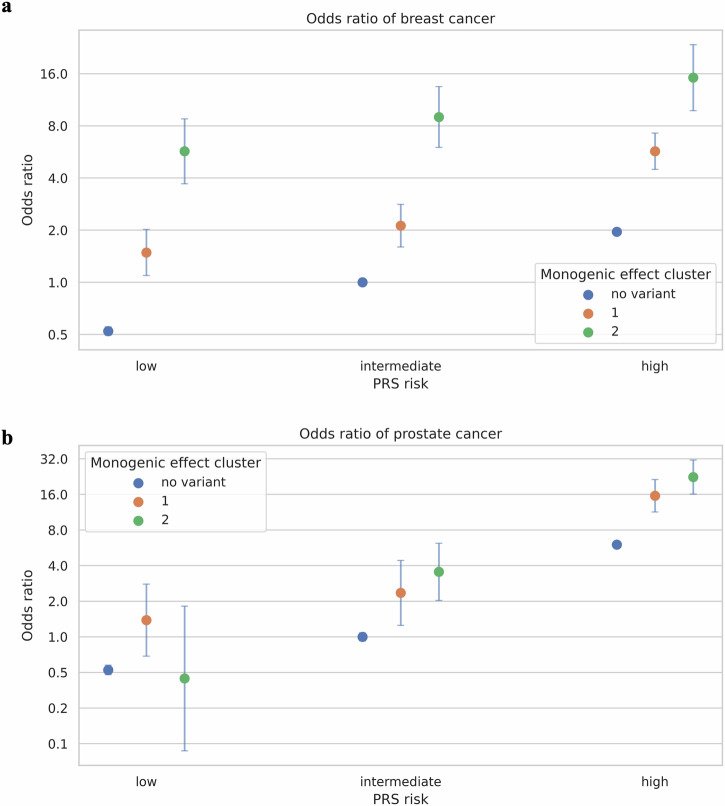
Polygenic risk score (PRS) and rare monogenic variant screening are valuable tools for predicting cancer risk and identifying individuals at high risk. Integrating both common and rare genetic variants is crucial for accurate risk assessment. However, estimating the impacts of rare variants on cancer and combining them with PRS remains challenging. Here, we analyze 454,711 exome sequencing and 487,409 array UK Biobank samples, focusing on breast and prostate cancers. We introduce an expanded PRS (EPRS) approach, yielding a systematic model for more effective risk stratification. By prioritizing and clustering genes with cancer-specific rare variants based on odds ratios and population-attributable fraction, we refine risk stratification by combining both monogenic and polygenic effects. Individuals in high-PRS groups with rare high-impact gene variants show up to 15- and 22-fold higher risk for breast and prostate cancers, respectively, compared to those in the intermediate-PRS groups without rare variants. Combined risk profiles vary across distinct rare variant clusters within the same PRS group for both cancers. Our EPRS approach enhances risk stratification for breast and prostate cancers, offering important insights for future research and potential applications to other cancer types.
多基因风险评分 (PRS) 和罕见单基因变异筛查是预测癌症风险和识别高风险个体的有价值工具。整合常见和罕见的遗传变异对于准确的风险评估至关重要。然而,估计罕见变异对癌症的影响并将其与 PRS 相结合仍然具有挑战性。在这里,我们分析了 454,711 个外显子组测序和 487,409 个阵列 UK Biobank 样本,重点关注乳腺癌和前列腺癌。我们引入了扩展的 PRS (EPRS) 方法,为更有效的风险分层提供了系统模型。通过根据优势比和人群归因分数对具有癌症特异性罕见变异的基因进行优先级排序和聚类,我们通过结合单基因和多基因效应来细化风险分层。与中间 PRS 组中没有罕见变异的个体相比,高 PRS 组中具有罕见高影响基因变异的个体患乳腺癌和前列腺癌的风险分别高达 15 倍和 22 倍。对于两种癌症,相同 PRS 组内不同罕见变异簇的组合风险概况各不相同。我们的 EPRS 方法增强了对乳腺癌和前列腺癌的风险分层,为未来的研究和对其他癌症类型的潜在应用提供了重要的见解。