INSERM CIC 1402, IS-ALIVE Research Group, University of Poitiers, Poitiers, France.
Médecine Intensive Réanimation, CHU de Poitiers, Poitiers, France.
Crit Care. 2024 Oct 9;28(1):331. doi: 10.1186/s13054-024-05118-4.
Sleep deprivation is common in intensive care units (ICUs) and may alter respiratory performance. Few studies have assessed the role of sleep disturbances on outcomes in critically ill patients.
We hypothesized that sleep disturbances may be associated with poor outcomes in ICUs.
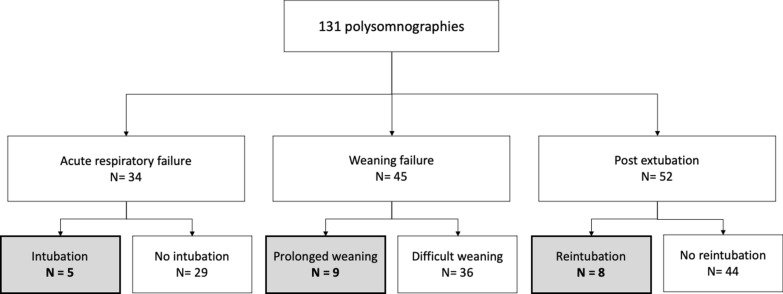
Post-hoc analysis pooling three observational studies assessing sleep by complete polysomnography in 131 conscious and non-sedated patients included at different times of their ICU stay. Sleep was assessed early in a group of patients admitted for acute respiratory failure while breathing spontaneously (n = 34), or under mechanical ventilation in patients with weaning difficulties (n = 45), or immediately after extubation (n = 52). Patients admitted for acute respiratory failure who required intubation, those under mechanical ventilation who had prolonged weaning, and those who required reintubation after extubation were considered as having poor clinical outcomes. Durations of deep sleep, rapid eye movement (REM) sleep, and atypical sleep were compared according to the timing of polysomnography and the clinical outcomes.
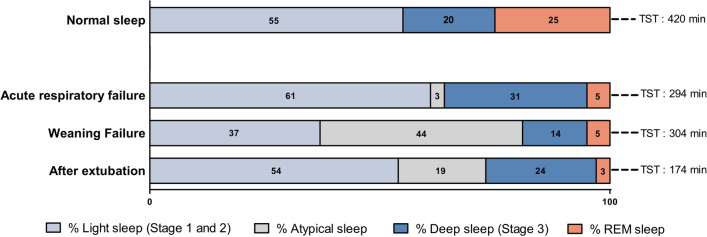
Whereas deep sleep remained preserved in patients admitted for acute respiratory failure, it was markedly reduced under mechanical ventilation and after extubation (p < 0.01). Atypical sleep was significantly more frequent in patients under mechanical ventilation than in those breathing spontaneously (p < 0.01). REM sleep was uncommon at any time of their ICU stay. Patients with complete disappearance of REM sleep (50% of patients) were more likely to have poor clinical outcomes than those with persistent REM sleep (24% vs. 9%, p = 0.03).
Complete disappearance of REM sleep was significantly associated with poor clinical outcomes in critically ill patients.
睡眠剥夺在重症监护病房(ICU)中很常见,可能会改变呼吸功能。很少有研究评估睡眠障碍对危重病患者结局的影响。
我们假设睡眠障碍可能与 ICU 患者的不良预后相关。
对 3 项通过完整多导睡眠图评估 131 名意识清醒且未镇静患者睡眠的观察性研究进行事后分析,这些患者在 ICU 住院的不同时间点被纳入研究。在因急性呼吸衰竭而接受机械通气的患者中,我们在自主呼吸(n=34)或在撤机困难的患者中(n=45),或在拔管后即刻(n=52)评估睡眠。因急性呼吸衰竭而需要插管、机械通气时间延长、拔管后需要再次插管的患者被认为具有较差的临床结局。根据多导睡眠图的时间和临床结局比较深睡眠、快速眼动(REM)睡眠和非典型睡眠的持续时间。
尽管在因急性呼吸衰竭而入院的患者中深睡眠仍保持不变,但在接受机械通气和拔管后深睡眠明显减少(p<0.01)。在接受机械通气的患者中,非典型睡眠明显比自主呼吸的患者更频繁(p<0.01)。在 ICU 住院的任何时候 REM 睡眠都不常见。完全没有 REM 睡眠的患者(50%的患者)比持续有 REM 睡眠的患者(24% vs. 9%)更有可能出现不良临床结局(p=0.03)。
在危重病患者中,完全没有 REM 睡眠与不良临床结局显著相关。