Johnson Elizabeth R, Kennedy Nolan W, Mills Carolyn E, Liang Shiqi, Chandrasekar Swetha, Nichols Taylor M, Rybnicky Grant A, Tullman-Ercek Danielle
Department of Chemical and Biological Engineering, Northwestern University, Evanston, Illinois, USA.
Interdisciplinary Biological Sciences Program, Northwestern University, Evanston, Illinois, USA.
bioRxiv. 2024 Sep 25:2024.09.25.615066. doi: 10.1101/2024.09.25.615066.
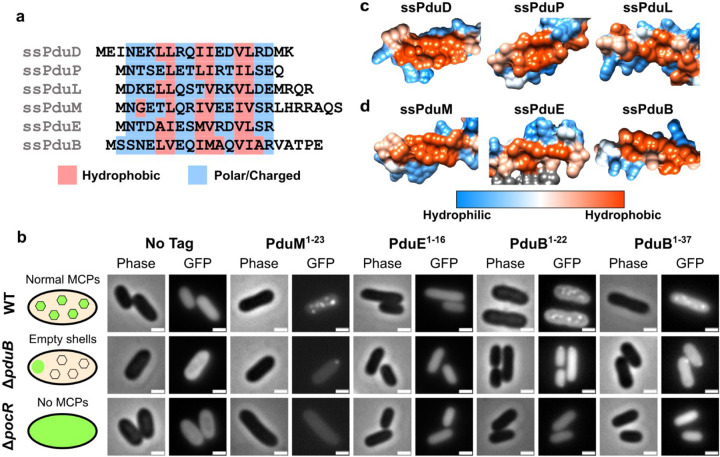
Spatial organization of pathway enzymes has emerged as a promising tool to address several challenges in metabolic engineering, such as flux imbalances and off-target product formation. Bacterial microcompartments (MCPs) are a spatial organization strategy used natively by many bacteria to encapsulate metabolic pathways that produce toxic, volatile intermediates. Several recent studies have focused on engineering MCPs to encapsulate heterologous pathways of interest, but how this engineering affects MCP assembly and function is poorly understood. In this study, we investigated the role of signal sequences, short domains that target proteins to the MCP core, in the assembly of 1,2-propanediol utilization (Pdu) MCPs. We characterized two novel Pdu signal sequences on the structural proteins PduM and PduB, which constitutes the first report of metabolosome signal sequences on structural proteins rather than enzymes. We then explored the role of enzymatic and structural Pdu signal sequences on MCP assembly by deleting their encoding sequences from the genome alone and in combination. Deleting enzymatic signal sequences decreased MCP formation, but this defect could be recovered in some cases by overexpressing genes encoding the knocked-out signal sequence fused to a heterologous protein. By contrast, deleting structural signal sequences caused similar defects to knocking out the genes encoding the full length PduM and PduB proteins. Our results contribute to a growing understanding of how MCPs form and function in bacteria and provide strategies to mitigate assembly disruption when encapsulating heterologous pathways in MCPs.
代谢途径酶的空间组织已成为解决代谢工程中若干挑战的一种有前景的工具,如通量失衡和脱靶产物形成。细菌微区室(MCPs)是许多细菌天然使用的一种空间组织策略,用于封装产生有毒挥发性中间体的代谢途径。最近的几项研究聚焦于改造MCPs以封装感兴趣的异源途径,但这种改造如何影响MCP的组装和功能却知之甚少。在本研究中,我们研究了信号序列(将蛋白质靶向MCP核心的短结构域)在1,2 - 丙二醇利用(Pdu)MCPs组装中的作用。我们对结构蛋白PduM和PduB上的两个新型Pdu信号序列进行了表征,这是关于结构蛋白而非酶上的代谢体信号序列的首次报道。然后,我们通过单独或组合从基因组中删除其编码序列,探索了酶促和结构Pdu信号序列对MCP组装的作用。删除酶促信号序列会减少MCP的形成,但在某些情况下,通过过表达编码与异源蛋白融合的敲除信号序列的基因,可以恢复这种缺陷。相比之下,删除结构信号序列会导致与敲除编码全长PduM和PduB蛋白的基因类似的缺陷。我们的研究结果有助于加深对MCPs在细菌中如何形成和发挥功能的理解,并提供在MCPs中封装异源途径时减轻组装破坏的策略。