Sabetta Zackary, Krishna Gokul, Curry-Koski Tala, Lopez Mackenzie, Adelson P David, Thomas Theresa Currier
Department of Child Health, University of Arizona College of Medicine-Phoenix, Phoenix, AZ, United States.
A.T. Still University Kirksville College of Osteopathic Medicine, Kirksville, MO, United States.
Front Physiol. 2024 Sep 25;15:1469073. doi: 10.3389/fphys.2024.1469073. eCollection 2024.
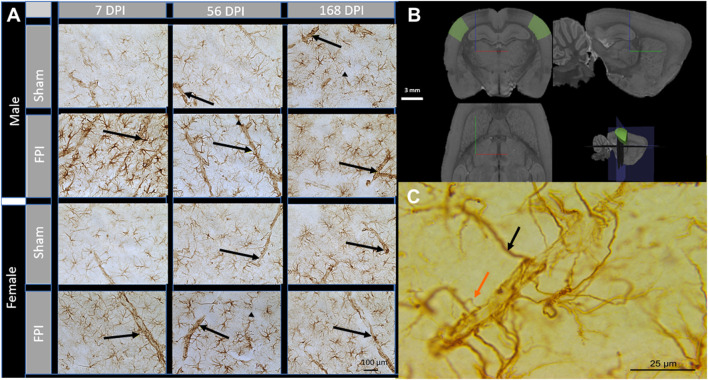
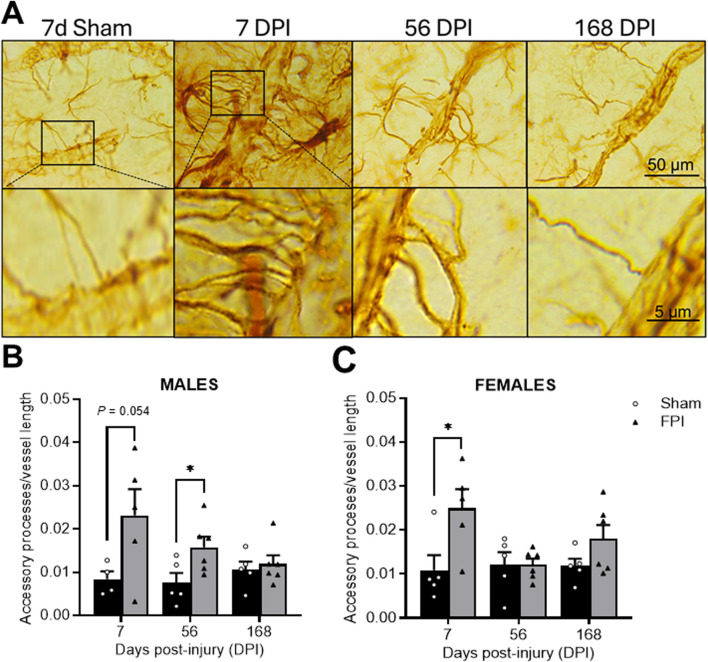
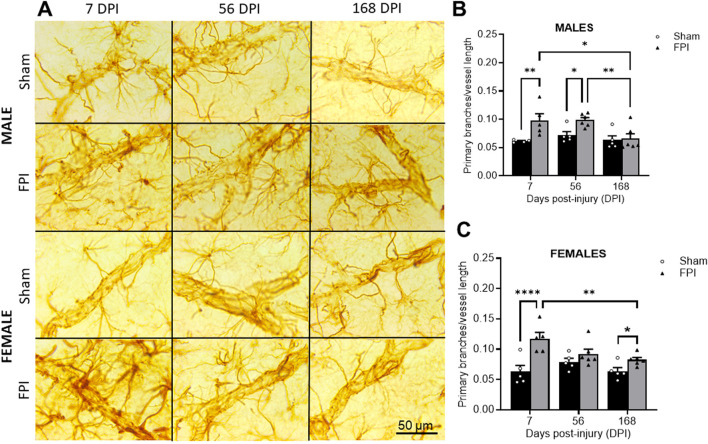
Traumatic brain injury (TBI) is associated with diffuse axonal injury (DAI), a primary pathology linked to progressive neurodegeneration and neuroinflammation, including chronic astrogliosis, which influences long-term post-TBI recovery and morbidity. Sex-based differences in blood-brain barrier (BBB) permeability increases the risk of accelerated brain aging and early-onset neurodegeneration. However, few studies have evaluated chronic time course of astrocytic responses around cerebrovascular in the context of aging after TBI and sex dependence. We observed increased glial fibrillary acidic protein (GFAP)-labeled accessory processes branching near and connecting with GFAP-ensheathed cortical vessels, suggesting a critical nuance in astrocyte-vessel interactions after TBI. To quantify this observation, male and female Sprague Dawley rats (∼3 months old, n = 5-6/group) underwent either sham surgery or midline fluid percussion injury. Using immunohistochemical analysis, we quantified GFAP-labeled astrocyte primary and accessory processes that contacted GFAP-ensheathed vessels in the somatosensory barrel cortex at 7, 56, and 168 days post-injury (DPI). TBI significantly increased GFAP-positive primary processes at 7 DPI ( < 0.01) in both sexes. At 56 DPI, these vessel-process interactions remained significantly increased exclusively in males ( < 0.05). At 168 DPI, both sexes showed a significant reduction in vessel-process interactions compared to 7 DPI ( < 0.05); however, a modest but significant injury effect reemerged in females ( < 0.05). A similar sex-dependent pattern in the number of accessory processes provides novel evidence of long-term temporal changes in astrocyte-vessel interactions. TBI-induced changes in astrocyte-vessel interactions may indicate chronic BBB vulnerability and processes responsible for early onset vascular and neurodegenerative pathology.
创伤性脑损伤(TBI)与弥漫性轴索损伤(DAI)相关,DAI是一种与进行性神经退行性变和神经炎症(包括慢性星形胶质细胞增生)相关的原发性病理改变,而慢性星形胶质细胞增生会影响TBI后的长期恢复和发病率。血脑屏障(BBB)通透性的性别差异会增加脑加速老化和早发性神经退行性变的风险。然而,很少有研究在TBI后衰老及性别依赖性的背景下评估脑血管周围星形细胞反应的慢性时间进程。我们观察到,胶质纤维酸性蛋白(GFAP)标记的附属突起在靠近并连接GFAP包绕的皮质血管处分支增加,这表明TBI后星形细胞与血管相互作用存在关键的细微差别。为了量化这一观察结果,对雄性和雌性斯普拉格-道利大鼠(约3个月大,每组n = 5 - 6只)进行假手术或中线流体冲击伤。采用免疫组织化学分析,我们量化了损伤后7天、56天和168天(DPI)时,体感桶状皮质中与GFAP包绕血管接触的GFAP标记的星形细胞初级和附属突起。TBI在损伤后7天显著增加了两性GFAP阳性初级突起(<0.01)。在56 DPI时,这些血管-突起相互作用仅在雄性中仍显著增加(<0.05)。在168 DPI时,与7 DPI相比,两性的血管-突起相互作用均显著减少(<0.05);然而,雌性中出现了轻微但显著的损伤效应(<0.05)。附属突起数量的类似性别依赖性模式为星形细胞-血管相互作用的长期时间变化提供了新证据。TBI诱导的星形细胞-血管相互作用变化可能表明慢性血脑屏障易损性以及导致早期血管和神经退行性病变的过程。